Forgetting (Troy Chin)

Screen Shot 2014-11-11 at 1.26.00 PM

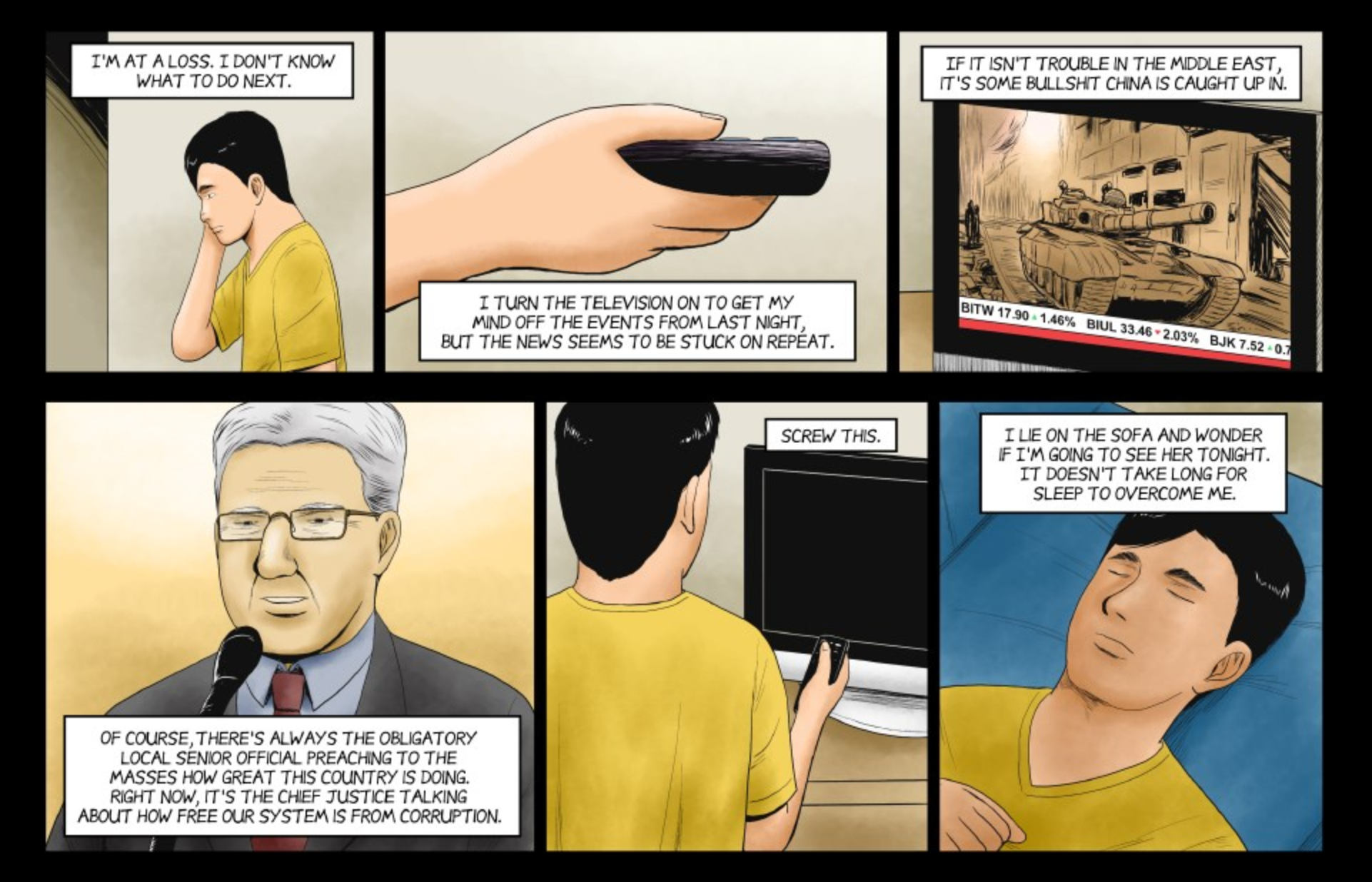
Forgetting is an interactive graphical story by Singaporean artist and author Troy Chin, and was exhibited at the Singapore ArtScience Museum as part of a show that ran concurrently with ICIDS this year (more about ICIDS in a future blog post or two).

The ArtScience Museum. Cool, no?

Forgetting concerns a man who keeps experiencing amnesiac episodes, as well as memories of a relationship with a woman named Julia. It starts out with the hoary “amnesia in a non-descript location” trope, but it soon moves beyond that as the protagonist returns to full memory and starts trying to piece together what’s really going on. The Singapore setting isn’t the main point of the story, but it’s manifest in a number of subtle ways, from the details of the protagonist’s job to his comments on the changing nightlife.

As Chin explained during an introduction to his work, Forgetting is meant to feel linear. Clicking on different panels in a strip, or on different objects in some of the more location-based scenes, can lead to different outcomes, but the system does nothing to indicate that you’ve made a choice, or to tell you where or what the other options are. It’s only at the end, when you are told which ending you reached, that there’s any kind of tracking acknowledgement. Reaching new endings unlocks additional clips of information; conceivably, there may be some grand reward for reaching all of them, as in many visual novels.

I haven’t managed to get that far yet, though, because despite trying to play as thoroughly as I could and going through the story seven or eight times, I’ve only found three conclusions and I haven’t been able to work out what else I could be exploring; and there’s no way of bookmarking or going backward in the story or (a la visual novels) fast-forwarding through already-seen bits, so a complete run-through takes a little while. Ultimately, that’s left me a little dissatisfied: I would like to have gotten far enough to piece together the mystery, whereas all I’ve got at the moment is some hints. I think that might be the experience the author intends — he’s gone to some lengths to conceal the mechanical underpinnings of this work — but it leaves me itching for more information.

Still, this is worth a look. There are moments of exploration, where you’re examining objects in a space and then getting multiple comic panels of exposition about those objects, that felt somewhere on the spectrum between graphical adventure and parser IF. I’d also be curious to know if anyone else gets further than I did. (My endings were Bliss, Instinct, and Cleansed, fwiw.)


Ectocomp 2014

Ectocomp is a Halloween Speed-IF competition in which authors have three hours to code a spooky game. (They may spend some additional time before that preparing to write, though.) Capsule reviews follow. I mention a few things that didn’t work for me, but I want to emphasize that three hours isn’t much time at all, from a game writing perspective: rough edges are to be expected.

Recommended pieces are starred.

Continue reading “Ectocomp 2014”

Terror Aboard the Speedwell, Lights Out, Please, and Her Pound of Flesh

In keeping with the season, three short reviews of horror IF. The review of Her Pound of Flesh gets into some spoilers, but they’re clearly marked; otherwise, these should be safe to check out even if you haven’t played the games in question.

Continue reading “Terror Aboard the Speedwell, Lights Out, Please, and Her Pound of Flesh”

Magical Makeover (S. Woodson)

Magical Makeover is a fairy-tale game in which you, an ordinary-looking person, are preparing for a ball for the incredibly wealthy and/or exquisitely beautiful, so you must use the help of a magic mirror and an assortment of enchanted cosmetics to get ready. Your choices about cosmetic enhancement affect what happens next. As a result, you wind up on one of seven paths, which are themselves linear with no crossovers.

In this opening section where you’re choosing how to remake your look, there’s nothing you can choose that will throw the story off the rails: you’re tweaking various variables for later, in ways that aren’t quite predictable, but the narration has customized descriptions for any combination of products you might attempt. It’s only afterwards that you find out what it’s all done, when it’s too late to make a difference.

This is a rather unusual structure for CYOA. There’s no room for cumulative stakes-building, no way to change course once you’ve decided what you’re doing about your skin this evening; by branching widely but unpredictably at the very beginning, it maximizes the amount of work the author has to do writing the different branches while minimizing the player’s sense of agency at any point.

And yet despite the fact that it violates almost every generalization I could make about sensible CYOA structure, I really enjoyed this game.

Continue reading “Magical Makeover (S. Woodson)”

Dial C for Cupcakes (Ryan Veeder)

Veeder

Dial C for Cupcakes is a short parser-based game (45-60 minutes of play time, probably) with gentle puzzles. It’s a sequel to his comp-winning previous work Taco Fiction, but it plays fine even if you don’t remember all the details of that game, or didn’t play it to start with. It’s light and fluffy without being uproarious, and makes for a nice Halloween treat.

Continue reading “Dial C for Cupcakes (Ryan Veeder)”