Further works from Fear of Twine. This time we have The Scientific Method, Drosophilia, Duck Ted Bundy, Abstract State-Warp Machines, The Work, Coyotaje, TWEEZER.
Category: Reviews
Some More Games from Fear of Twine
I mentioned Richard Goodness’s Fear of Twine exhibition and some of the works in it earlier. Here are some capsule responses to Zombies and Elephants, Workers in Progress, Saturday Night, Truth is Ghost, When Acting As A Wave, and The Girl in the Haunted House.
Reading and Hypothesis
I see more and more games with no story, only “backstory”. The game consists of piecing together what has gone before, and possibly performing a few anticlimactic actions to round it all off. Reviewers even speak of “the backstory” as if it’s the most important aspect of any game, right up there with mazes and hunger puzzles. It’s an outrage.
— Backstory, Stephen Bond
For authors of interactive stories, presenting most of your story as backstory is often convenient because you can tell what did happen in a place without having to code any NPCs or allow for any branching in the backstory narrative: the past is a part of the story your interactive reader can’t touch. It places those events beyond the reach of player agency. At its worst a backstory driven piece can seem soulless and lonely, as the player wanders desolate locations from which all the other humans have already fled.
But there’s also an argument to be made that the backstory mystery is one of the most natural possible shapes for interactive literature. When it sets up questions and allows the player to look for answers, it engages the reader directly with the substance of the story rather than with extraneous tasks and challenges. It encourages reading hypothetically, making guesses about what really happened that are then affirmed or disproven as one goes.

For anyone who isn’t familiar with The Fullbright Company’s Gone Home, it’s an indie game about a girl who has just come back from a year-long trip in Europe, to a house that her family moved into after she left and that is unfamiliar to her. No one is there, so she needs to wander the house and try to work out what happened to them. The house is also big and dark and suffering occasional electrical faults, while a storm rages outside, so for a while the game plays genre tricks with whether it’s really going to be a horror story.
Many people have responded with strong approbation, or at least strong feelings of some sort: first because it’s a game that allows itself to be not-very-gamelike, to indulge purely in its fiction; second, because it’s a queer coming of age story and those aren’t exactly well represented in mainstream games.
It is also pure backstory. But before we get into how I read that, some backstory of my own. There will also be some spoilers for Gone Home.
Choice of the Deathless (Choice of Games)
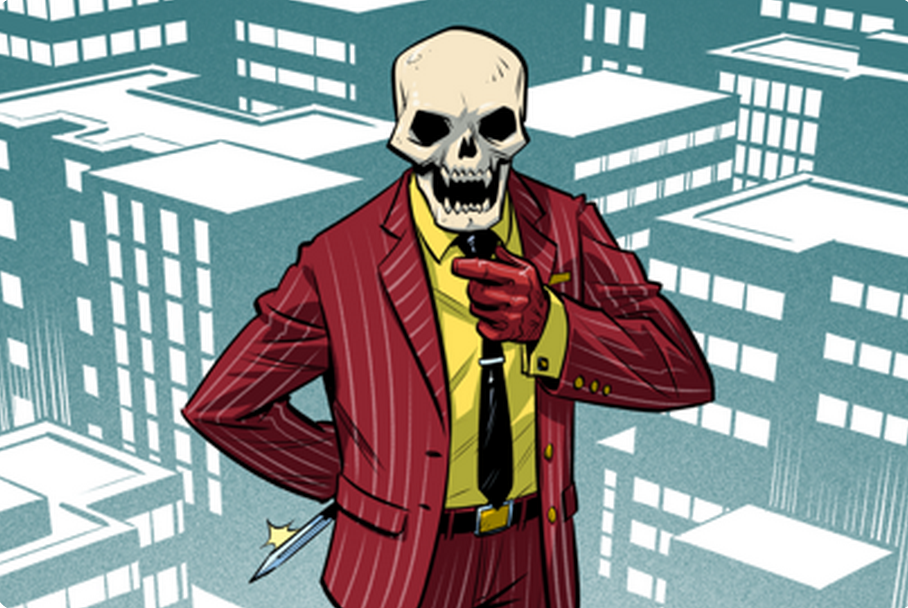
Choice of the Deathless is the latest piece from Choice of Games. Written by Max Gladstone, it’s billed on the Apple app store as “a necromantic legal thriller,” and it moves well away from the Choice of [Generic Trope] format of some of CoG’s earlier releases. Gladstone is writing within the same universe that he used for his two novels, Three Parts Dead and Two Serpents Rise: a world where high-powered law firms are engaged in the partially legal, partially magical exercise of managing the contracts that bind gods and demons. The Craft is a technical and brutal magic, done with blood and shards and entrails and a great deal of legalese.
The result is the most solidly written Choice of Games piece I’ve yet played. Gladstone’s descriptions sometimes run a bit wild for my taste: strange settings are extremely strange; painful experiences are bloodily painful. As a reader I find it hard to invest in a story that is kicked up to eleven that way on every single page. Nonetheless, his prose is confident, and he spends enough time with the various characters to develop them in detail.
Choices are often about the internal politics of the firm: whom to trust, whom to betray, whom to ask for a favor. The plot is fairly linear, in the sense that the major cases you encounter will tend to be the same over again on multiple playings — but the motivations you choose for yourself, and the relationships you have with other characters, do change substantially. One character was a minor enemy in one of my playthroughs, only to become my lover in the next. It’s a less branchy structure than some of CoG’s past stories, and I’m not sure I’d replay it as many times, but I enjoyed and cared about the individual playthroughs more. And those midgame choices about motive and affiliation do pay off in the endgame, when your range of options is very clearly tied to what you’ve done up to that point.
Indeed, in general I felt as though Choice of the Deathless was making less use of stats than the average CoG game, and more use of important narrative decisions that are remembered later. It’s the difference between having story gated on whether you’ve selected at least 5 “bold” actions so far, and story gated on whether you once did a single, memorable brave thing. Choice of the Deathless is tracking a range of stats for you, which you can go and look at, but the big outcomes seemed to involve callbacks to specific moments.
There were a few flaws.
Just occasionally I was offered a choice that seemed reasonable to me as the reader, but turned out to have been a mistake for some unanticipated reason — for instance, revealing my character’s ignorance about something she should have known. That was a bit frustrating, and I would have preferred the choices to be rephrased to reflect what my character knew about those options.
There is also a thread of decisions tracking how you’re spending money during the course of play, and you’re repeatedly invited to adjust where you live and how much you’re saving to pay down student loans. This is the case whether you come from a poor family or a wealthy one. The emphasis on this aspect made me think it must be an important part of the gameplay, but in fact it remained fairly peripheral to the actual story. I felt the piece would probably have done better just to jettison this; it felt to me like something introduced because the author thought this sort of stat challenge was necessary, but then underdeveloped. At no point in the body of the story did I notice my economy-management choices having a significant effect on outcomes. In all of my playthroughs I managed to pay down part but not all of my debt, but what exactly the numbers came to didn’t seem to matter.
Those quibbles aside, Choice of the Deathless is a pretty sizable piece, set in a detailed universe and confidently written.
(Disclosure: I received a review copy of this game.)
IF Comp 2013: Saving John (Josephine Tsay)
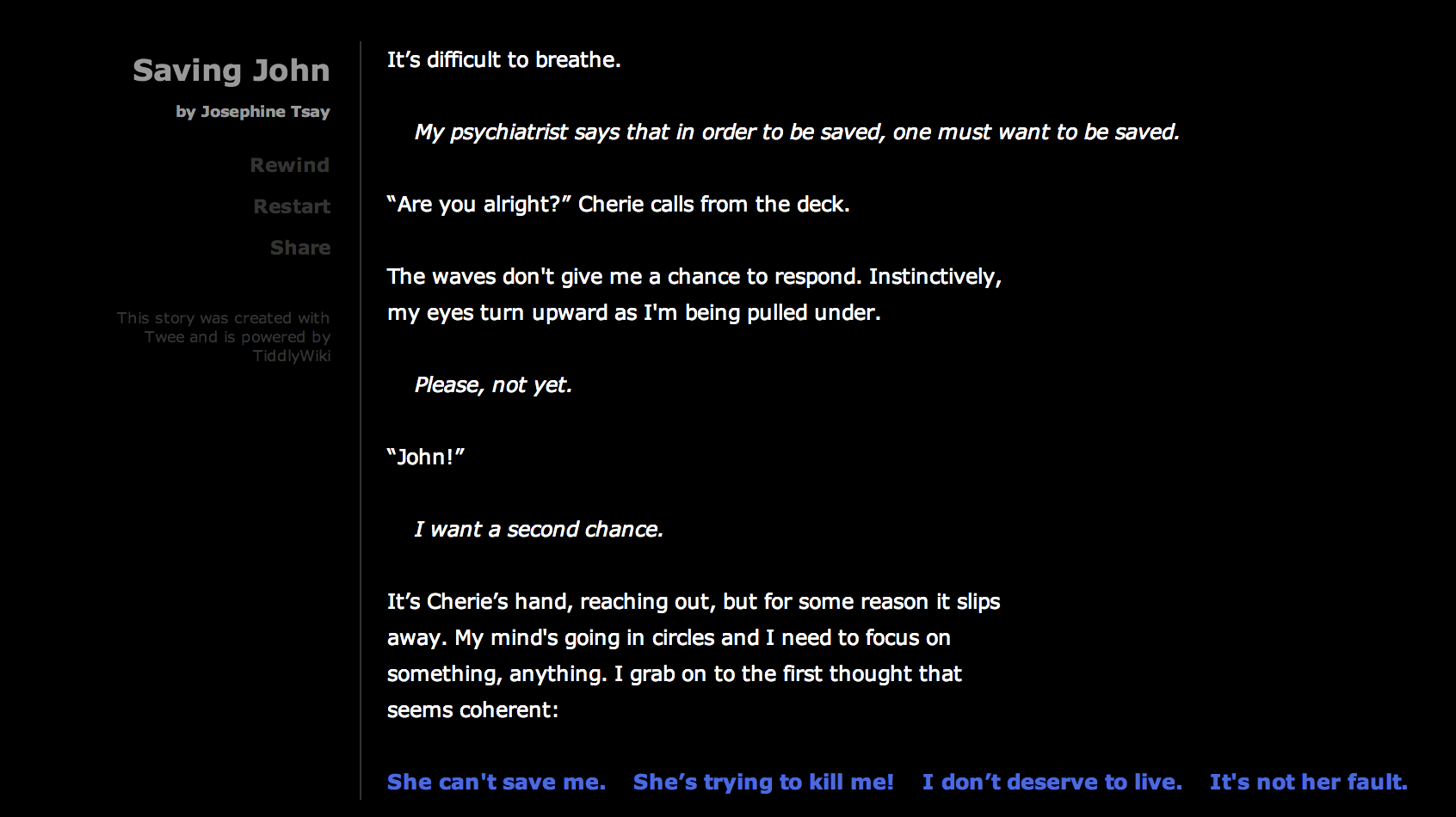
Saving John is a hypertext game about traversing the memories of a dying(?) man. It’s not terribly long to read through, but the author recommends several encounters with the text for best effect. Review after the break.
Continue reading “IF Comp 2013: Saving John (Josephine Tsay)”
IF Comp 2013: Tex Bonaventure and the Temple of the Water of Life (Truthcraze)
Tex Bonaventure and the Temple of the Water of Life is a parser-based adventure with an Indiana Jones theme you can presumably already see coming just from the title. Expect ludicrous archaeology. (One day, ONE DAY, someone will write an archaeology game with commands like LABEL POTSHERD and CLEAN BONES WITH SOFT TOOTHBRUSH and METICULOUSLY DESCRIBE SOIL TEXTURE IN NOTEBOOK. Jacqueline Lott, I’m looking at you.)
Continue reading “IF Comp 2013: Tex Bonaventure and the Temple of the Water of Life (Truthcraze)”
 Emily Short's Interactive Storytelling