IF Comp 2012: Guilded Youth (Jim Munroe)

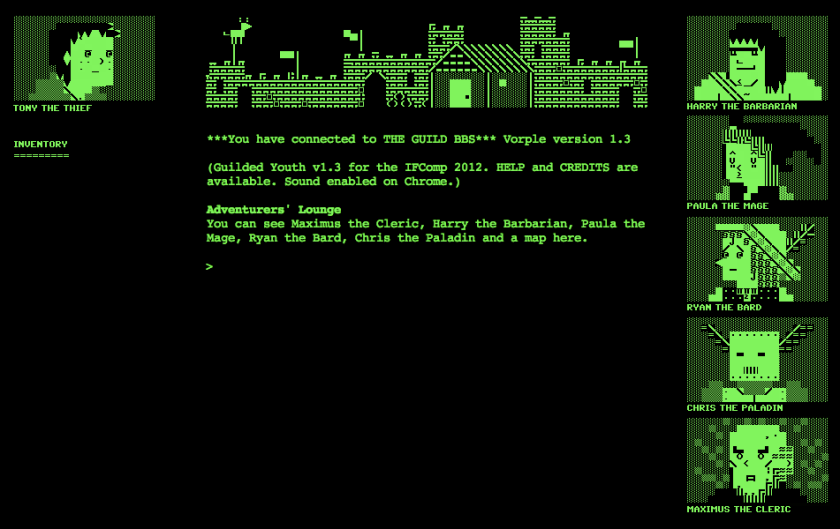
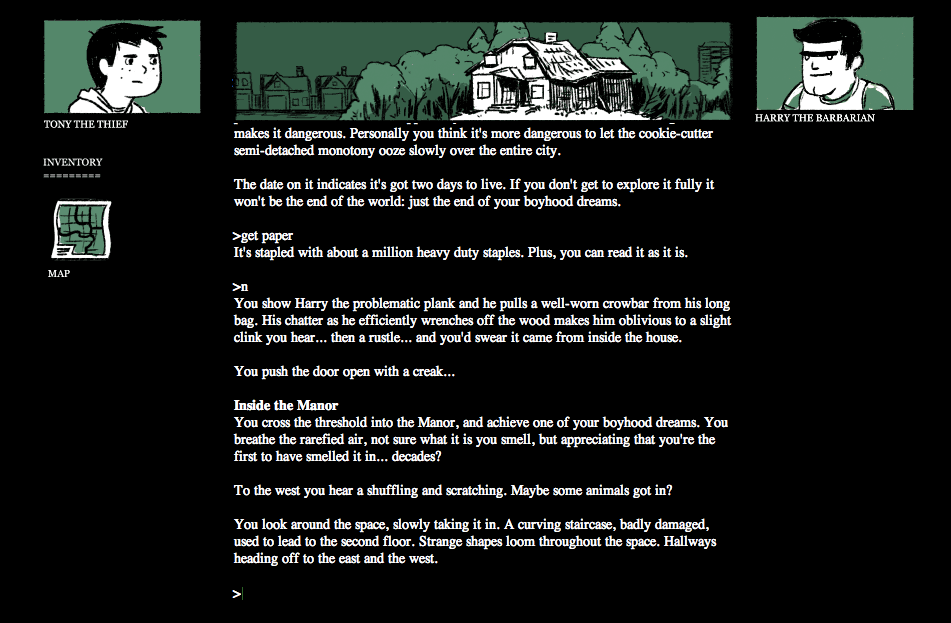
Guilded Youth is an Inform 7 game with a Vorple front end, concerning a teenager interacting with his MUD guild-mates both online and off. Per tradition, I will have some non-spoilery content after the jump; then if there’s anything spoilery I wish to discuss, it will be separated from the rest of the review with spoiler space. The fact that I am covering Guilded Youth at all means that it does feature listed beta-testers.

Continue reading “IF Comp 2012: Guilded Youth (Jim Munroe)”

IF Comp 2012: Transit (Shaye)

Transit is a CYOA-styled work, created in Twine, about being stranded at a foreign airport. Per tradition, I will have some non-spoilery content after the jump; then if there’s anything spoilery I wish to discuss, it will be separated from the rest of the review with spoiler space. The fact that I am covering Transit at all means that it does feature listed beta-testers.

Continue reading “IF Comp 2012: Transit (Shaye)”

IF Comp 2012: Living Will (Mark Marino)

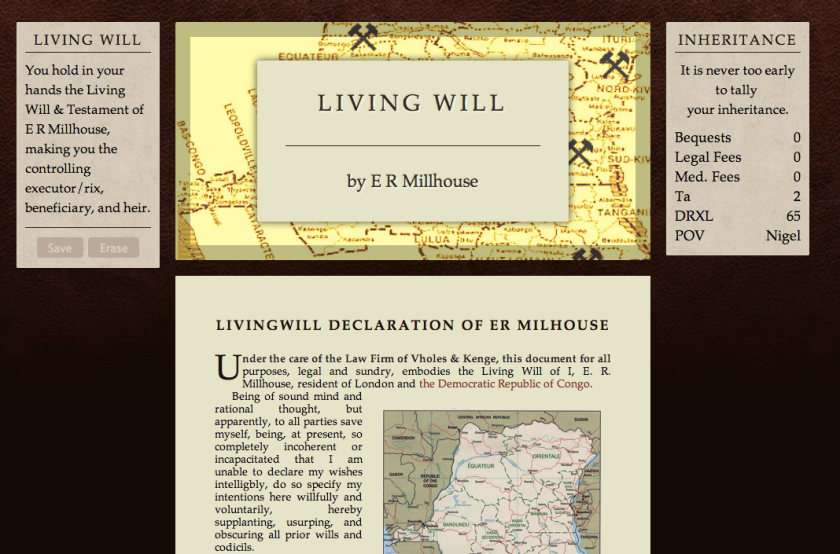
Living Will concerns a will that changes dynamically in response to the reader, with the possibility that taking different paths through the will may result in different legacies and messages from the deceased.

Per tradition with my IF Comp reviews, I will have some non-spoilery content after the jump; then if there’s anything spoilery I wish to discuss, it will be separated from the rest of the review with spoiler space.

Disclaimer: I saw this game originally in an unreleased version prior to the comp, at which time I gave some feedback on it. I didn’t bang on it long or hard enough to really claim the title of beta-tester, but nonetheless my comments should be read in light of this favorable predisposition.

Continue reading “IF Comp 2012: Living Will (Mark Marino)”

Choice of Games: Eerie Estate Agent (Gavin Inglis)

Eerie Estate Agent is a newish piece from Choice of Games, created by writer Gavin Inglis. The premise is that you’re an estate agent (or realtor, in American terms) and you’re responsible for getting 57 Crowther Terrace rented out. Your unpleasant boss is just looking for an excuse to fire you and the other employees around the office don’t exactly have your back, so the stakes are high. The problem is that no one seems to want to stick around the place for long, possibly because of all the spooky stuff that happens there.

Inglis identifies as a writer more than a game designer, and that shows, in ways both good and bad. I’ve often thought that the actual prose quality was a bit of a weak spot in many Choice of Games offerings: the text in Choice of the Dragon, for instance, is typically utilitarian, and though some of the later works become more ambitious, the results are not universally happy.

Eerie Estate Agent has a much more distinctive and engaging voice than these: breezy but well-controlled, lightly humorous, sometimes casting the protagonist as a not entirely nice person. There’s a good sense of the Edinburgh setting (not perhaps surprising, as Inglis seems to know the place well). In the eerie happenings, he tends to hit a good middle ground between the creepy and the funny, going for paranormal indications that are amusing but that would probably be distinctly unnerving if they happened a lot in real life. (Rooms that periodically fill up with the scent of tea? Indications that seem to resemble the scurrying of a dozen ghostly rodents?)

A down side is that Eerie Estate Agent doesn’t deliver very strongly on Choice of Games’ traditional strength: lots and lots of agency.

Continue reading “Choice of Games: Eerie Estate Agent (Gavin Inglis)”
The Act

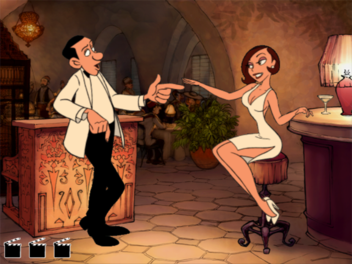
The Act is a very unusual arcade game I’ve been hearing about for years but until recently had never gotten a chance to play. The player has a single dial, which she can use to move the body language of the main character along a spectrum. Typically (though not always) that spectrum runs from Bashful Dope to Hardened Pickup Artist. The gameplay centers on getting the character to moderate his behavior appropriately in a number of social situations, but especially when flirting: don’t come on too strong at first, but don’t be too slow to pick up cues. Get the interplay just right, and you can complete the scene and move on.

Given that even such supposed interactive narrative stars as Heavy Rain have characters who routinely walk into walls, the idea of a game that was pretty much entirely about reading and responding to body language intrigued me. (L.A. Noire tries that too, of course, but in a very different way.)

And now that The Act is out for iOS, I finally got a chance to play.

Continue reading “The Act”

Cover Stories minicomp

Cover Stories was a minicomp in which artists contributed cover art in the first half, and then in the second half authors chose covers they liked and wrote games to fit them. A lot of cool covers were submitted, not all of which got used (alas).

The comp followed the lead of the Apollo 18 Tribute Album project in that it explicitly incorporated a time period for beta-testing and encouraged authors to beta one another’s work. I really like this model, and it seems to result in more consistently polished output than some of the other models. The term “minicomp” isn’t entirely applicable, since it’s really more like a mutually edited anthology, but I’m not going to quibble too much.

I’ve posted reviews of a number of the Cover Stories games I played on IFDB. I especially recommend Olivia’s Orphanorium, a dark comedy about managing a Dickensian orphanage, and Home Sweetie-Bot Home, which rather surprisingly includes a voice-recognition feature allowing you to play the game via speech.