IF Demo Fair themes: interface

I should have posted about this more immediately, but I came home from PAX East with a bad cold and I’m just now getting really over it. However: the IF Demo Fair went off with a minimum of fuss and a lot of great entries. (And if you’re curious what the physical setup was like, there is a stream of photos by Mark Musante here.) I’m planning to cover the full list more thoroughly in SPAG — a little more official and permanent than my blog, as the entries deserve. But I did want to look at a few trends and examples.

The Demo Fair specifically invited people to experiment with the interface and/or UI, and we saw several experiments in dealing with the parser challenges that have been so frequently discussed lately.

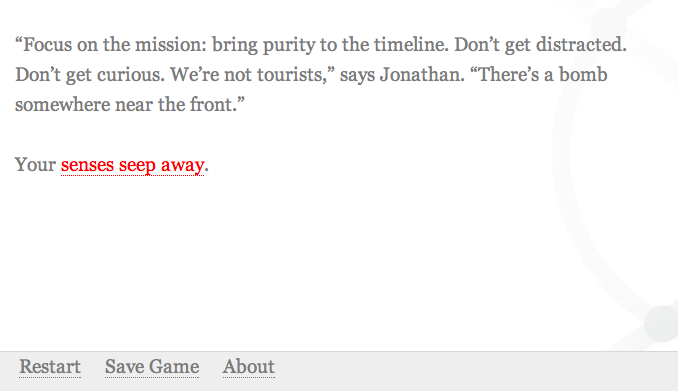
Vicious Cycles with hyperlinks
Simon Mark submitted Vicious Cycles, a game that already existed as a parser-based piece of IF from 2001, but now re-envisioned as with wholly browser-run, hypertext-like interface. It sometimes feels a bit like Undum, but sometimes branches out a bit, with windows of explicit inventory — an inventory that includes thoughts and ideas as well as objects. The effect is sleek and streamlined, though (in my own opinion) it makes the sacrifice that all CYOA makes relative to parsed IF: as soon as the player is thinking only in terms of a single set of choices (which object to interact with, say), some of the texture and depth of the world is set aside. And I did sometimes miss having a full transcript and scrollback. However, there was a lot about the experience I did like — its smoothness and accessibility — and it is relatively rare for CYOA/hypertext to come so close to suggesting an IF-style world model. (Though not completely unheard of.)

Richard and Larry Build a Time Machine
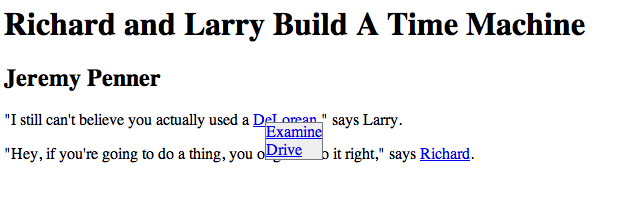
A related demo was Richard and Larry Build a Time Machine, by Jeremy Penner. Interactive objects are hyperlinks, but clicking on them brings up a contextual menu with a couple of suggested verbs. The whole transcript expands — and in keeping with the time-travel theme, things the player does later in the game can insert new content earlier in the story. What’s more, the player can click on any section of the transcript to undo the action there — sending other ripples of causality through the transcript. It’s a short piece, and worth a look. More information, and the source code, may be found here.

Quest 5.0 WebPlayer
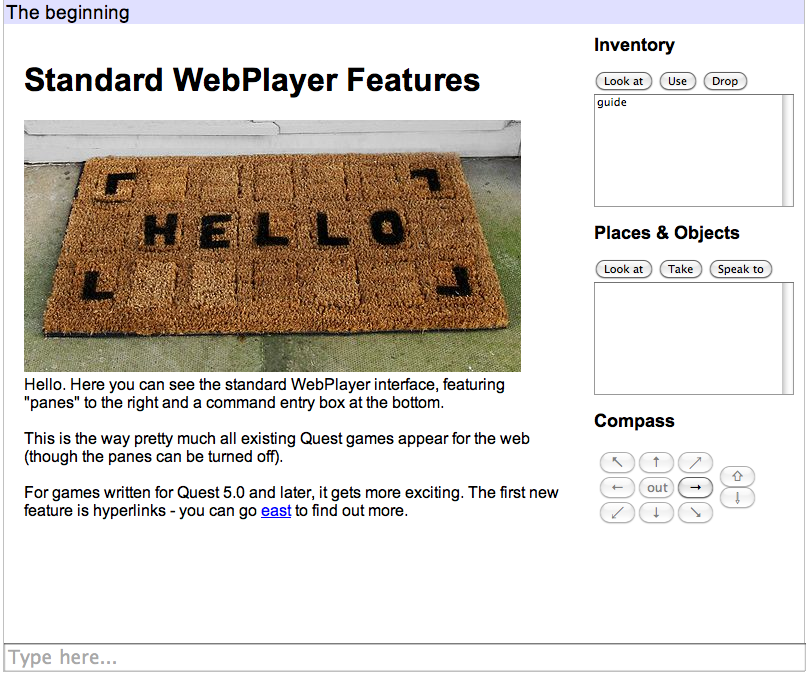
Alex Warren brought us the web player for Quest 5.0. The standard features (easily turned off, however, I gather) include a constant inventory window, another window of items present in the game world, and buttons for the compass directions. As in “Richard and Larry,” clicking on an object name in the game produces a drop-down menu of possible verbs. The inventory and stuff-in-this-location windows are more than I personally would want on-screen all the time in many games, but it’s clear that these are highly modifiable features of the system. (The flexibility of the system is clear from Warren’s second small demo game, in which two side by side windows present command lines and descriptive text, and the player can type on either side to see what happens from both points of view.)

Vorple, with a tooltip
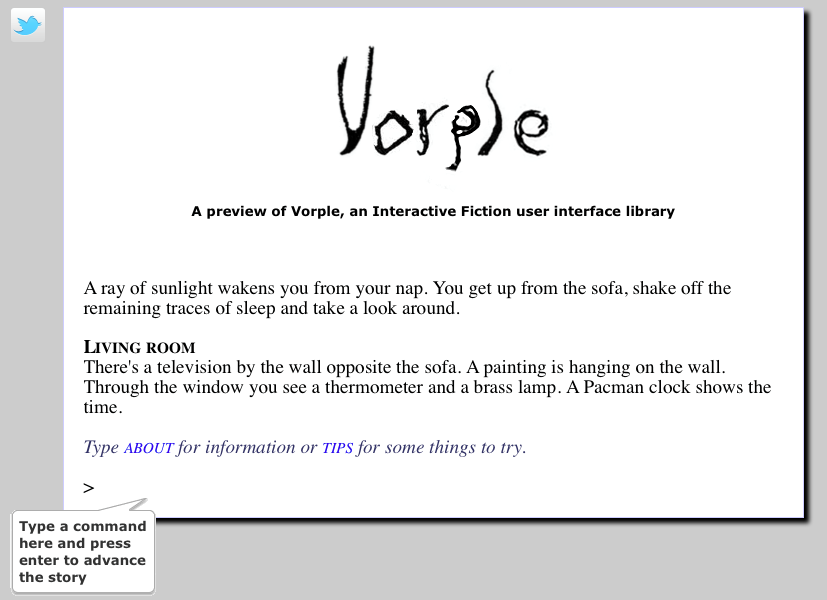
I was also excited by the possibilities in Juhana Leinonen’s Vorple interface demo. Vorple is a javascript front end that Juhana plans to adapt to multiple game engines, including CYOA tools like Undum and conventional parser-based IF systems like Glulx and the Z-machine. The example in the demo fair showed off a number of neat abilities, like the ability to erase parser error messages after a turn, leaving behind a clean transcript. But I especially liked its ability to bring up a tooltip-like guide when hovering over game text. This is a mechanism I currently find really appealing as a way to provide help and affordance clues to the player: hover over a word or phrase in the text to get some tips about what verbs will work on that noun, a bit like the menu constructions in “Richard and Larry” above. Move your mouse away again, and the tooltip is gone. Alternatively, click to paste the command in line. Without getting rid of the command line entirely, and without cluttering the transcript or the screen with unattractive structures, a tooltip system could offer helpful glosses using UI conventions people are already familiar with from other web pages and applications.

Vorple is still a long way from completion, as I understand it, and the tooltip concept is only one of a number of things it can do. But I’m currently quite enamored of the possibilities.

Finally, this wasn’t part of the Demo Fair at all, but Jon Ingold’s recent experiment in a parser that error-corrects in the command line is worth a mention too, as it’s approaching many of the same problems from a different perspective.

A tangent about marketing

This is a spin-off from the post about Jon Blow’s remarks on the IF parser, but it goes in a different direction, so I wanted to take it back to the front page.

I’ve been having a comment exchange with a commenter named Veridical Driver, who suggested a number of possible improvements to the IF interface (automapping, journaling events as they happen, bolded words to show what’s interactive, etc.). I pointed out that there are games that try most of those things; Veridical Driver responded that it’s not enough because IF should be standardized on those features.

So this post started as a response to Veridical Driver’s last comments, especially these bits:

These are things that the IF community may have experimented with, but not things that are any way standardized in the IF interface. The standard IF interface has barely changed from the Infocom days.

Adrift may have mapping, but Inform and z-machine is the standard for IF and do not. Some games might have custom note systems, but this is really something that should be standard, just inventory is standard in all IF. Sure, there is a keyword interface extension… but this kind of functionality should be a standard part of all modern IF.

…The problem is, you are thinking as an IF author, not as a gamer. You don’t like the ideas/features I mentioned, or suggestions other have made, because they constrain your artistic vision. But as a gamer, I don’t care, I just want some fun.

Nnno, I don’t think that’s quite it. Two of the examples I pointed to (Floatpoint, Bronze) are my own games; other projects of mine (especially Alabaster and City of Secrets) include graphical sidebar content that’s nonstandard but is designed to ease player experience and communicate game state better. So it’s not that I dislike these features categorically.

Where I’m pushing back is on the idea that we can or should enforce these features as a standard.

There I’m speaking not just as an artist, though I can think of several of my works for which the features you describe would be a bizarre and awkward prosthesis on the text — what’s automapping for in a one-room conversation game? what’s journaling for, in a game that runs for five minutes and is designed to be replayed?

But setting that aside, I’m also coming to this as someone who’s handled a lot of feedback on one of the most-used tools in the IF community for the last five or six years. People want to do a lot of different things with their interactive fiction, and they should have the opportunity to try their various visions. Some specific use cases, other than the artistic concerns I already mentioned, where your suggestions might be an active hindrance include

  • games intended for mobile platforms or small screens, where screen real estate is at a premium
  • works for the visually impaired, which need to be simply accessible with a screen reader
  • works written with a heavy narrative focus, which may put aside the concept of “rooms” entirely in favor of a different style of presentation; these aren’t always even intended for a gaming audience at all

These aren’t hypothetical; they’re things that people are actually working on and are the basis of real support requests.

So the issue is, tools that force too many features run a big risk of narrowing the creative range to just the projects that work well with those features. Inform has tried to err on the side of making a lot of things optional — through extensions — while not imposing too many constraints through core library decisions. This is always an area of compromise, and there are some features we’ve added that have made Inform games larger, to the chagrin of those optimizing for very small, low-processing-power machines. So these things are always on our minds.

I’m happy to say that a lot of progress has been happening, and continues to happen, on the extensions and interpreters side. The desire to foster collaboration, conversation, and creative thinking about IF interfaces is a major part of the impetus for the IF Demo Fair we’re putting together for PAX East.

Still, this opt-in stuff is obviously more work, and it’s not going to force authors to include the features you’re looking for — and the novice authors are the ones least likely to put in the extra work if the tool doesn’t make them do so. I typically consider it a good sign — not always but often — if I start up a competition game and find that it has cover art, a splash screen, a non-standard status bar, etc. That’s not because I think those are universally important, but because it means the author put some time into generating non-default content. Which means he thought about it. Which is good.

From a game consumer’s point of view, I think what would help the most is curated collections and branding.

Continue reading “A tangent about marketing”

You can also see some marketing here.

So Jonathan Blow’s recent criticism of the IF community has been getting a lot of attention (Aric Maddux, Chris Klimas, Robb Sherwin, Stephen Granade, indiegamer, metafilter), and that may be why we got a spin-off Metafilter thread on the topic of parsers today.

I have a couple of thoughts about this.

1. This is Jonathan Blow. He tends to be outspoken — what he has to say about adventure games in this article is nothing compared with what he has to say about social games, which he labels as outright evil. There’s some content backing both points, but it’s been generalized and strongly stated for effect. While I disagree with a lot of the substance and think it could stand to be quite a bit more nuanced, he’s giving an interview about a future product, in which he has successfully said a lot of provocative things, generated a buzz, and positioned himself memorably with respect to a couple of other schools of gaming. To a reader less sensitized than we are, this might come off as no more than “this game will be content-rich, not work like social games, and will have some of the appeal of an adventure game, but more accessible.”

2. That said, the examples that he’s using suggest that he’s not really responding to the latest and greatest. So I feel free not to take them especially seriously as criticism of the latest community output.

2a. Yeah, the hat tip to the awesome plot device that is amnesia — that’s worth a snicker, but so what? Someone sufficiently skilled could still do a cool game about amnesia. Whether that person is Jonathan Blow remains to be seen.

2b. It looks like he is taking a specific potshot at Telltale’s episodic adventure games. I haven’t played by any means all of them, but I find them relatively free of maddening adventure game logic, pleasantly accessible, and really funny. That said, they are closer to graphical adventure roots than much modern IF is to its roots. IF has made forays into the puzzleless, the systematic/simulationist (where puzzles are based on a standard set of learnable rules and multiple solutions are available for most problems), and the tactical (where there is a whole scale of possible win/loss via randomized combat, etc.) I do occasionally wonder what would happen if there were more graphical adventure games that explored some of that territory — though I’m sure there are more than I’m currently aware of. See also Life Flashes By.

3. The idea Blow repeats here is a standard meme. On the big scale of Cluelessness about the Thing He Is Critiquing, this rates only about 5 picoEberts. And that’s our problem to solve. There will always be a serious barrier to sharing and marketing IF as long as the standard perception is that it’s about fighting the parser.

Part of the problem is that lots of people haven’t really played much IF since 1980-odd; another part is that the way IF has developed isn’t in the direction that they think it should have developed. There are good reasons why the parser hasn’t (and shouldn’t!) become a chatbot that pretends to understand all player input, but that’s a natural direction to wonder about; see this old chat with Brian Moriarty, who, I think we can agree, has more of an insider view on the problem than Blow ever has.

Meanwhile, we’ve made some progress on teaching the player IF affordances — which I think is the real solution here — but it’s not a finished process. We’re working on these issues, in a lot of different forms and projects.

Anyway. Long story short: yeah, I agree Blow is incorrect about what we’re doing and about our evolution. But I don’t think his being off base is really anything more than a reminder of something we all already knew: IF has PR problems. Our best steps forward aren’t visible enough. They don’t do enough to supplant what people already think about interactive fiction.

Announce: IF Demo Fair

Do you have a vision of the (or a) future of interactive fiction that you would like to share with interested players, authors, implementers and theorists?

The IF Demo Fair will be running during PAX East (Boston, March 11-13), showcasing new and interesting demonstrations in the IF world.

These don’t need to be polished, complete games, just pieces that show off your concept. We’re particularly interested in demonstrations that explore one of our themes:

  • novel ways to interact with in-game characters
  • innovative user interfaces for text/story-based games

But if you have a great idea that doesn’t match either of these themes, send it anyway! We welcome any demonstration that can reasonably be construed as relating to interactive fiction and storytelling: traditional parser-based IF, works with multimedia and graphical components, choose-your-own-adventure, or interactive poetry.

Entries in the Fair will be set up on laptops in the IF suite for players to explore. Saturday afternoon, there will also be an official playthrough in the Alcott Conference Room at the Westin, where we will go through all the entries on a projector screen (exact time TBA).

Authors who are there with their submissions are welcome (indeed, encouraged) to talk briefly about their design concepts.

Note that this is not an official PAX event. No badges are required to attend or participate.

Entry restrictions. This is not a competition, and there are no judges or prizes. Authors who have submitted content are welcome to comment on each other’s work. The only restriction is that you must be willing to have your work showcased in a public forum, and presented or linked from a website afterward.

Intent to enter: Friday, February 18. Email me (emshort@mindspring.com) with your intent to enter and include your technical requirements, answering these questions:

  • does your project need software to run other than a standard IF interpreter?
  • is it restricted to one OS?
  • will your project need internet access to run?
  • are you going to be present in person to install your project and/or present it on your own device?

I reserve the right to refuse an entry that is technically infeasible for us to present, but will do my best to accommodate reasonable requests.

Submission: Sunday, March 6. Email me (emshort@mindspring.com) your project or a link to where it lives on the web, and installation instructions.

Optionally, you may also submit an author’s note (no more than about 500 words, please) explaining the background of your project, anything you want players to know about it, and your hopes/expectations for the project.

Feedback for authors. Forms for anonymous feedback will be available both in the IF Suite and during the live presentation. Players and audience members who would like to share their thoughts without attribution can do so via these forms.

After the event, we’ll provide website coverage for the submissions, with links to author projects, as well as an article on the event in SPAG.

Proposed: IF Demo Fair

One suggestion that we’ve been kicking around on the mud for PAX East is a sort of minicomp/show, as follows:

Authors have the opportunity to work on tech demonstrations during February, focusing on one of several themes. These would not have to be full games — a single scene or mockup would suffice, as long as it gets the idea across. The point is to share interesting new concepts, not to produce finished products.

During PAX, these will be on show on laptops so that people would have a chance to experience them individually.

On Saturday afternoon when we have the big room available, there will be a dedicated Demo Fair time when we get together and play through the demos on a projector, and discuss.

Authors will be invited to talk about why they did what they did, if they’re present. It’s still permitted to submit a demonstration if you’re not going to be there, and you’re welcome to accompany your demo with some authorial notes to be shared with everyone.

This is not a competition, in that there will be no official prizes, judges, or winners, and anyone is free both to enter and to offer feedback on other entries.

The currently proposed themes are:

* New styles of NPC interaction
* UI concepts

It sounds like this is of interest to enough people that we’re probably going to do something like it. Before we do a definite public announcement, though — are there other themes we should include? Concerns or suggestions?