Tabletop Storygames: Microscope Union

I’ve written before about the storygame Microscope, in which players collaboratively generate the timeline for a fictional place or institution. Microscope Union is a spinoff of that, focusing on the development of a single family tree.

You start by naming a person who did something — it should probably be something extraordinary, but you can decide what extraordinary means to you — and some traits that allowed them to do this. Then you work backwards, filling in details about previous generations (back to the great-grandparents), and showing where those traits came from. Each phase of the game, you select one “union” to focus on. (You can also choose to have parents/grandparents not be biological parents per se, but be key influencers of the child’s life — we went this route a couple of times.)

The resulting play experience feels more coherent and directed than standard Microscope: because new people and events fit into a defined graph, it’s easier to remember who’s who, and easier to reason about causation. By the time we finished the game (two sessions of about 2-3 hours each), I felt like I had a pretty good idea of the driving forces in the final protagonist’s life.

I also liked that we wound up roleplaying the same characters in the context of their relationships with their parents, their spouses/romantic partners, and their children: this gave us a reason to explore some depths and idiosyncrasies that don’t always come out in RPGs.

Continue reading “Tabletop Storygames: Microscope Union”

Below (Chris Gardiner)

Screen Shot 2015-04-11 at 4.15.28 PM

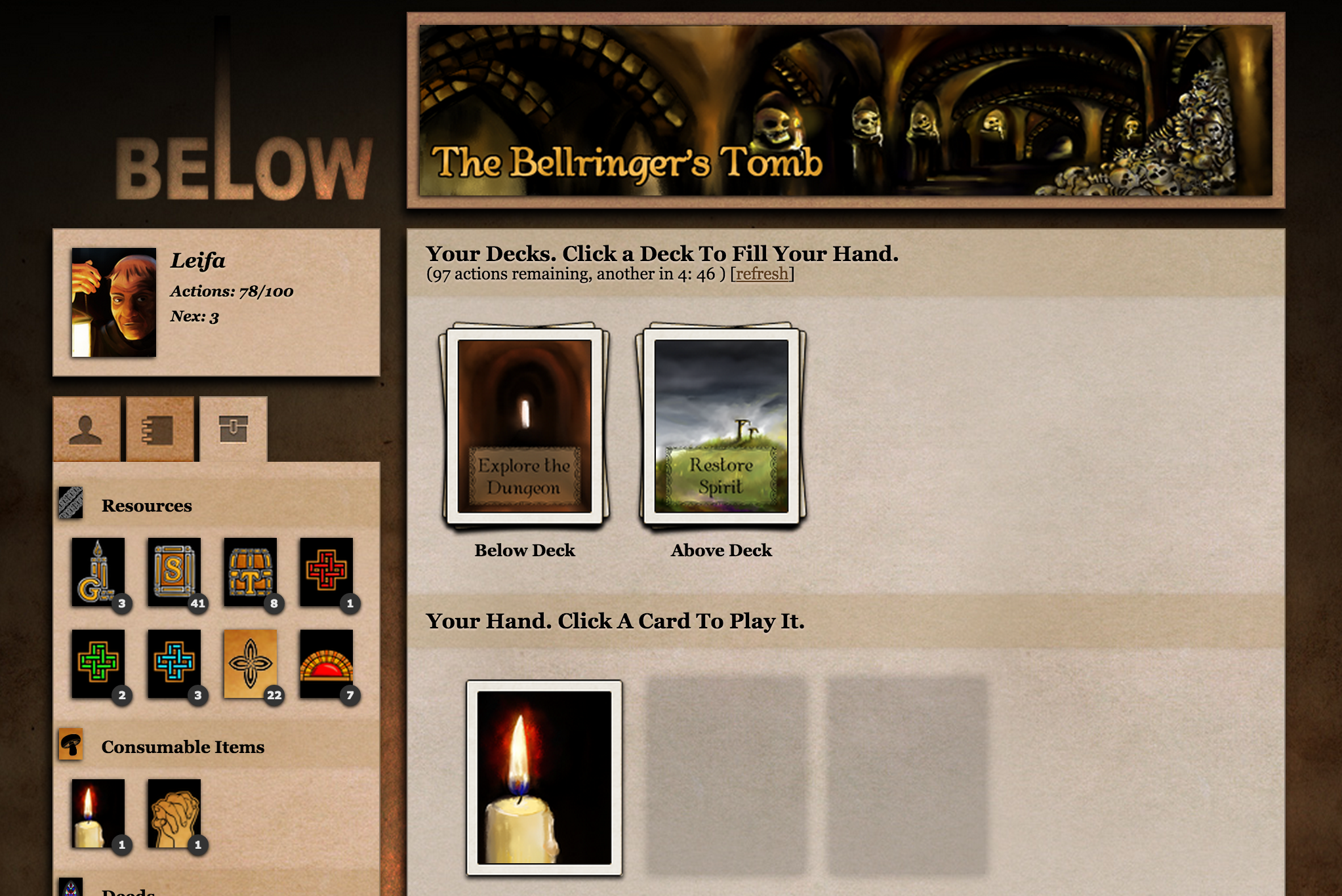
Below is a StoryNexus world by Chris Gardiner. Chris is part of the Failbetter team, but Below is released (as I understand it) as his own personal project. He describes it thus:

…it’s a story-driven, dungeon-delving online card game you play in your browser. You play Below cards to explore the dungeon and Above cards to renew your spirit. But the more you draw on the Above deck, the more dire the plight that drove you into the dungeon.

Its inspirations are Beowulf, Moria, the Tombs of Atuan, and a whole pile of folklore. You can learn the Giant-Tongue, speak at the Althing, bargain with the White-Handed Lady who is sometimes called death, forge a Lion-Helm, hunt outlaws in a haunted barrow, outwit a Troll-Wife, and leave legacies for those who follow you (like a Streak of White Hair, Words of Caution, or Family Secrets).

Continue reading “Below (Chris Gardiner)”

Interactive Narrative GDC Talks (Part 2)

As I noted here, there is a bunch of GDC content that might be of interest to interactive story folks. Last time I looked at talks that were really focused specifically on interactive fiction, especially work by inkle and by Choice of Games.

This time, two related subjects: social simulation and character modeling of various types, and complex morality. (And character with complex morality, as a bonus.)

Thinking About People: Designing Games for Social Simulation, Mitu Khandaker-Kokoris, The Tiniest Shark. (Recorded talk.) I’ve linked already to the Gamasutra presentation of Mitu’s slides, so you may have seen me mention this talk before. Gets into a number of types of games and also a series of criteria for thinking about social simulation games. Some of those criteria are pretty-much-always-desirable things such as “communicating to the player”; some describe a spectrum with many possible spots for productive work (“autonomous vs authored”).

Designing Morally Difficult Characters, Dan Nagler, Gigantic Mechanic. (Slideshow only.) This talk calls out the idea of giving characters complex, non-binary ideologies, and also shouts out to some of the very same tabletop storygames that I mentioned in my microtalk. If you follow the links, you’ll also find that this talk relates to a partially live action educational simulation that is sort of Senate LARP.

Beyond Binary Choices: How Players Engage With Morality, Amanda Lange. (Slideshow only.) This one gets at the issues with simplistic good and evil choices, offers some statistics about how people tend in practice to play simplistic-choice games, and then pulls out a couple of interesting exceptions to the general rules (like: Spec Ops: The Line manages to get a lot of players to do the pure-evil choice by laying enough emotional groundwork to make them feel their protagonist might be quite angry at that point).

Desire is Not A Dirty Word: Writing Healthy Fanservice for Games, Michelle Clough. (Slideshow only.) As with several of the other slideshows, there’s definitely some information being missed if you can’t see the full recorded talk, but there’s still enough here to give the gist: it’s about writing characters who are meant to be sexy and perhaps romantically active without falling into creepy objectification.

Measuring and Manipulating Player Trust, Chris Hazard, Hazardous Software. (Slideshow only.) This is the kind of talk I love to go to because it expands the boundaries of what I think I should bear in mind when working on a game. It’s an AI summit talk, it’s fairly math-heavy, and it’s about mathematical models for a) describing how likely NPCs are to make barters and do favors given various levels of trust in the player and b) conversely, assessing what the player feels about the risks and rewards in the game using similar trust modeling. It’s sufficiently abstract that I think one would have to put in a good amount of work to get from “these are some really interesting concepts” to “here is what gameplay based on this would feel like.” But I find this kind of thing fascinating.

And a bonus link not from GDC: this now-in-progress orc dating sim looks like it takes on a lot of the issues in Mitu’s and Michelle’s talks.
XYZZY Award Finalists are out

The finalists for the 2014 XYZZY Awards have been announced; if you want to vote, you have until April 25th at 0:01 US-Pacific to do so. Perhaps the most obvious difference vs previous years is how many of the nominees are commercial IF; there was more of it this past year than usual, but also I think it got more attention than it has in some years. There was also a strong showing for choice-based IF, featuring Twine, inkle, ChoiceScript, and Versu games.

In a few categories there are (unusually) only two nominees. If you’re curious, this thread on intfiction talks about why that is and how the nominees are selected; also about whether the current nomination system is best or whether we might want to go to one that allowed people to nominate multiple games per category in the first round.

Spring Thing 2015, and Aspel

Spring Thing is now open, with nine new games: six in the main category, three in the “Back Garden” area for games that aren’t in competition for prizes and have somewhat looser entry requirements. There’s a mix of systems, too — Twine, Undum, Seltani, Glulx and z-machine, and Ren’Py.

My contribution is a Back Garden game called Aspel, which is a realm in the choice-based multiplayer Seltani platform. As my entry blurb says:

Aspel is an experimental interactive experience designed for multiple players, featuring asymmetric information and collective decision-making. The text you see on the screen won’t necessarily be the same as what everyone else sees, so you’ll need to communicate with your fellow players in order to experience it most fully. To make that easier, I’ll be around to participate/host at the following times:

Tuesday April 7 at 8 PM British/3 Eastern/noon Pacific
Sunday April 19 at 8 PM British/3 Eastern/noon Pacific
Friday May 1 at 8 PM British/3 Eastern/noon Pacific

…but of course people are more than welcome to arrange their own visiting hours.

At some point I’ll likely write something about the experience of writing for Seltani.

Interactive Narrative GDC Talks (Part 1)

Every year GDC talks are recorded and stored in the “GDC Vault”, which is accessible to people who have attended a recent GDC. There are also usually a few talks that are outside the paywall, though — and this year, there are quite a few non-paywall talks that might be of interest to IF and interactive narrative folks. There are also quite a few talks where the actual recording is behind a paywall, but the slides are available for free.

There are so many recommendable talks in this collection that I’m going to break them out over a couple of posts, starting with these fairly IF-specific talks:

Leading Players Astray: 80 Days and Unexpected Stories, Meg Jayanth, Freelance/inkle. (Slideshow, recorded talk.) An entertaining and watchable presentation about the tension between 80 Days’ boardgame mechanics and the story and the way the game tempts players into embracing bad strategy decisions. Meg also talks about the research that went into building 80 Days and the process of constructing the story as a whole.

Adventures in Text: Innovating in Interactive Fiction, Jon Ingold, inkle. (Slideshow, recorded talk.) Talks about narrative structure and tool implementation in inkle products, usable lengths of text, choice design, and a lot else. Well worth a look for anyone working in the choice-based game space.

Classic Game Post-mortem: Adventure, Warren Robinett. (Slideshow, recorded talk.) This is about the construction of the action-adventure game Adventure for the Atari 2600, but it talks about how that game was based on the Crowther and Woods game — and it also gets into a lot of delightfully sticky detail about the memory costs of a lot of the game elements. The latter is something that people working on interactive fiction now only have to worry about rarely, and usually only if they’re doing something either very large or targeted at a very restricted platform. A neat piece of game history with IF relevance.

Harvesting Interactive Fiction, Heather Albano, Choice of Games. (Slideshow only.) Intended to acquaint games narrative folks with recent developments in IF, this talk covers material that may already be familiar to IF veterans. Includes discussion of Hadean Lands, Codename Cygnus, Blood & Laurels, various Choice of Games titles, and much of the inkle collection, among other things. Edited to add: it’s a little hard to work out fully from just the slides, but I meant to mention that Heather did talk a lot about the use of ambiguity in text, and the storytelling leverage that you get from not overspecifying everything (which is sometimes easier when you’re working with words and not a full 3D model). This is an interesting area I’ve heard the Choice of Games folks talk about on various occasions but I’m not sure it’s gotten the discussion traction of some of the other concepts here (such as complicity).