ICIDS: The future of interactive storytelling, plus some Versu thoughts

Hartmut Koenitz submitted a talk for ICIDS that was essentially a manifesto about what needs to happen next in interactive digital narrative, and accompanied this with a workshop on the future of interactive storytelling. The points of the manifesto are as follow:

  • We need a new theory of narrative for interactive digital narrative in order to get rid of accumulated preconceptions.
  • Interoperability is key: tools need to be developed in such a way that they can be hooked together and progress on one hand can be used by others.
  • Sustainability is essential. Lack of archiving has already destroyed a lot of valuable research work.
  • Interactive digital narrative needs to be author-focused. There is a challenge in training new authors in procedurality in order to get useful feedback from them.
  • User experience is crucial. We need to focus on how people actually experience and enjoy this work.

Continue reading “ICIDS: The future of interactive storytelling, plus some Versu thoughts”

ICIDS: Interactive Documentary

I mentioned in my general ICIDS post that William Uricchio spoke about interactive documentaries: interactive story forms designed to convey information, sometimes by journalists to support news articles, sometimes as stand-alone long-form projects. He showed us his team’s project _docubase, a collection of (currently) 172 documentaries: these aren’t hosted at _docubase, but have catalog entries there, allowing the curious to link through and see the originals.

There was quite a lot in his keynote, and what follows isn’t so much a summary of that as a reflection on some of the specific tools and examples that he shared.

Continue reading “ICIDS: Interactive Documentary”

ICIDS, Some Thoughts

ICIDS is an academic conference in interactive storytelling. This year it was held in Singapore, and I was invited as a speaker, which was awesome. I spoke about Versu and Blood & Laurels. Graham Nelson accompanied me, and though he was sightseeing for some portion of the trip, he did come along to one of the workshops, which tackled story modeling and authorship; and we co-guest-taught Alex Mitchell’s class in interactive storytelling at the National University of Singapore.

I found the whole experience pretty fascinating. ICIDS is devoted to a lot of the same things that we discuss in the IF community: how to make interactive stories, how to build tools for authors, how to make use of procedural techniques to do things that stories haven’t mostly tried before, how to gauge player/reader responses to interactive story experiences and learn to make better ones.

Continue reading “ICIDS, Some Thoughts”

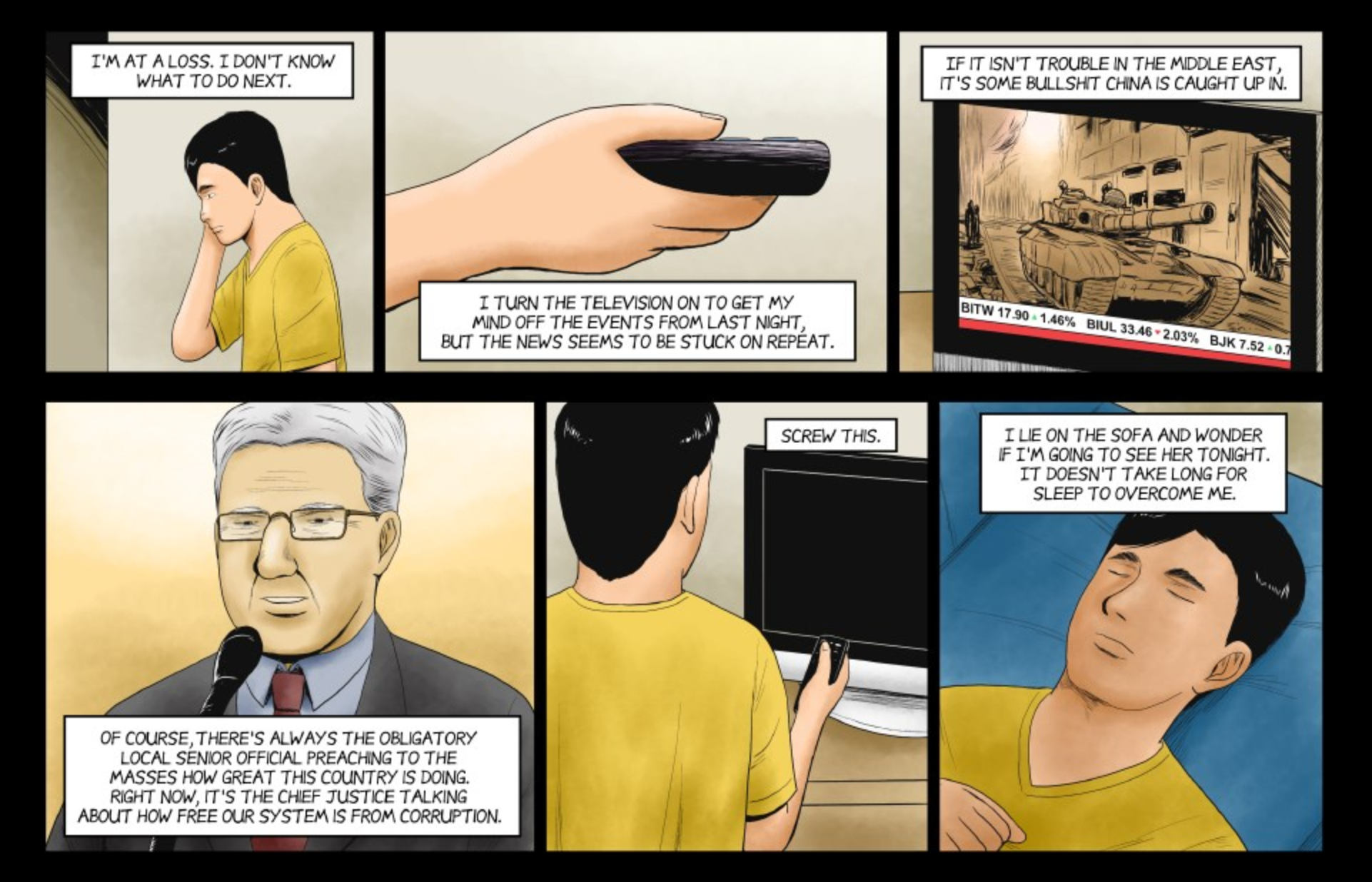
Forgetting (Troy Chin)

Screen Shot 2014-11-11 at 1.26.00 PM

Forgetting is an interactive graphical story by Singaporean artist and author Troy Chin, and was exhibited at the Singapore ArtScience Museum as part of a show that ran concurrently with ICIDS this year (more about ICIDS in a future blog post or two).

The ArtScience Museum. Cool, no?

Forgetting concerns a man who keeps experiencing amnesiac episodes, as well as memories of a relationship with a woman named Julia. It starts out with the hoary “amnesia in a non-descript location” trope, but it soon moves beyond that as the protagonist returns to full memory and starts trying to piece together what’s really going on. The Singapore setting isn’t the main point of the story, but it’s manifest in a number of subtle ways, from the details of the protagonist’s job to his comments on the changing nightlife.

As Chin explained during an introduction to his work, Forgetting is meant to feel linear. Clicking on different panels in a strip, or on different objects in some of the more location-based scenes, can lead to different outcomes, but the system does nothing to indicate that you’ve made a choice, or to tell you where or what the other options are. It’s only at the end, when you are told which ending you reached, that there’s any kind of tracking acknowledgement. Reaching new endings unlocks additional clips of information; conceivably, there may be some grand reward for reaching all of them, as in many visual novels.

I haven’t managed to get that far yet, though, because despite trying to play as thoroughly as I could and going through the story seven or eight times, I’ve only found three conclusions and I haven’t been able to work out what else I could be exploring; and there’s no way of bookmarking or going backward in the story or (a la visual novels) fast-forwarding through already-seen bits, so a complete run-through takes a little while. Ultimately, that’s left me a little dissatisfied: I would like to have gotten far enough to piece together the mystery, whereas all I’ve got at the moment is some hints. I think that might be the experience the author intends — he’s gone to some lengths to conceal the mechanical underpinnings of this work — but it leaves me itching for more information.

Still, this is worth a look. There are moments of exploration, where you’re examining objects in a space and then getting multiple comic panels of exposition about those objects, that felt somewhere on the spectrum between graphical adventure and parser IF. I’d also be curious to know if anyone else gets further than I did. (My endings were Bliss, Instinct, and Cleansed, fwiw.)

Upcoming IF Events and Competitions

Votes are due for the IF Comp no later than November 15; if you wish to judge, there’s still time to play and rate at least 5 games. Please do consider playing and voting, as the competition thrives on participation.

ClubFloyd has been on hiatus during IF Comp, but resumes meeting Sundays after the comp ends. This is an opportunity to play (usually parser) IF collaboratively with others on ifMUD.

Inform 7 workshop, November 18, Lowell, MA. Run by Brendan Desilets in tandem with the ACM meeting.

ECTOCOMP, the competition for short spooky games, is also currently running; the download package includes a voting form, which should be filled out and sent to the organizer by November 22 to participate.

Also on November 22 (8 PM British, 3 PM Eastern, noon Pacific), the IF Discussion Club will meet on ifMUD for a post mortem discussion of the IF Competition. We have an IRC bot set up now that should allow people to participate via IRC if they find the MUD interface daunting.

The next meetup of the Oxford-London IF group will be the afternoon of November 23 at the Jam Factory. Expect food, optional pints, and relaxed IF-related chat.

NaNoGenMo is for people creating 50,000 word autogenerated novels, concurrent with NaNoWriMo. Here is an awesome thing that Liza Daly did, an autogenerated Voynich Manuscript-alike. Runs through November 30.

AdventureX is a London-based convention for adventures, with a lot of emphasis on point-and-click graphical adventures, but room for IF as well. Some IF folks will likely be there. It runs December 6 and 7 this year.

ParserComp, a competition for parser-based games written within a timeframe of several months, organized by Carolyn VanEseltine. Authors may begin at any time; games are due in first draft form February 1, 2015, and in final draft February 14. Games will be judged in multiple categories.

Spring Thing has traditionally also had a competition format with an entry fee. For 2015, its direction is being somewhat changed: it is now a free-to-enter festival focusing on celebration rather than competition, with non-cash prizes only, and there is a “back garden” section that allows introductions, demos, and parts of games intended for commercial release. Intents are due March 1, 2015.

Ectocomp 2014

Ectocomp is a Halloween Speed-IF competition in which authors have three hours to code a spooky game. (They may spend some additional time before that preparing to write, though.) Capsule reviews follow. I mention a few things that didn’t work for me, but I want to emphasize that three hours isn’t much time at all, from a game writing perspective: rough edges are to be expected.

Recommended pieces are starred.

Continue reading “Ectocomp 2014”