Oxford/London First Meetup

The inaugural meetup of the Oxford/London interactive fiction group was well attended, and ran for a good four and a half hours before the last of us had to go our separate ways. Many thanks to those who came!

We talked about loads of things, as you might expect, including work in progress by several of the participants; the parser/non-parser split in recent IF production; ways to make the more parser-focused side of the community more welcoming to new participants; life in the game industry; why horror is or is not hard to write; storytelling features in the Silent Hill games; game mechanics and marketing strategies of Fallen London; and a number of other topics.

There was also a proposal that it would be good to have scheduled IF discussion on ifMUD, like ClubFloyd but for critical conversation — perhaps around a topic or question announced in advance. The idea was that there’s a desire for some more focused live discussion of interactive fiction, but that just dropping by the MUD casually doesn’t always provide this, depending on who happens to be logged in at the time. Having a pre-announced topic would give the conversation a bit of shape and make it easier for participants to perhaps have thoughts together in advance.

Proposals for future events:

— IF game jam
— group play-through and discussion sessions, about interesting new releases or works by members who want feedback
— book-club style discussion of games members had picked and played in advance
— overview of new Inform features with Graham Nelson
— (brought up online rather than actually at the event) overview of TADS adv3Lite library with Eric Eve
— (likewise) tabletop storygaming

The next meetup is already scheduled and will be at the Failbetter Games headquarters in London, Feb 18, 7 PM.

Oxford/London IF meetup

A couple of months ago I ran a poll to see whether people might like to have an IF meetup group in southern England, and if so whether they preferred Oxford or London. Then I went to a conference, then got a really really bad cold, then the holidays were upon us and it seemed like a bad time to add extra things to anyone’s calendar.

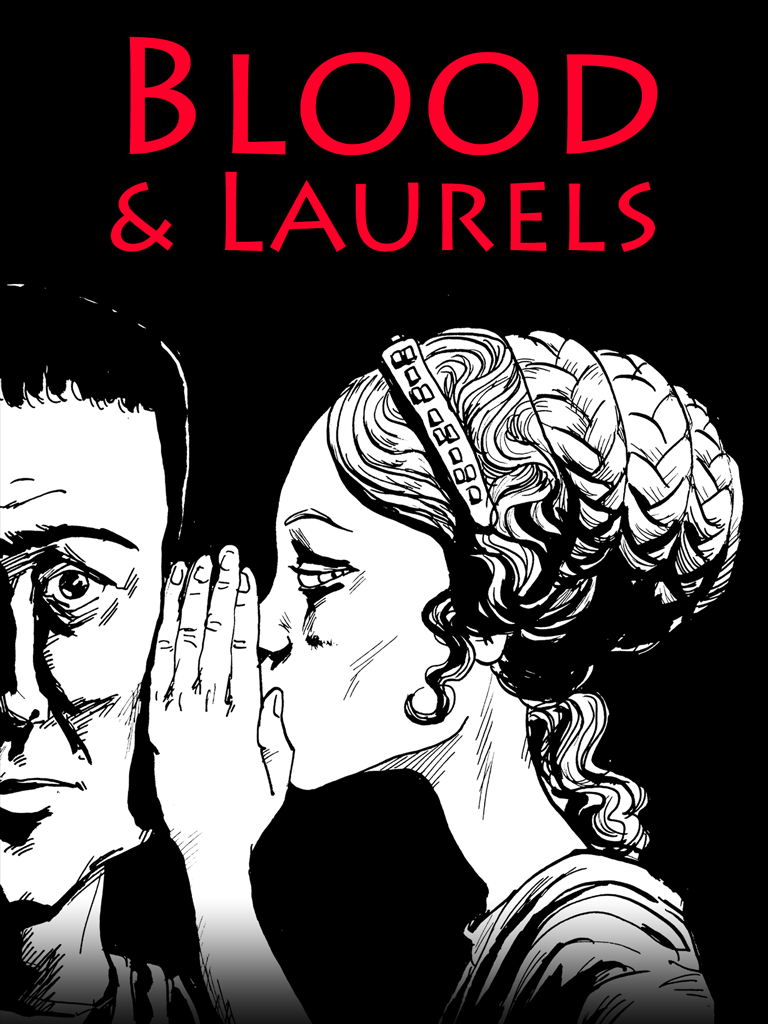
But! Now that’s past, I’m eager to get this rolling. The feedback about location was decidedly mixed — lots of people who could only make one of those options — so I’m going to try for alternating locations. And because Oxford is where I am and it’s easier to start here, I’ve proposed a first meetup for Feb 2, in Oxford, at the Jam Factory Restaurant. We can meet, chat, talk about what kinds of things we’d like this group to do. I will bring a copy of Blood and Laurels, my next game, for people to look at if they are interested. Please feel free to bring your WIPs or favorite games as well.

If you hate the time, the choice of day of the week, the relative lack of advance notice, I’m happy to factor all those things into future plans about what we’re doing — I just wanted to get something rolling after that hiatus.

Want to RSVP? Want to join the group to get announcements of future events? The site is here.

Edited to add: we now have space and time for a London meeting as well, Feb 18 at 7 PM. Signup at the same link.

Various IF News: Text Fiction, Inky Path, et al

Inky Path. Inky Path is a new quarterly literary magazine for interactive fiction. Founder Devi Acharya describes it thus:

We cannot currently pay authors for their work, but do hope to showcase it in an interactive literary magazine, a lit mag that leads readers to certain pieces depending on their choices. Right now the hope is for it to be a very multimedia experience. This means definitely cover art and neat graphics/layout. We also plan on running contests (hopefully paid) through the site.

About selectivity: That’s going to depend largely on the volume of submissions, but we hope to submit most of the pieces that reach the inbox. We also accept works from all different sorts of IF writers and programs, including both parser-based and choose-your-own-adventure games.

Basically, this is a way for up-and-coming IF writers to get their work shown instead of lost in the archives, as well as a way for newcomers to IF to read some great IF work without being lost on a site like IFDB or the IFArchive.

This idea of a curated, attractive space for IF has come up a few times in the past, but there haven’t been many focused attempts to actually pull it off in a sustained way. It’s something that’s very much needed: especially with IFDB seeing an increased volume and variety of submissions, and with IF being created and announced to different communities, it’s not always easy to get visibility for the best material. Perhaps Inky Path will help with that. If you want to be involved, they’re seeking both content submissions and people interested in reading for the site or contributing graphic design experience.

IGF Nominees. Speaking of getting attention, the nominees for this year’s IGF have been announced. Aaron Reed took an honorable mention in the Nuovo category for 18 Cadence, while Deirdra Kiai (known for The Play and Impostor Syndrome, among others) took four nominations for their stop-motion musical adventure Dominique Pamplemousse — including a nomination for the grand prize, in a field of some 650 indie games.

French IF Comp. IF players who read French may be interested to know that four games have been entered in the French IF competition. Votes are due February 2. If you’re not familiar with French IF idioms, you may find it useful to check out the IF instruction card in French or a full manual translated into French for help with the commonly used commands.

German IF Magazine. (Added in an edit — sorry, I meant to include this initially.) Textpäckchen presents German-language IF on a regular release schedule, and its first two games are already available. The help page includes some lists of standard verbs that may be useful for those learning German IF idioms.

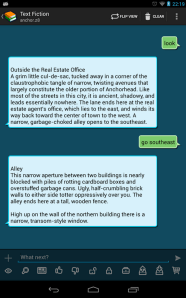
Android Z-machine interpreter. Screen Shot 2014-01-11 at 10.47.40 AM Patrick Albrecht has announced Text Fiction, a new Z-machine interpreter for Android, which uses a texting-like UI for the back and forth between the player and the game. It’s already gotten quite a few positive reviews, and offers features like text-to-speech and play of zblorb-wrapped files. It’s free at the Google Play store.
IF authors on Patreon. Colin Sandel, co-author of One Eye Open, has a Patreon page now, as do sometime Twine authors Porpentine, Mattie Brice, Anna Anthropy, and Merritt Kopas. The neat thing about Patreon is that it’s a crowd-funding model that allows for smaller pieces and less overhead for creators than Kickstarter: a good Kickstarter campaign takes a month or more of hard work to run and usually requires the creator to offer a lot of rewards that themselves add to the duration of the project. (And then there’s the challenge of meeting one’s Kickstarter deadlines, which can turn out to be difficult for unforeseen reasons, even for experienced developers.)

Patreon works on the idea that you’re supporting the author rather than a specific work, and is suitable for smaller pieces, so you pledge to give a small amount of money for each new release, regardless of what that is — the author doesn’t need to put together a pitch video and reward tiers for each project, and also has an idea of expected earnings and therefore how much work it’s reasonable to put into each release. It’s also possible to cap one’s contributions per month to prevent yourself from going over budget. Credit card fees and Patreon fees take around 8% of contributions, leaving the rest for the creator. Many Patreon-supported works are then released entirely free with no further associated costs.

If you can’t tell, I’m enthusiastic about this model and I hope it proves workable, because I think it’s a great way to build up a living income for people who create outside the mainstream, but still have an interested audience. From the viewpoint of the surrounding community, it often also means new work, released on a regular schedule, typically free for newcomers — which means that people who aren’t sure whether they’re interested enough to splash out money on new work can try it out free. Win!

(There’s probably some kind of midpoint still unaddressed, between Patreon and Kickstarter: depending on patronage levels Patreon makes sense for things that might take the creator less than a month to make, and Kickstarter for things that might take a year; I’m not so sure about projects that need to be supported in the 3-to-6 month range. But still. Having more models for this is good.)
Reading and Hypothesis

I see more and more games with no story, only “backstory”. The game consists of piecing together what has gone before, and possibly performing a few anticlimactic actions to round it all off. Reviewers even speak of “the backstory” as if it’s the most important aspect of any game, right up there with mazes and hunger puzzles. It’s an outrage.

— Backstory, Stephen Bond

For authors of interactive stories, presenting most of your story as backstory is often convenient because you can tell what did happen in a place without having to code any NPCs or allow for any branching in the backstory narrative: the past is a part of the story your interactive reader can’t touch. It places those events beyond the reach of player agency. At its worst a backstory driven piece can seem soulless and lonely, as the player wanders desolate locations from which all the other humans have already fled.

But there’s also an argument to be made that the backstory mystery is one of the most natural possible shapes for interactive literature. When it sets up questions and allows the player to look for answers, it engages the reader directly with the substance of the story rather than with extraneous tasks and challenges. It encourages reading hypothetically, making guesses about what really happened that are then affirmed or disproven as one goes.

Screen Shot 2013-11-30 at 7.35.37 PM

For anyone who isn’t familiar with The Fullbright Company’s Gone Home, it’s an indie game about a girl who has just come back from a year-long trip in Europe, to a house that her family moved into after she left and that is unfamiliar to her. No one is there, so she needs to wander the house and try to work out what happened to them. The house is also big and dark and suffering occasional electrical faults, while a storm rages outside, so for a while the game plays genre tricks with whether it’s really going to be a horror story.

Many people have responded with strong approbation, or at least strong feelings of some sort: first because it’s a game that allows itself to be not-very-gamelike, to indulge purely in its fiction; second, because it’s a queer coming of age story and those aren’t exactly well represented in mainstream games.

It is also pure backstory. But before we get into how I read that, some backstory of my own. There will also be some spoilers for Gone Home.

Continue reading “Reading and Hypothesis”

Choice of the Deathless (Choice of Games)

Screen Shot 2013-12-29 at 1.07.43 PM

Choice of the Deathless is the latest piece from Choice of Games. Written by Max Gladstone, it’s billed on the Apple app store as “a necromantic legal thriller,” and it moves well away from the Choice of [Generic Trope] format of some of CoG’s earlier releases. Gladstone is writing within the same universe that he used for his two novels, Three Parts Dead and Two Serpents Rise: a world where high-powered law firms are engaged in the partially legal, partially magical exercise of managing the contracts that bind gods and demons. The Craft is a technical and brutal magic, done with blood and shards and entrails and a great deal of legalese.

The result is the most solidly written Choice of Games piece I’ve yet played. Gladstone’s descriptions sometimes run a bit wild for my taste: strange settings are extremely strange; painful experiences are bloodily painful. As a reader I find it hard to invest in a story that is kicked up to eleven that way on every single page. Nonetheless, his prose is confident, and he spends enough time with the various characters to develop them in detail.

Choices are often about the internal politics of the firm: whom to trust, whom to betray, whom to ask for a favor. The plot is fairly linear, in the sense that the major cases you encounter will tend to be the same over again on multiple playings — but the motivations you choose for yourself, and the relationships you have with other characters, do change substantially. One character was a minor enemy in one of my playthroughs, only to become my lover in the next. It’s a less branchy structure than some of CoG’s past stories, and I’m not sure I’d replay it as many times, but I enjoyed and cared about the individual playthroughs more. And those midgame choices about motive and affiliation do pay off in the endgame, when your range of options is very clearly tied to what you’ve done up to that point.

Indeed, in general I felt as though Choice of the Deathless was making less use of stats than the average CoG game, and more use of important narrative decisions that are remembered later. It’s the difference between having story gated on whether you’ve selected at least 5 “bold” actions so far, and story gated on whether you once did a single, memorable brave thing. Choice of the Deathless is tracking a range of stats for you, which you can go and look at, but the big outcomes seemed to involve callbacks to specific moments.

There were a few flaws.

Just occasionally I was offered a choice that seemed reasonable to me as the reader, but turned out to have been a mistake for some unanticipated reason — for instance, revealing my character’s ignorance about something she should have known. That was a bit frustrating, and I would have preferred the choices to be rephrased to reflect what my character knew about those options.

There is also a thread of decisions tracking how you’re spending money during the course of play, and you’re repeatedly invited to adjust where you live and how much you’re saving to pay down student loans. This is the case whether you come from a poor family or a wealthy one. The emphasis on this aspect made me think it must be an important part of the gameplay, but in fact it remained fairly peripheral to the actual story. I felt the piece would probably have done better just to jettison this; it felt to me like something introduced because the author thought this sort of stat challenge was necessary, but then underdeveloped. At no point in the body of the story did I notice my economy-management choices having a significant effect on outcomes. In all of my playthroughs I managed to pay down part but not all of my debt, but what exactly the numbers came to didn’t seem to matter.

Those quibbles aside, Choice of the Deathless is a pretty sizable piece, set in a detailed universe and confidently written.

(Disclosure: I received a review copy of this game.)