Versu SDK Closed Beta

We’re now launching a closed beta for the Versu SDK tools. An open beta will follow in a few months, and other content creation tools in time, but for right now, we’re looking for code-savvy people who are interested in writing for Versu and are willing to give feedback on the language and library, nitpick the documentation, request features, help us get the toolset into shape for a broader audience, and also perhaps start developing content that they’d like to publish.

People testing out the beta SDK get the development kit, documentation, several annotated example story files to learn from, assorted characters to mix and match with those story files, and access to brand-new library features that haven’t been seen in released content at all. They will also get technical support in working on their projects and access to a user forum. Allowing user-generated content is one of Versu’s core purposes, and we’re really looking forward to seeing what people do with the tool and adapting it to better fit a variety of needs.

If you are interested, you don’t need an iPad to participate. The development tools are suitable for Mac or Windows platforms. They’re also currently best suited to people comfortable doing a bit of coding. Experience with an IF language counts and would be quite relevant.

Since we’re expecting to be pretty engaged with our closed beta crew, there are a limited number of slots available. If you’d like one of them, please share some information with us here. We expect we’ll have picked a group and be distributing the software around August 5.

Assorted Interesting Projects

Screen Shot 2013-07-01 at 2.08.38 PM

Tim Fowers — for whom I worked on Clockwords back in the day, and who has produced several other board and computer games — is doing a deck-building word game called Paperback. It looks like a terrifying collision of Scrabble and Dominion.

Coin Opera 2 is a book of poems about computer games, poems that emulate formal features of computer games. There is even a two-player poem. (I have no idea what that looks like in practice: chorus vs chorus leader? But it’s intriguing.)

Skullduggery is a twist on storytelling RPGs of the kind I sometimes talk about here, only (a) competitive and (b) oriented towards villainy. (Actually, some storytelling RPGs are already oriented towards villainy or at least petty crime, but usually not to quite the same degree…)

Now in its final hours, the Boss Fight Books series takes on classic video games one at a time. I’m especially pleased to see that Anna Anthropy is writing for this series.

Kickstarter politics comments after the jump.

Continue reading “Assorted Interesting Projects”

The Statue Got Me High (Ryan Veeder)

statue_gotOne of Ryan Veeder’s particular strengths is a gift for manipulating player expectations and guiding player behavior for humorous effect.

In You’ve Got a Stew Going, he steers the player into a bunch of weird, rat-protagonist behavior, and at one point breaks the fourth wall to tell the player directly that something is going to be a dead end. In Taco Fiction, he gives the player so explicit a set of instructions about how to carry off an “easy” armed robbery that we know something’s got to go wrong, but we trundle along into it anyway. In Nautilisia, he breaks the fourth wall hard, helpfully explaining all the symbolism as the player encounters it in a quick riff on surreal IF.

This willingness to drop immersion and plausibility in favor of something else — typically a punch line — makes Veeder’s games(*) feel less like stories or living worlds than like exceptionally high-quality knock knock jokes.

That sounds like a slam, but I say it with the deepest respect. There are lots of interactive stories that have non-interactive jokes written in, but Veeder’s funniest bits require the player to help make the comedy happen. This is much harder to achieve and much funnier when it works. Paul O’Brian has just recently written about a similar effect in Dinner Bell, and long ago Adam Cadre wrote about participatory comedy in Fine-Tuned, but it’s not a common effect. The key to all this is that Veeder is able to conduct the player’s behavior accurately enough to get us right where he wants us, when he wants us there: pacing is one of the hardest things to get right in interactive narrative and one of the most necessary to humor.

There’s more to it even than that, though. There’s some participatory comedy in IF that works with the grain of role-playing. A lot of the jokes in Lost Pig are rewards for thinking like Grunk and giving a Grunk-appropriate order like BURN PANTS or BURP. Tale of the Kissing Bandit rewards the player for thinking of commands like TWIRL MUSTACHE. Those are bits that reward the player for playing along with the narrative.

A lot of Veeder’s pieces, by contrast, make the following pitch to the player: Look, you and I both know that what the game is asking you to to do is disgusting (eating things only a rat would eat), pointless (exploring this surreal dreamscape filled with unsubtle metaphors), or just flatly a terrible idea (robbing a restaurant that probably doesn’t have a large cash stock anyway, armed only with a nonfunctional gun), but aren’t you curious what will happen if you do? Come on. I just need one volunteer from the audience.

It’s the joke that plays out because you’re tempted into doing something against your better judgment, or at least against your sense of what is going to work out well for the PC. I trust Veeder isn’t like this in real life, because people who in real life constantly test to see whether they can make you do things you don’t want to do aren’t comedians, they’re jerks. But this strategy works pretty well, and is often very funny, within the safe space afforded by a game. It doesn’t even necessarily feel that antagonistic. Instead it feels as though the player and the author are communicating on some plane distinct from the lower plane where that poor sap the player character hangs out.

The Statue Got Me High demonstrates the same aptitude for player direction, misdirection, and subversion, though this time with less fourth-wall breaking and more reliance on the player’s IF-based expectations. Veeder gets the player to scurry around trying to solve puzzles that seem to matter, then changing up the situation every time one gets close, in a tight, ingenious sequence that doesn’t outstay its welcome.

I’d like to get spoilery about this and narrate my own play-through experience, but I am going to do so after the jump, for the sake of those who might not have played yet.

Continue reading “The Statue Got Me High (Ryan Veeder)”

XYZZY Award Reviews

The XYZZY Awards blog has daily reviews coming out of each category of XYZZY nominees from 2012, which I’m really enjoying reading, and not just because it means coverage for some of my stuff.

These are subject-specific reviews, so for instance Carl Muckenhoupt writes exclusively about the puzzles of the games in the Best Puzzles category, with attention to their individual design, the kind of thinking required to solve them, the overall puzzle arc in a particular game, and so on.

And the reviewers are an all-star cast. Over in the Best Use of Innovation category, Aaron Reed (Blue Lacuna, 18 Cadence, maybe make some change) talks about how the link mechanics of howling dogs worked for him, and its context in the Twine revolution in general. In Best Individual NPC, indie game designer and IF author CEJ Pacian unpacks the way New Rat City plays with gamer tropes. In Best Technological Development, Dannii Willis — creator maintainer of the widely-used Parchment interpreter for browser play — covers StoryNexus, Playfic, Quest and Vorple.

In other words, this some of the most in-depth coverage of IF to come along in some time, written by subject experts and directed at the popular favorites of 2012. If you’re interested in what the IF world has been up to lately — including formats ranging from traditional parser IF to Twine to StoryNexus and one-off experiments — the blog is well worth following.

Assorted Projects

Boon Hill

Boon Hill is a successful-but-still-in-progress Kickstarter for a project in which the player/reader explores a graveyard full of epitaphs. It’s an invitation to create your own meaning out of scraps of evidence, conceptually a little reminiscent of 18 Cadence.

Screen Shot 2013-05-12 at 8.42.51 PM

Conversations With My Mother is a Twine piece by Merritt Kopas, in which you can click on the text to swap one piece of text for another before proceeding. It’s powerful and very brief to experience, and it does some things with Twine that go beyond typical formal features of choice-based narrative. Worth a look.

Screen Shot 2013-05-12 at 8.29.01 PM

Pipe Trouble is one of those pipe-laying puzzle games… except that it’s also about the politics of gas pipelines in Canada. Connect the pipes in the wrong way and you’ll annoy farmers, cause spills, or irritate environmental protesters. And it has text by Jim Munroe.

Tabletop Storygames: The Quiet Year

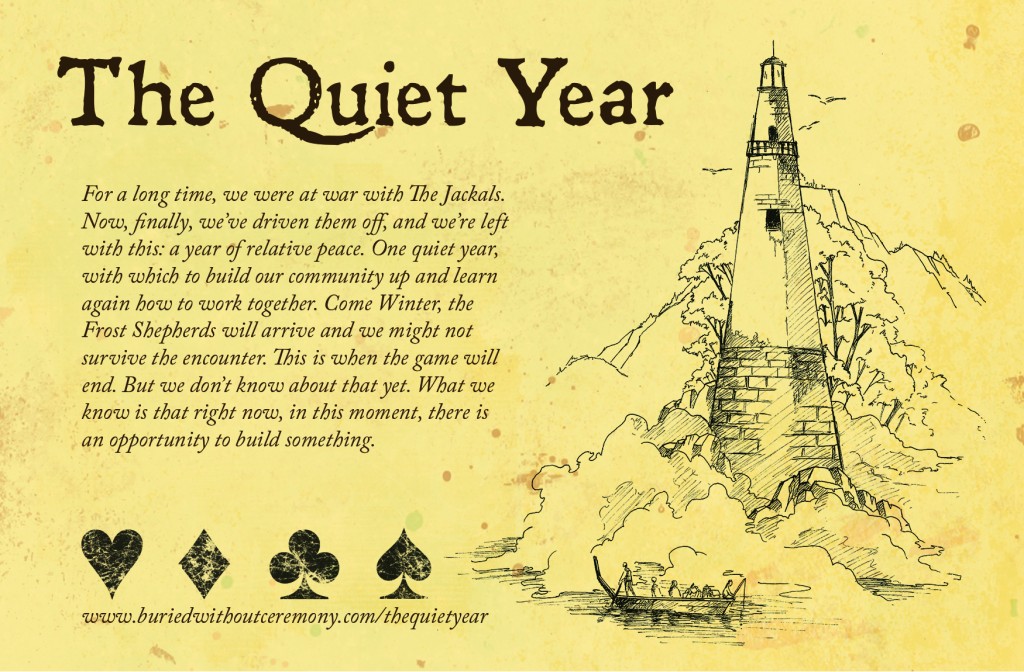
quiet-year-promo-1024x672

The Quiet Year is a story game about one year in the life of a threatened community. The War with the Jackals (not explained) is just over. The Frost Shepherds (also not explained) will turn up in a year, though the inhabitants of the town don’t know that.

In the meantime, there are up to 52 turns (one for each week of the year), and a deck of cards is used as a randomizer to determine what sorts of things might happen during those weeks. Each turn, a player draws the next card, follows instructions from a chart about what that card means for the community, and then takes one of three actions: proposing a communal discussion about a particular issue; discovering something new in or around the community (which means drawing it on the map); or starting a project (also drawn on the map, but set to conclude several turns later). By the time play is over and the last card is drawn, the map is large and complex and bears signs of many events that have happened to the community.

Our story told of a group divided by religious disagreements, threats from outsiders, limited resources (especially iron, which we didn’t have much of until late in the story), and a certain amount of archaeological curiosity.

Continue reading “Tabletop Storygames: The Quiet Year”