Tabletop Storygaming: A Penny For My Thoughts

A Penny For My Thoughts is a short storytelling game about trauma and lost memory. The premise is that the three players are all victims of some disastrous experience that caused them to lose their memories. Thanks to a special mind-enhancing drug, they are able to access fragments of those past events — both their own and one another’s.

To begin, each player writes down on a card three visceral experiences or sense impressions: in ours, these were things like “the smell of rotting lemons” or “vertigo.” Then the players take turns rebuilding past memories for their characters. Each draws a card from the shuffled stack and says, for instance, “I remember the smell of rotting lemons.” The other two players take turns asking establishing questions, such as “Were the lemons from a lemonade stand?” and the player who is doing the recollection must — in good improv style — reply, “yes, and…”, accepting the offer and providing an additional detail of his or her own.

Continue reading “Tabletop Storygaming: A Penny For My Thoughts”
A little more about what I’ve been working on recently

Yesterday I gave a talk at UCSC about some work I’ve been doing with Richard Evans (of Sims 3, et al) (Aaron Reed’s write-up is here). We’ll also be presenting on our research at the GDC AI summit.

Our company, LittleTextPeople, has now been acquired by Linden Lab. More details about that can be found here.

Jon Ingold’s The Colder Light

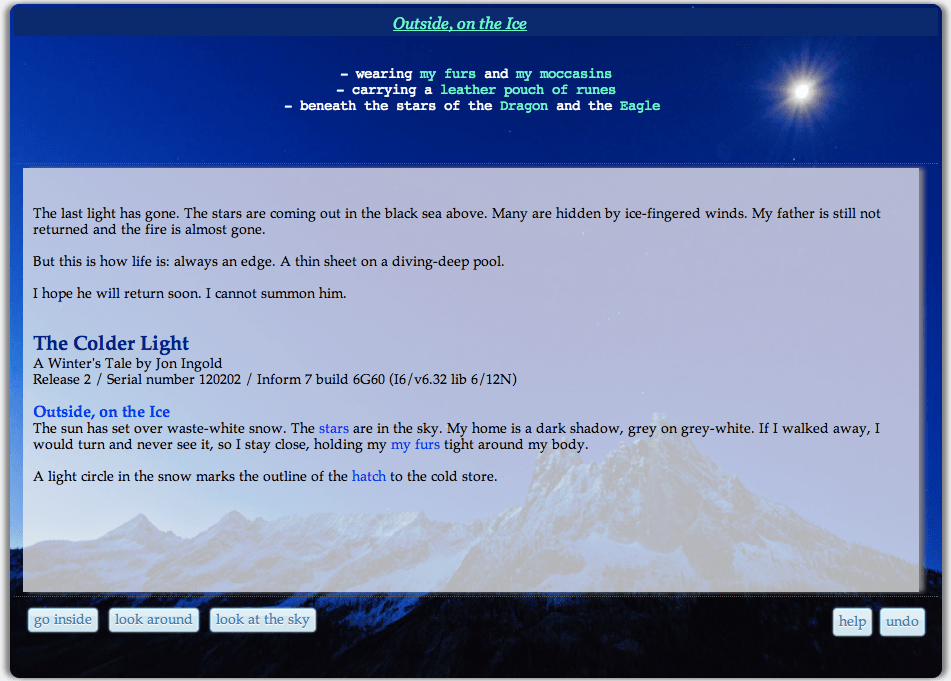
The Colder Light (online play, IFDB page) is the latest game from Jon Ingold: in this case, a spare, melancholy tale about life on the ice. It also uses an interface evolved from some work by Erik Temple (see for example Erik’s alternate interface to Sand Dancer).

This interface attempts to address some of the community’s long-standing concerns about the parser by presenting affordances explicitly. The player can click on hyperlinked objects in room descriptions and inventory and receive a list of plausible ways to interact with these. The result is a play experience with the noun-and-verb variety of classic parsed IF, a more consistent world model than the average CYOA, and enough diversity to make for genuine puzzles; but without any guess-the-verb issues. It also, I imagine, eased the authoring burden that Jon didn’t have to write the vast range of error messages that typically come with parsed interactive fiction.

There are some other possible novice-friendly features it doesn’t have: HELP only produces credits information, there are no hints to speak of, and mapping is also up to the player. But it’s still pretty accessible and I would be interested to see what new-to-IF players might make of it.

So that’s worth noting, and has already received some discussion. There have been a lot of user interface experiments over the past year and a half or so, but to my mind A Colder Light is one of the most successful in capturing the sense of possibility and setting immediacy that I like from parsed IF, while offering a significantly more accessible experience to the user and avoiding unnecessary screen clutter.

But the work also bears analysis on a couple of other levels.

First of all, it centralizes all its puzzles around a consistent mechanic — achieving this is a bit of an obsession of mine, I admit. To discuss that, I’ll need to be slightly spoilery, though I’ll try to avoid giving away specific puzzles.

Continue reading “Jon Ingold’s The Colder Light”

The Written World on Kickstarter

The Written World is a computer-mediated interactive storytelling game (additional details available here). The authors describe it as an interactive fiction MMO, but it’s also not completely unlike a library of Fiasco-style playsets.

The game provides assets — characters, character goals, possible events — embodying a story concept, but each actual experience is a two-player exchange between a Narrator player and a Hero player, a bit reminiscent of Sleep Is Death. The players participate primarily through writing, by creating descriptions of what happens next. If either of them doesn’t like what’s been done by the other, they can spend some Force to override the decision; Force is in turn earned by writing particularly compelling content. The aim of the exercise is not essentially competitive, but mediated cooperation aimed at producing an interesting story.

The Written World chief Simon Fox was kind enough to answer a few of my questions about how the mechanics work.

Continue reading “The Written World on Kickstarter”