Brief Bibliography about IF History

Recently someone contacted me asking to link an article explaining the difference between “old” and “new” IF. I don’t know of any such article that’s remotely up to date. Besides, this is not as easy to answer as they might have hoped, even if you agree on what we’re counting as “old” for these purposes.

But here is a sort of periodization. I’m intentionally vague about dates because people disagree about the milestones. I’m leaving a lot out because this is meant to be a digestible overview. And it’s also worth pointing out that this is a perspective taken from within a particular community, so there were other communities (adult IF, non-English-speaking IF, gamebook/CYOA enthusiasts, visual novel readers, literary hypertext folks) whose histories could usefully be drawn alongside this.

First, a couple of general histories:

The old Inform Designer’s Manual has a brief history of IF through 2000Let’s Tell a Story Together covers IF from the beginning through around 2005. Twisty Little Passages was also released in 2005 and covers about the same period. The history section of the IF Theory Reader contains accounts of French and Italian IF, as well as Duncan Stevens on the period 1994-2004, and Stephen Granade on the trend towards shorter works of interactive fiction over the course of the late 90s.

The Brief History of Interactive Fiction was an awesome (paper! full-sized for your wall!) timeline that ran through the year 2000; I don’t think there’s a great graphical version of it online, but the list of events included can be found here.

Ca. 2011 Nick Montfort and I wrote an account of IF communities that is arguably already way out of date: at the time, Twine was only barely on our radar. Meanwhile, ifwiki has a glossary that defines a number of terms that might be relevant to reading some of the linked reference work.

Continue reading “Brief Bibliography about IF History”

March Link Assortment

preorderNow Play This is almost upon us, at Somerset House: April 1-3, a display of many intriguing and unusual games, plus microtalks and various other goodies. Birdland will be on display, as well as new work from S. Woodson, and Matthew Moore’s tabletop game Bring Your Own Book. (BYOB is in pre-order now, incidentally, and it may appeal to people with an interest in procedural text.)

Because I was doing scheduling before I had NPT’s schedule, there is also an IF Open Problems Meetup April 3 at the Red Lion in Oxford. If you have an issue of interactive narrative that you are stuck on or want to solve, bring us a description or demo of your problem that you can present in roughly 3 minutes. This could be anything from “how do I fix this puzzle in my text adventure” to “how to I get this multiplayer open air scenario to work”: we will brainstorm. If you do not have a problem, you are still welcome to come and answer others! If we run out of problems to talk about, we will declare victory and have snacks.

Also April 2, the SF Bay IF Meetup is gathering.

EGX Rezzed, April 7-9, London. Mostly a broader sort of games conference, but it includes the Leftfield Collection, an eclectic selection of curious things, as well as a panel featuring Jon Ingold (inkle) and Chris Gardiner (Failbetter Games); a talk on Firewatch; and a Sunless Sea retrospective.

April 7, nowhere in particular, also brings us the release of this year’s Spring Thing games.

Bot Summit, April 9, will be a set of presentations at the Victoria & Albert Museum in London.

London April 26 there is an IF Meetup focusing on tools: this time inkle presents ink, James Long presents the Top Secret tools designed for play-by-email narratives, and Matt Thompson presents a domain specific language similar to Inform, but designed to describe stories in terms of tropes. Please note that Failbetter Games has moved to a new location and that we have moved with them, so if you’re used to coming to North Greenwich for meetups, note the new address.

Boston’s PR-IF meetup is still to be announced, but it’ll show up here when there’s a date.

May 5 there is an event in London called Invisible Wall:

Invisible Wall is an event for women (trans inclusive) and gender minorities who want to work in this brilliant and fascinating medium, whether that’s as a journalist, critic or developer. We’ve brought together several women who already work in games writing to talk about their jobs and experiences, including Keza MacDonald, UK editor of gaming site Kotaku, Meg Jayanth, writer of award-winning narrative adventure 80 Days, and Olivia Wood, editor at Failbetter Games.

*

This isn’t really new news, except that I didn’t know about it and so didn’t mention it sooner: there’s also an LA Meetup group for interactive fiction. I don’t see any events planned for this month, though.

*

Failbetter Games’ funding initiative Fundbetter is accepting applications for support to develop narrative games, especially text-centric ones. (This is an investment, not free money; be sure to read the instructions and conditions about how it works.)

In particular, they note they’ve gotten almost no applications from women so far, and would welcome more. I find it hard to believe that the proportion of women writing narrative games is that small. I suspect the issue may be more about women’s tendency to disqualify themselves.

For those of you who might be inclined to self-disqualify: if you’re enthusiastic about your project and think it has potential, but feel like there are a couple questions on the question list for which you have less than perfect answers, I’d encourage you to a) seek advice/do research and see if you can polish those answers up, and then b) go ahead and submit, maybe even if one or two bits are things you’re still not sure about.

If you are having trouble thinking about their questions on UI, here’s a Pinterest collection of UIs from IF and text-based narrative games. They’re not all great! Which is itself something to think about.

Business and marketing plans are not so much my main area of expertise, but for what it’s worth, here’s a summary of one of an indie summit 2016 talk on strategies for the current market. One might Google the speakers to see if they’ve written more in-depth coverage elsewhere.

Meanwhile, over here Filamena Young is blogging about the process of applying to Fundbetter… complete with thoughts on the questions, and resources she’s using.

If you want a supportive place to talk to other IF authors, some of whom write for money, the euphoria &if channel is active. Even if you don’t want to go into detail about your plan in a public place, you may find a couple sympathetic listeners you can contact privately for further feedback. The channel is used very frequently for discussing work opportunities and beta-reading requests and other topics associated with being a semi-pro IF writer, so your request will not be out of place there.

Perhaps the polishing may not be enough to render your pitch sparkling and flawless in every regard, and that might be okay. If there’s something compelling about the project, Failbetter does sometimes work with people who have promising but not-quite-there pitches, to help them refine the marketing and the hook and other things that might need work. To be honest, just getting this advice might well be worth as much as the money they kick in.

*

If you didn’t get enough GDC coverage with my posts, here’s Liz England’s takeAaron Reed has also written up his thoughts, and Andrew Plotkin has his.

Wrong conference? Here’s Nick Montfort on the panel we did at SXSW, along with Allison Parrish and Daniel Temkin, on IF, esolangs, bots, and other ways of hacking language.

Continue reading “March Link Assortment”
Conference access, and related topics

This post started out as part of my monthly link roundup, but it turned into its own thing. The link roundup will still appear, but for ease of digestion I have separated the two.

ICIDS, the International Conference on Interactive Digital Storytelling, has a call for papers for this year’s conference, and will also be hosting an exhibition of related works. The deadline is June 17, and the conference itself will be November 15-18 at the Institute for Creative Technologies, University of Southern California, Los Angeles, USA. Discussions of interactive narrative systems and/or specific works are often appropriate for this conference.

Likewise, there is now a creative track for the ACM Hypertext conference, which would be an appropriate place to submit Twine, Undum, or similar hypertext works for display. The deadline for that submission is May 6, 2016, and the conference itself (which contributors are expected to attend) is 10-13 July 2016, in Halifax, Canada.

Students traveling to the Hypertext conference may be interested in this support application to help defray travel costs. Except for invited keynote speakers, I am not aware of any financial provisions to support non-students in traveling to either of these events if they don’t have institutional support to do so. (Indeed, most academic conferences do not waive your registration fee even if you are speaking, unless, again, you’re doing an invited keynote. Those fees are usually on the order of hundreds of dollars rather than thousands as at GDC, but it is inevitably something to be aware of.)

More distantly but still relevant to some readers of this blog, there’s also

  • the meeting of the Electronic Literature Organization (Victoria, BC, June 10-12, submissions closed)
  • ICCC, the International Conference on Computational Creativity (Paris, June 27-July 1, submissions closed)
  • (Edited to add:) nucl.ai, artificial intelligence in creative industries, which this year has tracks on procedural content generation and dynamic storytelling (Vienna, July 18-20, submissions still open through April 15).
  • DiGRA/FDG, a joint meeting of the Digital Games Research Association and the Foundations of Digital Games conferences (Dundee, August 1-6, submissions closed)
  • IEEE Computational Intelligence in Games (Santorini, September 20-23, still accepting papers and demos)
  • AIIDE, Artificial Intelligence and Interactive Digital Entertainment (Burlingame CA, October 8-12, still accepting papers).

Yeah, I probably can’t go to those either. Accessibility of conferences is an issue. So is the fact that in some subfields of games, one is “expected” to go to X or Y conference in order to be taken seriously in that particular subfield, which is taxing for people who are busy and not independently wealthy.

Mattie Brice has written about boycotting GDC this year because it does too little to support marginalized creators who contribute content; and one of the reasons John Sharp withdrew from IndieCade was out of concern about whether it was really helping people at the edges to do their work in a sustainable way.

Continue reading “Conference access, and related topics”

Superluminal Vagrant Twin (CEJ Pacian)

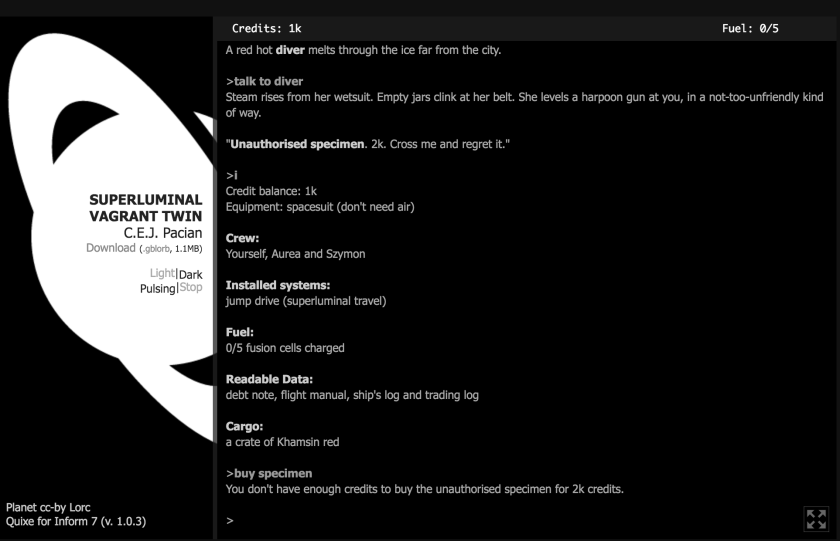
Screen Shot 2016-03-27 at 5.12.11 PM.png

Superluminal Vagrant Twin is a new parser piece by CEJ Pacian, an exploration-and-trading adventure set in a universe of bizarre and evocative planets. The premise is that you’re trying to collect five million credits — an amount that seems frankly impossible given your initial resources — by jumping your hunk-of-junk ship from one planet to the next in search of odd jobs.

With large-scale solar system engineering, terraforming, and bioengineering, the setting reminded me a little of both Sun Dogs and Hoist Sail for the Heliopause and Home; but Pacian’s universe is populated with more characters than either of those.

Pacian’s past work includes the exploratory fantasy Weird City Interloper, the partially procedural Rogue of the Multiverse, the ant simulator Dead Like Ants, the on-rails puzzle shooter Gun Mute, and the conversation game/love story Snowbound Aces, among others.

As wildly varied as those pieces are, they tend towards a few common features: a light, focused world model that prioritizes a few verbs and sets aside the rest; characters and settings communicated in a few quick and evocative strokes; a sense of a world never completely explained.

Superluminal uses these techniques to create a fairly simple but very novice-friendly and well-directed parser experience. The verbs the player will need are all listed up front. Important nouns are in boldface, and there are rarely more than four or five to interact with in any given location. A couple of status commands keep notes on everything the player has encountered so far, which makes notetaking unnecessary; and the hyperjump premise of the story means that there is no map in the traditional sense, but that most locations are accessible within one or two moves at all times. I found that I could play in a more casual mode than I usually bring to parser IF.

Meanwhile, Superluminal does as good a job as I’ve seen at a trade-and-exploration parser game, even including a little light grinding but without becoming too dull or frustrating. Sometimes you’ll find or be able to buy objects and then need to figure out who else in the universe might be interested in paying you for them: this is complex enough to reward the player for actually reading the text, but no so complex that you’re likely to get stuck for long. And there are lots of ways to win — I completed the main plot arc without getting anywhere near 100% of the money-earning side quests. Among parser IF games with a monetary score, Superliminal offers just a bit more of a story development than in Captain Verdeterre’s Plunder, but it’s not nearly as hard to win as Gotomomi, whose much more intricate world model sometimes felt a bit overwhelming.

And while we never interact long enough with any NPCs to get to know them very well, there’s enough here about the different cultures, politics, and art styles of the various planets to make for a very entertaining playthrough.

I got through it in probably around 90 minutes of play time, but it would take longer to find every detail. Online and downloadable versions are both available.

GDC Highlights, Thursday/Friday

(Belatedly, because I was in a place without good wifi for a few days after the conference, apologies:)

Thursday was the day of Lost Levels, when folk coalesce in the Yerba Buena Gardens for unconference-style talks about subjects dear to them. It’s a good place to find altgames conversations; and as it happens, Kate Compton had organized a Lost Levels section about AI use for altgames purposes, and even put together a zine introducing various tools. So that was pretty excellent, though I wasn’t able to attend all of it, as I also had lunch plans. It made for very different types of discussions from the utility scoring examples, combat and pathfinding solutions that tend to make up most of the main AI Summit.

Later that afternoon, we had a procedural text discussion in the park as well, sort of by accident. I’d put out feelers on Twitter looking/expecting to find maybe three or four people who wanted to have coffee and talk about textual procgen. In practice we had such a large crowd that we couldn’t fit into a coffee shop and had to return to the Gardens and effectively be a Lost Level of our own. (I’d feel bad about the unofficial nature of our participation there, except that the whole point of LL is to be unofficial, so hm.)

In any case, that turned into a set of really enjoyable conversations about what people are looking to do with procedural text, whether that’s representing a complex world model, or focusing on the poetic aspects of the language, or combining text and art in evocative ways. Devine Lu Linvega told us a bit about Paradise; the Sproggiwood/Caves of Qud creators talked a bit about using procedural text in a game that isn’t primarily text based; I talked some about Annals of the Parrigues and also about what I’d like to do with partially procedural dialogue in order to blend emotional aspects better into authored conversation. There were a bunch of other subgroups of the conversation that I didn’t overhear, since there were so many people, but it was great to meet so many people who are into the topic, and I hope to follow up on some of these things more later.

As a bonus, here are Kate Compton’s slides on procedural text using Tracery.

*

Friday morning Squinky spoke about designing discomfort, giving an overview of many of their own works as well as a survey of others in this general space, and talking about techniques such as realtime dialogue that doesn’t give the player time to contemplate their response (or in which pauses are noted); controls that are intentionally awkward in order to represent social discomforts.

*

Friday morning there was also a talk about idle games that sparked some interesting discussion, though I wasn’t able to be at that one. (The talk isn’t available yet, and I don’t know for sure that it will be; however, here’s a talk from 2015 that sets some of the stage.)

*

Friday afternoon, I spoke as part of the Rules of the Game panel, and argued for why we should be thinking about visualization (and visualization tools) early in the process of designing a new system; on the same panel, Liz England gave a great talk about documentation and specifically about knowing the target audience of your documentation so that you can focus on the kind of content and presentation that will work best for them. At the same time, Joe Humfrey was giving an introduction to ink, inkle studios’ newly open-sourced IF tool.

Later Friday afternoon, I also checked out the talk on lost greats from the TRS-80, including Atlantic Balloon Crossing and a few battle/resource-collecting games. I was struck by how much the pleasure of these lies in watching the numbers go up and down and engaging with a simulation as a piece of math. Perhaps this isn’t so far off from the appeal of idle games either.

GDC Highlights, Tuesday/Wednesday

Tuesday: I went to several AI panels; they were fun, but mostly not related to what I write about here, except by loose analogy. (When AI goes wrong, it goes really really wrong, though.)

Richard Rouse III gave a talk on dynamic stories for games, with shoutouts to some IF work, Versu and Prom Week, and Sam Ashwell’s CYOA types. (Gamasutra writeup here.)

Sam Barlow talked on Her Story: the research that went into the project, the use of mystery and player imagination to fill gaps, etc.(Gamasutra writeup.)

To me, the most compelling moment was the slide of the spreadsheet he used to track word use and figure out which elements needed to be changed. I could really have gone for a 20-30 minute deep dive just into that aspect of the writing. (Hypothesis: because Her Story was successful and looks simple, there will probably be ripoffs, and they will probably be terrible. There is a lot of invisible craft that goes into the word choice to make the game function as it does, and someone careless about that issue could get it very wrong.)

Continue reading “GDC Highlights, Tuesday/Wednesday”