IF Comp 2011: The Play

It’s comp time, so I’m going to short summaries in my RSS feed in order to avoid dumping spoilers into the aggregators. And, as usual, I will be skipping games that have no evidence of beta-testing.

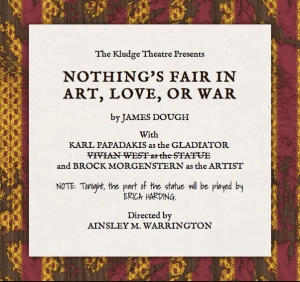
“The Play” is an Undum piece by Deirdra Kiai (Life Flashes By, Pigeons in the Park). “The Play” concerns the dress rehearsal of a play about a statue come to life, her artist, and an escaping gladiator. There’s a certain amount of slapstick humor, but mostly the story is about juggling the moods of the actors you’re overseeing in an attempt to get through the evening.

In the review to follow, there are some comments on thematic content at the beginning, then spoiler space, then a more detailed discussion of structure. That said, even the thematic comments give away a certain amount of what the game is about, so if you want to encounter it entirely fresh, don’t read on.

Continue reading “IF Comp 2011: The Play”

Choice of Romance

Choice of Romance is a piece from the Choice of… series: not exactly new, but I’ve been too busy to look at it until recently.

I wonder a bit about the marketing strategy of calling the stories “Choice of [blank].” It makes the stories sound more generic than they actually are, especially when the thing that goes in the blank is as sweeping as “Romance.”

In this case, the title is deceptive. “Choice of Romance” isn’t a generic romance story. On the contrary, it (like Choice of Broadsides) is set in a slightly alternate version of a historical setting, designed to allow the player to play as either gender, seeking a partner of either gender, and to give players with female characters the opportunity to exercise more agency than would otherwise have been available.

Continue reading “Choice of Romance”

Narrativist Games

I recently got this question (slightly rephrased for brevity):

Off the top of your head, what are the key [narrativist] games one should know about? Do any particularly stand out? Any recent games I should rush to read? I am thinking primarily in terms of GNS, or — even more loosely — along the lines of games like My Life With Master, Dogs in the Vineyard, Stalin’s Story, and Little Fears. But I’m not dogmatic here.

This is a different question from the big storytelling games thread we had a couple years back — and in any case new stuff comes out all the time. So I thought I’d put some of my own thoughts here but also solicit feedback from the community, because I’m sure I’m missing a lot.

The wikipedia page on GNS theory defines narrativist play as follows:

Narrativist play relies heavily on outlining or developing motives for the characters, putting them into situations where those motives come into mutual conflict, and making their decisions in the face of such stress the main driving force behind events.

…and I’d say these features are fairly uncommon in IF and in video games in general, perhaps because it’s not easy to come up with mechanics that specify protagonist motivation. The Baron and Fate are obvious exceptions, with The Baron in particular stopping frequently to ask the player why he’s chosen to do something. Arguably Rameses also belongs in this category, because the player’s interaction is almost entirely about specifying what he wishes the protagonist had the guts to do, before Rameses’ neuroticism quashes the impulse.

A softer approach to this problem is to ask the player interpretive choices without extensively acting on the answers. Echo Bazaar occasionally asks the player to reflect back on a past event or action, or to express an attitude or intended action for the future. The “Free of Surface Ties” card, for instance, asks the player to choose an attitude towards the current game situation. The Countess storyline involves a similar choice. When the player’s decisions here don’t affect the gameplay but purely express motive, EBZ’s authors refer to this phenomenon as reflective choice. Very occasionally in the later stages of the game, however, motives do come into direct conflict: for instance, if the player builds up a lot of connection with two opposed social groups, he may encounter a card that demands him to pick sides. Still, a lot of this content is optional and it makes up a small percentage of the plotlines in the EBZ universe. So I wouldn’t say that the story is mostly driven forward by conflict between motives that the player has been able to select.

I wouldn’t be surprised to learn that Bioware has also done some storylines in which the player makes some choices about affinity or loyalty and then is challenged on those as the story unfolds. I haven’t had time to take in anything as enormous as Mass Effect 2 or Dragon Age II lately, but that sounds like the kind of territory they might be exploring.

So what do people think? Are there other games (IF or otherwise) that really qualify as “narrativist” in this sense? I’m sort of mulling over my own alternative taxonomy of interaction in computer-mediated storytelling, but I’d be curious to hear thoughts about the GNS approach.

Ebert & Moriarty Addendum

A couple of things keep coming up in the discussion about Ebert and Brian Moriarty’s defense of him, which let me take one at a time.

1) “I don’t see what’s great about Moriarty’s argument. Why is it better than Ebert’s original statement?”

Moriarty offered a much more coherent argument about why, exactly, choice might be a problematic thing to have in a game. Of course, coherent doesn’t mean “right” or even “compelling,” but I am sick to death of the argument that a choice-based work entails the absence of the artist and therefore the absence of meaning and artfulness. That is obviously nonsense, and if it’s not clear why, try Home or Photopia or Rameses or The McDonalds Game or Judith or Don’t Look Back or Passage or The Path or Treasures of a Slaver’s Kingdom or any of a gazillion other works that convey meaning in the gap between what the player wants and what the player is allowed to choose.

Moriarty’s defense did not rely on this argument, but looked at some other possibilities that do hang together intellectually, even if in the end I don’t agree.

2) “Why do we care what Ebert says?”

I mostly don’t, but he’s got immense cultural clout. When he says things that dismiss games as a cultural product, that enables others to do so comfortably without further investigation. This isn’t the end of the world, but it’s unfortunate.

3) “Why do we care whether games are art? Is it even worth arguing about this?”

Maybe not, but in Ebert’s argument and in many other people’s, “games aren’t art” is shorthand for saying that games don’t and can’t convey anything important, can’t meaningfully enrich the lives of players, can’t be a valid mode of expression for game designers. Ebert himself makes this explicit.

But possibly the secondary argument (“what is art? are games that thing?”) is just obscuring the original question, and we can and should go back to that. Can games say things that matter? To me this is an obvious yes. But once we embrace this seriously, maybe we can have more conversations about what they’re saying and how. There’s not enough game criticism of this kind and I would like to see more of it.

Four talks at GDC

Well, GDC is officially over for the year. This conference was a powerful one for me in a lot of ways, exhausting and inspiring. Thumbnail sketches of some memorable talks from the last two days:

(1) Chris Crawford spoke on the history of computer game programming, complete with lots of fun pictures of positively ancient machines, and ending with his pitch for games to be about people. I’d heard a lot of it before, but it was an enthralling and well-delivered talk, and even though we disagree on some fundamental approaches to the problem, I sort of love hearing the point made over again. Afterward we met up in the hallway and there was a curious playground-fight vibe from some of the onlookers as we discussed our different approaches to the gameplay-about-people problem. Which isn’t what I intended — I just wanted to say hi to him after assorted emails and comments exchanged over the years. But whatever the surrounding circle may have thought, I have no beef with Chris, nor I think does he have any with me.

Anyway, one of the points Chris made in our unfortunately brief discussion was that he felt the parser in IF doesn’t do a good enough job of taking in information from the player — that it doesn’t listen well enough; it doesn’t allow the player to make a big enough part of the conversation between game and machine. I’m not quite sure what this indicates: is the input not granular enough, or the output too wordy, or the range of things that can be said via parser too narrow, or…? I’m not sure whether I’ll agree once I figure out what this means, but it’s an interesting statement.

(2) Brenda Brathwaite talked about her series of tragedy-focused games, the series to which Train belongs. The core of her talk that stuck with me was this: “Whenever there’s human-on-human tragedy, there’s a system.” So her approach is to explore that system in rules, and make the player complicit. There was a lot else in the talk, about the personal nature of her work and about her own feelings in creating it. I don’t really feel comfortable trying to summarize here, but it was a brave talk to give, and fascinating.

In fact, quite a lot of this GDC has felt unusually personal for an industry conference, from Michael Todd’s talk (which I didn’t see but heard praised by many many people) about designing games while clinically depressed, to the rawly open content of the rapid-fire indie talks, to conversations with Deirdra Kiai and Terry Cavanagh about the motivations behind my own work and/or theirs.

(3) Ernest Adams gave a talk on spec’ing out an interactive narrative, in which he discussed a lot of standard problems: the freedom/agency/story problem, the question of whether the player should be able to change outcomes (and the fact that an interactive narrative doesn’t have to be one in which the player changes the plot), etc. It wasn’t as flashy a talk as the others, and it didn’t contain a lot of information that was new to me, but it was cool to see these issues organized in one place. You can see it too, since he has put the slides (odp) and storytelling template materials (odt) online.

(4) Brian Moriarty gave the most coherent and philosophically interesting argument in support of Ebert’s “games can’t be art” dictum that I’ve ever heard. (This gets long.)

Edited to add: there is a set of point by point notes from Moriarty’s talk here, which covers some details my analysis doesn’t discuss.

Continue reading “Four talks at GDC”
The Sacrifice Mechanic

Over on the Escapist, Extra Punctuation has an awesome article about a game mechanic of leveling down rather than up. I’ve occasionally kicked around a similar idea, though starting more from “how do we do choice narratives where the choice feels significant?” — and one way to make the player actually care about choices is to tie the results into gameplay.

I’m attracted by the idea of a plot reminiscent of (the movie version of) “Last of the Mohicans,” where our protagonists start out as wealthy, happy, proper young ladies of English extraction and end up as bedraggled, hardened, and — in one case — dead. It’s a story of stripping away all peripherals until each character’s deepest feelings and commitments are revealed. That kind of story could make a compelling tragic game, or a story of triumph at excruciating cost, not far off from the structure of Victor Gijsbers’ Fate.

Leveling down, or gradually giving up your collection of Batman gadgets, or losing one after another of your crew of sidekicks until you stand alone, or burning away one after another of your huge inventory of doodads — that’d be a way to do the gradual-loss plot. Like I said, awesome.
