Writing for Video Game Genres: from FPS to RPG (Wendy Despain)

Screen Shot 2017-08-04 at 9.20.39 PM.png

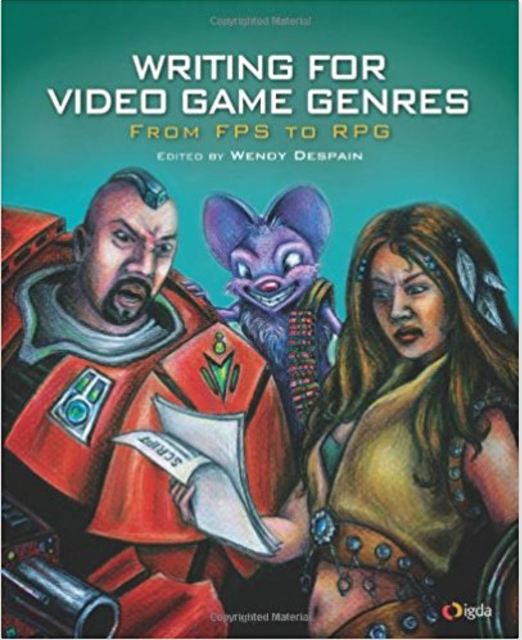
I’ve mentioned this book before; it’s been around for a while, published 2009. Writing for Video Game Genres is (as the name might suggest) divided up into chapters by genre, with contributions by writers experienced in different areas.

As the introduction explains, it’s not a book about how to write in general, or even a guide to getting started in games; it’s meant to provide a deeper dive into the specific challenges associated with various genres, which are often very unlike each other. That said, these chapters are often rather introductory: genre-specific observations, certainly, but likely to be most useful to people who are first considering engaging with that genre, or who want an overview of areas where they haven’t worked before.

The book includes a section on parser interactive fiction, written by J. Robinson Wheeler. Some of the other genres covered are what we might think of game genres (MMOs, sports games, action games, adventure games, platformers, casual games, alternate reality games, serious games…); some are book genres (science fiction/fantasy, horror); and some are focused on particular platforms (handheld, mobile). These days, I’d probably expect to see an additional chapter on writing for augmented and/or virtual reality (and perhaps less about ARGs).

Continue reading “Writing for Video Game Genres: from FPS to RPG (Wendy Despain)”

End of April Link Assortment

May 5 is the next meeting of the SF Bay IF Meetup.

May 7, voting closes for the games in Spring Thing, so there’s still time to play and vote on some games if you’re interested in doing that.

We actually have two Oxford/London IF Meetup events this month, both centered on procedurality, text, and dialogue, but aimed at different skill and experience levels:

spiritCE.png

May 12, we have a workshop on Spirit AI’s Character Engine, which will get comfortable authors who are comfortable using Unity up and running with the tool, and allow them on-going use of the SDK. This is a first introduction to this engine, so no prior experience authoring with Character Engine is expected, but technical comfort with Unity and some experience writing procedural text will both be useful.

May 19, the Oxford/London IF meetup does a workshop on Tracery and building your own Twitter bots. For those who are interested in just getting started with procedural text generation and doing something fun with it in a short amount of time, this is ideal for you.

Feral Vector is May 31-June 2 this year. This is a joyous, playful indie conference in Yorkshire and has always been delightful when I’ve been able to attend. (I can’t make it this year, alas.)

*

I talked with Dark Pixel about NPC interaction in games, what we can do with AI, and what we’re currently working on at Spirit AI:

*

Continue reading “End of April Link Assortment”

Illuminismo Iniziato (Michael J. Coyne, Spring Thing 2018)

illuminismocoverIlluminismo Iniziato is a parser-based puzzle game in Spring Thing 2018, and a sequel to Risorgimento Represso (2003). The protagonist has come from our world, but been drawn into a universe of wizardry. You’ve got an overarching quest to solve, but getting through it requires breaking into various locations and getting access to various objects, as well as relying extensively on tyromancy, the art of scrying via cheese. Your protagonist bumbles around a bit, and while you’re able to do good things for some of the NPCs, you’re also responsible for assorted farcical mishaps.

The puzzles are fair and reasonably clued. I got stuck and had to ask for help once, and it was totally my own fault for not thinking enough about one of my existing inventory items. In general, nothing was too ferociously hard, and several of the puzzles are of the farce-puzzle sort where you will get them wrong in goofy ways before you get them right. I’d say overall it took me around three hours to play through.

The implementation is very solid. I ran into one tiny cosmetic bug once, and it was the kind of error (not having a custom response to looking at the floor in a particular room) that wouldn’t even arise in a game that was less ambitious about its world model. The NPCs have lots to say and a multitude of reactions to what you do, without overpowering the rest of the game. The world state feels complex, and your actions feel consequential, but until a timed sequence in the end-game, I never ran into a place where I’d gotten myself into a dead end by doing the wrong thing. This is quality parser-craft.

Continue reading “Illuminismo Iniziato (Michael J. Coyne, Spring Thing 2018)”

Zeppelin Adventure (Robin Johnson, Spring Thing 2018)

Screen Shot 2018-04-14 at 8.35.32 PM.png

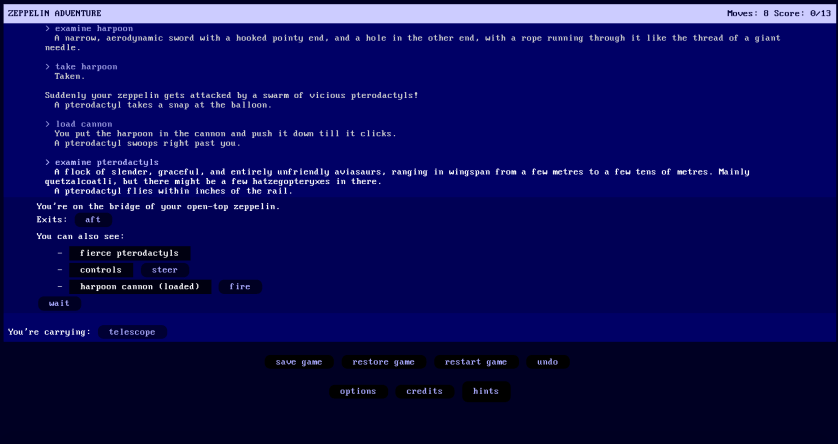
Robin Johnson’s Versificator engine is designed to give the player access to a parser IF-like world model but a choice-based interface, free of verb-guessing. The two previous games in this space, Draculaland and Detectiveland, feature navigation and inventory puzzles that feel quite text adventure-like, but in a more accessible format.

At any given time, the player has quite a few choices available — usually one or several movements between rooms, as well as ways of examining or interacting with environmental objects, and then some things that you can do with your inventory items. But these aren’t listed all in one place; instead, choices associated with something in your inventory become visible only when you’re carrying that inventory item. So there are partially hidden options, and you do generally have to draw some connections yourself before being able to execute a puzzle solution.

zepellincover.jpgFeatured in Spring Thing 2018Zeppelin Adventure continues that tradition, set this time in a wacky-explorer universe where people are plotting out Mars from their giant balloons. Yours, however, suffers an accident and crash-lands on a planet dominated by robots, and you have to go on a quest to find repair parts for your engine.

As the cover art suggests, this is a pulpy kind of story that leans into certain genre conventions both present and historical.

Continue reading “Zeppelin Adventure (Robin Johnson, Spring Thing 2018)”

Venience World (Daniel Spitz, Spring Thing 2018)

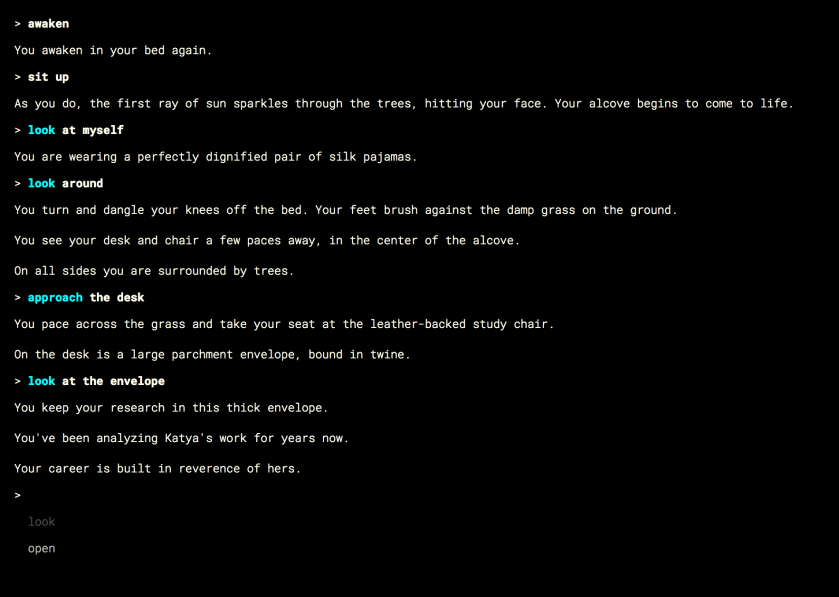
Venience World from Spring Thing 2018 offers another possible revision on the parser. Every turn, you have a command line, but listed below it are suggested autocompletions, one word at a time. You can select an autocompletion with up/down arrows, or you can click on one, or you can type out the contents. After you’ve picked the first word, you get options for the next word or phrase, and so on until you’ve completed a line of input.

Below, for instance, we’re offered the opportunity to start with “look” or “open”:

Screen Shot 2018-04-15 at 1.42.38 PM.png

These parser training-wheels mean that the game can allow the player fairly unusual commands, like BEGIN INTERPRETATION, with no fear of verb-guessing. In this regard, it builds on the author’s previous work Niney, also using unusual parser commands.

Venience World prevents you from reentering a previous command verbatim even if it seems like that command ought to be currently available, and that has results that can feel straight-up buggy. (At one point I repeatedly tried to type LOOK and it would just not register the K keystroke at all, in a weird and disorienting way. I tried several times before I realized that I wasn’t allowed to enter the word LOOK right then, but this feels like the least intuitive way to communicate that to the player.)

There are a handful of previous pieces that have played with similar methods.

Continue reading “Venience World (Daniel Spitz, Spring Thing 2018)”

Life in a Northern Town (People + Places, Spring Thing 2018)

Screen Shot 2018-04-16 at 9.04.33 AM.png

From Spring Thing 2018, Life in a Northern Town is what sometimes gets called dynamic fiction as a subset of interactive fiction: a piece in which, for most characters, you’re never making a single choice that changes an outcome or modifies the shape of a narrative. (Brianna’s chapter, in inklewriter, is an exception: she has actual agency over who she chooses to engage with. But the vast, vast majority of this story is about people making dangerous decisions while the player has no opportunity to intervene or prevent them from doing so.)

For most of the elements, a majority of the clicks are click-to-continue options, and some of the sub-stories in the piece are presented in formats such as groups of images on Instagram, where branching would be very hard to arrange. Other elements are told in Twine or on WordPress, eight different people’s perspectives on the same story — though it’s not really trying for a mimetic effect here. It’s not ARG-ishly pretending to actually be the blogs of all these people. Here and there, images are included, especially on the Instagram segments, but elsewhere it’s almost all text, including the largest chunk of the story which is presented in unstyled Twine.

Still, it’s not the same story it would have been if it had been written into a book. The work of reading it is part of the point, for one thing. This is a story about labor, and the labor is recaptured in the way of reading.

For another, the dynamic-fiction presentation fractures the temporal sequence of scenes, especially in the Twine segments. Often there will be a short scene of dialogue between characters, and then clicking through a link will reveal another beat in the same conversation, another interaction, which might be chronologically before or after the first. It doesn’t really matter how they’re joined up, temporally. I never found this to be confusing. Rather, it gave me a sense that I was getting the overall impression of the interaction and then a couple of other key moments from that interaction, in the same way I might when going over a memory in my head. A handful of times the revealed secondary beat actually overturns the sense of the initial interaction.

So I can see reasons for the way it’s presented, but this is a long piece of work — took me some hours to read, and I’m a pretty fast reader — and by the end I would really have appreciated a more comfortable, less laborious reading experience. Other markers are missing, too: there aren’t chapter breaks, so sometimes the story ratchets forward to a new scene or location without an explicit division. There’s no progress indicator, either, which I really miss when I’ve got a multi-hour work on my hands.

Something like this stands or falls on the quality of its writing. In my initial encounter with the first of its linked stories, “Dangerous Work”, I was a little discouraged by the styling and structure — of course it’s not always the case, but standard, unformatted blue-and-white-on-black Twine sometimes goes with low-effort authoring. But I found myself continuing to read screen after screen, connecting with the luckless protagonist and her precarious life in and around Minneapolis.

Continue reading “Life in a Northern Town (People + Places, Spring Thing 2018)”