Necklace of Skulls, The Sinister Fairground (Cubus Games)

cubusCubus Games is a maker of gamebook apps, and they have released a version of Necklace of Skulls by Dave Morris as well as a game called The Sinister Fairground.

In both cases, I felt that the UI was a bit clumsy and a bit unpolished, compared with the sleekness of 80 Days and inkle’s other work, or the splashy dynamism of Tin Man Games’ Appointment with FEAR. When you encounter new objects in the text — things that you might write down as keywords in a paper gamebook — you have to tick off a checkbox to acknowledge them as part of your inventory. I didn’t realize this in my first playthrough of Necklace of Skulls and got really confused about why I seemed to be missing objects that the text said I possessed; and indeed it’s not quite clear to me why it’s useful to make the player do this.

Along the same lines, the navigation through the helper pages for Necklace of Skulls (map, items, journal, checkpoint, table of contents) had me thoroughly confused and tapping in circles: there isn’t a clear hierarchy of how these pages relate to one another, and the icons and back buttons don’t all do quite what I would have expected.

Continue reading “Necklace of Skulls, The Sinister Fairground (Cubus Games)”

Hybrid interfaces: Texture; Contrition (Porpentine); Spondre (Jay Nabonne)

Lately we’ve been seeing more and more work that falls somewhere between parser-based IF and hypertext: in the past six weeks or so, I’ve run across two new games and a creation tool that push the boundaries in various directions.

Jim Munroe and Juhana Leinonen recently released Texture, a system designed especially to produce touch-based IF that will play well on mobile devices. Texture features the idea of applying verbs to passages of text:

Screen Shot 2014-12-16 at 11.55.07 AM

When a verb is used on text, it replaces that text with something new, or else moves forward to a new page, mimicking the change-or-advance link distinctions in many Twine games. (With Those We Love Alive actually makes this distinction obvious by coloring these links different colors.)

The pairing of verbs and nouns means that navigation is a bit less obvious than in most pure hypertext Twine pieces, allowing for puzzles. The back end is still extremely simple, though, so although it might appear to be a system that would compete with the parser, in practice there’s no way (yet) to build up an extensive world model. The verbs that are available may change from page to page, and the author is handcrafting each verb-phrase interaction.

To the best of my knowledge there aren’t any released pieces yet that use Texture, but I’ll be interested to see what comes of it.

Continue reading “Hybrid interfaces: Texture; Contrition (Porpentine); Spondre (Jay Nabonne)”

Transcript Live, and a few other Changes

The IF Discussion Club met again, this time on New Directions in IF, and the transcript is now available.

Also: for a long time the “Reading IF” section of this blog has had lists of games to play, but those lists hadn’t been updated since ca. 2007 and were getting seriously out of touch with what is going on in current IF. (A lot of the links pointed to Baf’s Guide or the IF Scoreboard rather than IFDB, for instance, which made them essentially deadweight.)

I thought about just cutting this portion of the site entirely, but site stats suggested that some people were actually reading the lists still, for all I considered them horribly rusty. So I have now totally overhauled these pages. They’re now explicitly intended as lists of lists. That is, there are various topics one can explore and get a little bit of an overview of some of the kinds of features that occur in IF games, but when it comes to delivering specific suggestions, they then mostly point onward at IFDB polls, lists, and tags, as well as game-list-y blog posts (and in one case, a Pinterest board of screenshots of IF interface types).

My hope is that by relying partly on IFDB, I’ll have an at least partially self-maintaining system (in that other people besides me add tags). Even if that part turns out over-optimistic, at least I’ve gotten rid of the stuff that treats choice-based IF as a rare and peculiar deviation from the norm. I also got rid of the “world model” page, which were feeling — not even 2007, but more 2001 or so, thanks to the somewhat breathless excitement about games that implemented ropes and fire. (I was really excited about ropes and fire back then.) Likewise, the “setting” page was very heavily oriented around the assumption that IF was always organized into rooms, and that’s so far from being the case now that it just seemed a bit silly.

Some things went in, too. Added more puzzle types to the puzzle page, especially wordplay things. Added more narrative structure coverage. I expect I’ll keep tweaking this, and/or linking in additional game lists as appropriate, but if there are things I could be doing to make these resources more useful to people, let me know. (And then I may or may not do anything about it depending on how demanding the request is, but…)

Windhammer Prize for Gamebooks

The Windhammer Prize is a prize for short traditional-style gamebooks: distributed in PDF, but designed to be played with a pencil and paper and sometimes dice. Windhammer contestants have to be short — no more than 100 segments allowed — and the contest is run yearly. It feels a bit odd, especially now that the IF community itself produces so much choice-based literature, that there’s so little discussion of gamebooks or awareness of the surrounding community. So as part of my continuing mission to cover IF-adjacent material, I tried out a bunch of Windhammer contestants.

Some highlights follow.

Continue reading “Windhammer Prize for Gamebooks”

Three Fourths Home ([bracket]games)

Screen Shot 2014-11-26 at 3.10.18 PM

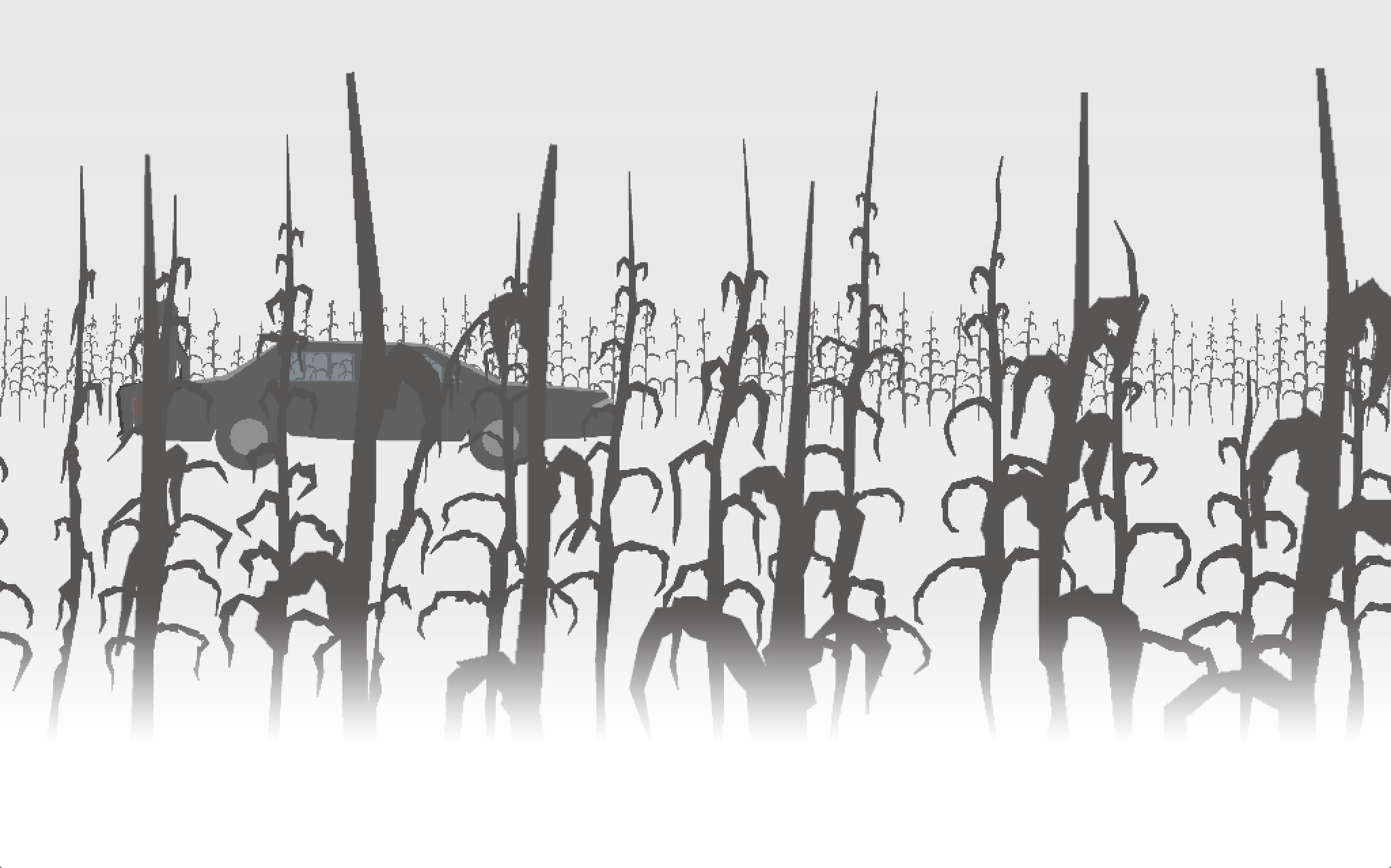
Three Fourths Home is a choice-based interactive story about a young adult named Kelly driving home through the Nebraska rain while carrying on a telephone conversation with her mother (and, as Mom passes the phone around, other members of the family). With music, sound effects, and illustration, it’s more lushly constructed than the average Twine game, but offers the same general style of play.

The conversation is simple menu-based stuff, usually with two or three available options, but — a little like Coming Out Simulator 2014 — Three Fourths Home also uses animation and location imagery to remind you constantly of where you are, as your car slides down the road between corn fields and past water tanks and into gathering darkness. While you play, you have to actively keep driving your car, or the whole story slides to a stop. Driving only consists of holding down a single button, but I found this was a good physical representation of being slightly distracted by an ongoing task. Sound effects also present some environmental distractions.

Continue reading “Three Fourths Home ([bracket]games)”

Loose Strands (Darned Sock Productions) and Mapped CYOA

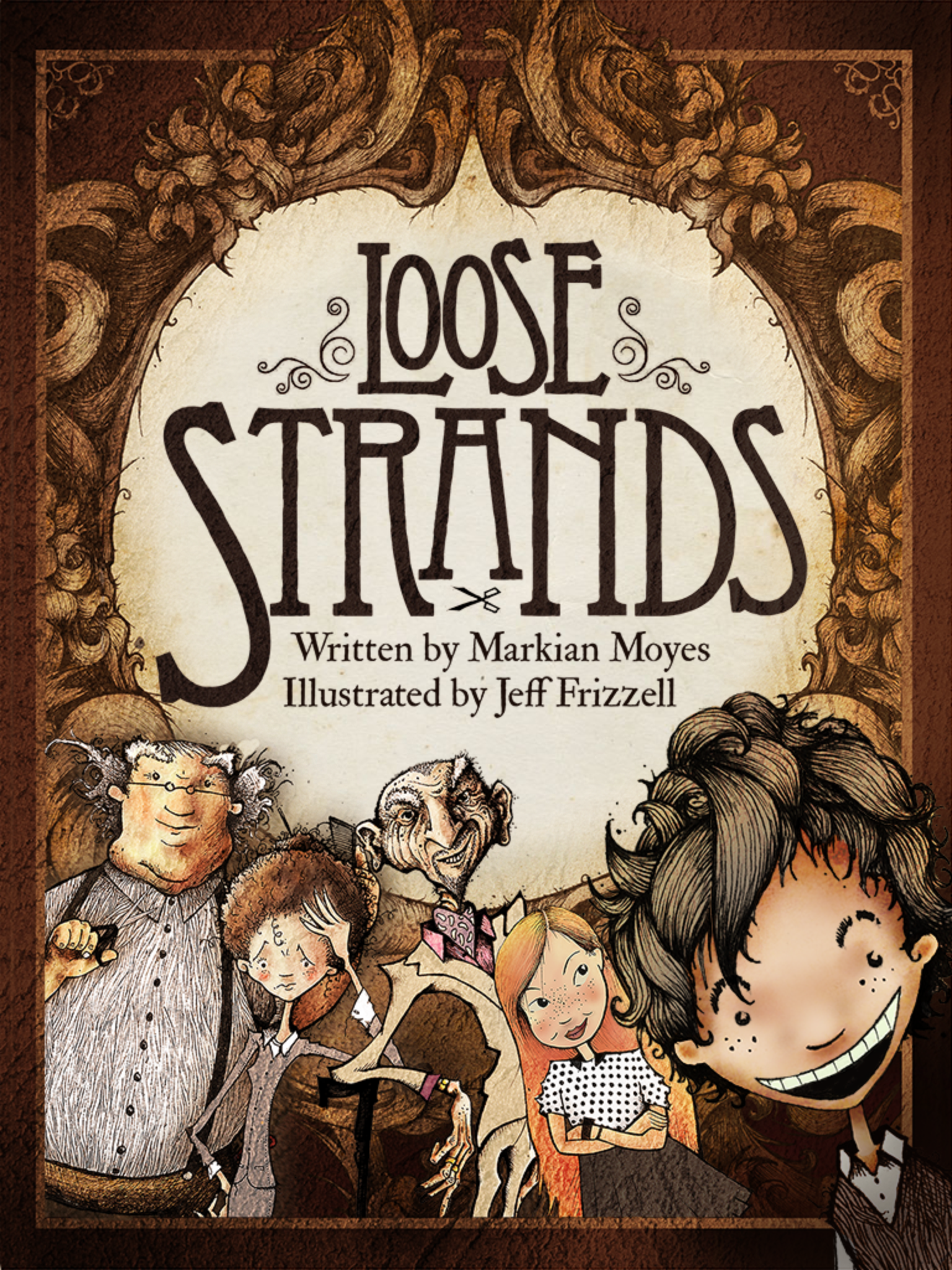
coverphotoLoose Strands is a choice-based interactive story app for kids ages 9+. It tells the story of Roland Bartholomew Dexter the Third, a boy who lives in an impoverished barbershop and is never allowed to go outside. His parents fashion clothes and even food out of hair leavings. Since he can’t go outside to school, he reads books about history and dinosaurs and airplanes, but these books have been so rigorously censored that they aren’t much fun. It never seems to be his birthday.

The only bright spot, if you want to call it that, is that Roland has unusually vivid dreams about the might-have-beens, the things that would have occurred if only he’d made a different decision from the one he did take.

Loose Strands is a story about regret: about being debilitated by the desire to erase the past, or, conversely, plagued by the inability to learn from our mistakes. It handles this with a kind of Lemony Snicket gloss. The villain is cartoonishly evil, the world a fantastic rendition of a totalitarian dystopia. The characters are charming, but not enormously nuanced. Now and then the narrator addresses the reader in a condescending Let Me Tell You About The World fashion, and the pacing around the end of part 1 felt a bit slow to me. Nonetheless, it’s a story about the nature of choices that makes a strong use of the choose-your-path structure.

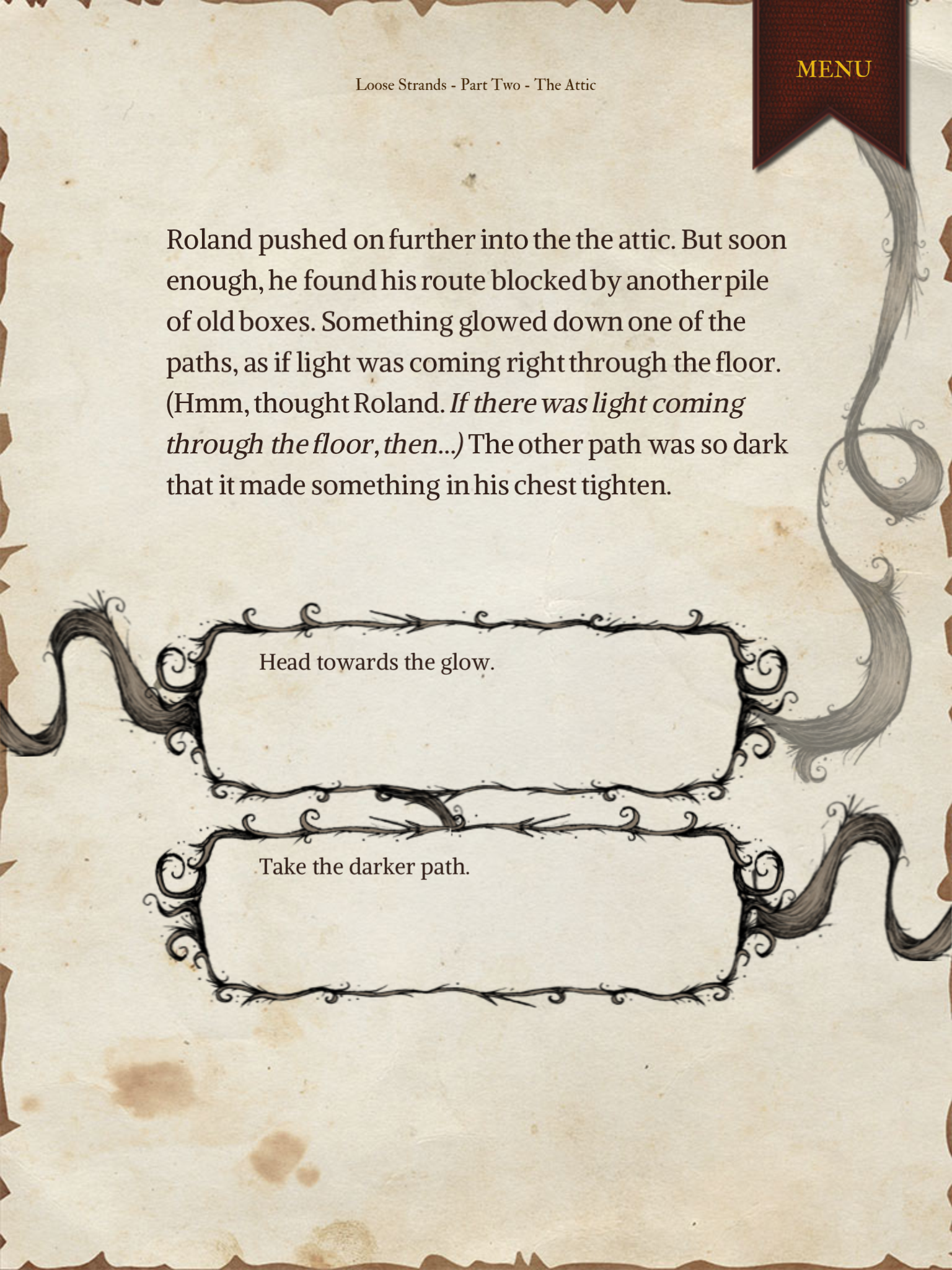
Whenever you get to a choice point, you can swipe the page in one of two (or occasionally three) directions in order to proceed to the next portion:

choicephoto

And when you’ve made a choice, the book immediately zooms to the overall story map and blacks out a bunch of spots — showing you how your decision has prevented you from ever seeing certain possible futures. It’s partly a reminder that what you do matters, a “Clementine will remember that” tag — but it’s expressed in an explicitly negative way.

Loose_strands_photo

Likewise, you can sometimes use the map to go to an earlier page, but if you’re trying to rewind too much, you’ll get a message saying you’re not allowed to go back.

Continue reading “Loose Strands (Darned Sock Productions) and Mapped CYOA”