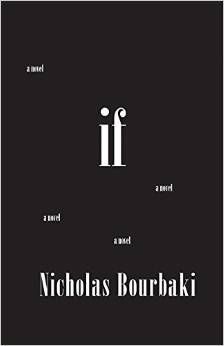
 “This author sent me a review copy of his CYOA novel.” I took the book out of its wrapper and held it up.
“Nicolas Bourbaki doesn’t exist,” my husband said. “He’s an invention.”
Someone had handwritten the enclosed note. I shrugged. “Maybe this guy really has that name.”
We were both wrong, as it happens; as this interview explains, Bourbaki-the-author assumed, with an extra h in the first name, a shadow of Nicolas Bourbaki the collective of pseudonymous mathematicians. His book, If
If sometimes embraces, sometimes rejects standard CYOA practice. It’s written in the second person, mostly, except when a first-person narrator crops up by surprise and many pages into the story: this first-person character is a bully, and for as long as we remember that he exists, the whole narration feels like a mean-spirited harangue against the protagonist. The main character also floats between characterization and Faceless Protagonism: he has a gender and passes through a specified series of ages, but some characteristics are intentionally withheld. On page 192, a character refers to him by name, though on page 194 we discover that this was a false identity anyway.
But having a name would probably pin the protagonist down in the wrong way. If belongs to that particular subgenre of IF whose overt hook is the opportunity to reach radically different life outcomes from the same starting point: works like Life’s Lottery


 Emily Short's Interactive Storytelling