Donut County (Ben Esposito)

Screen Shot 2018-08-29 at 10.31.55 AM.png

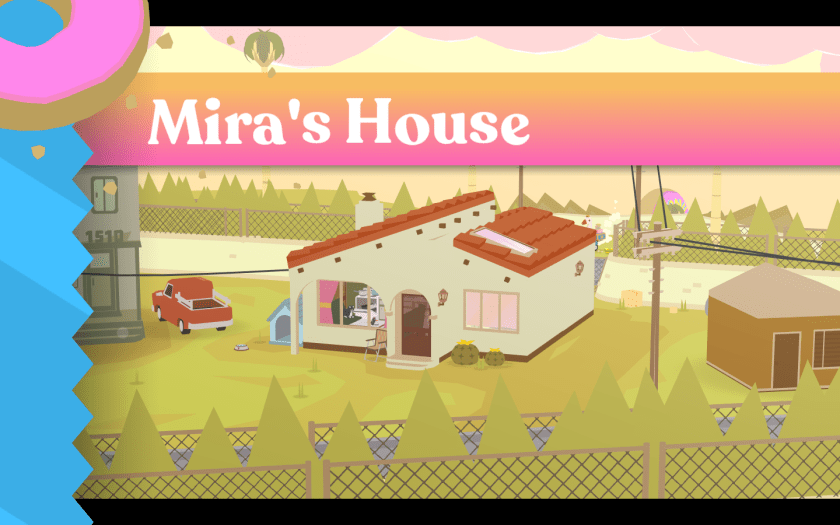
Donut County is a mellow casual puzzle game wrapped in story. The gameplay: you control a hole moving across the ground. If you place it under something small enough to fall in, the object vanishes below, and the hole gets bigger. It’s Katamari-esque, but there are some nifty extra effects: the hole can fill with water, which makes things float on the surface; sometimes items that are in the hole give off smoke or fumes, or leave appendages sticking out, which you can use to affect the environment in new ways. (Note for new players, by the way: I initially found the gameplay a little sluggish, but going to the settings and turning control responsiveness up to maximum made it a much more natural and enjoyable experience.)

The story? This is all a game-within-a-game presented within a flashback, with multiple protagonists, sort of. Let me start from the beginning because there’s a lot to unpack here.

Donut County begins with a frame story that everyone in town is living at the bottom of the hole, after six weeks in which this hole has been terrorizing the community. Mira, a human, blames BK, a raccoon who has all this time been playing an addictive video game that involves hole manipulation (and just incidentally manages to really swallow things in the real town). BK also happens to run a donut shop, and the hole tends to turn up whenever anyone orders donut delivery at home.

As you, the player, play levels of Donut County, you receive experience points and rewards that correspond to the in-game points BK is trying to accumulate; and then you cut back to the frame story in which the denizens of Donut County are talking about what has happened to them over the past few weeks and whose fault it all is.

This makes for one of the most convoluted triangle-of-identity problems I’ve yet seen. The framing introduces an undercurrent of unease and self-doubt in what is otherwise a relaxing, candy-pink game of playful destruction.

Where do you-the-player stand in all this? Are you BK, playing the game and destroying the entire community? Are you one of the other townspeople or perhaps Mira herself, telling the story of how the gameplay destroyed the community, a kind of interactive reenactment? Is there a possible redemption in store after you’ve done all this? Should you maybe stop being a hole?

I want to talk about where the story goes from there, but this will involve spoilers, so let’s have a break first.

Continue reading “Donut County (Ben Esposito)”

Video Game Writing From Macro to Micro (Marek Walton / Maurice Suckling)

videogamewritigVideo Game Writing from Macro to Micro. This book bills itself as “four books in one,” and this is not wrong. Part I covers a history of games with a focus on story and storytelling. Part II concerns day-to-day concerns of game writing as a career — the fact that Part II starts with briefs, contracts, non-disclosure agreements gives some idea of the granularity and the focus on the nuts and bolts of doing business as a freelance games writer. Part III, “Beyond the Basics,” backs out again and looks at the theoretical basis of the discipline — why should games have stories? — as well as craft considerations like how we fill a story world with dramatic potential. And Part IV, the briefest and most varied section, pulls together statements from working game writers about what their job is, how it functions, and what the lifestyle is like.

The summary in Part I goes from the 70s, with Colossal Cave, through a year or two ago, landing on Her Story and Until Dawn. It’s a good overview, though most titles get no more than a paragraph or two, and the book is mostly interested in setting up some sense of market context, genre, and the major strengths, innovations, or weaknesses of each title. It doesn’t particularly dig into individual games to take apart how they worked as instances of narrative design. People who are already pretty familiar with the game industry and game history may find this to be largely review.

Continue reading “Video Game Writing From Macro to Micro (Marek Walton / Maurice Suckling)”

An Incomplete List of Things I’d Need to Know In Order Not to Be A Total Impostor

In honor of folks freaked out about how many things they “have to” do to advance their career, I present a very partial list of things I’ve been encouraged or expected to do/know since I got into games.

Not shown: which of these were fantastic advice, which were legit job requirements, and which were gatekeeping.

  • history and canon of literary hypertext in the 90s
  • improv technique
  • theories of narratology
  • all works of Infocom, Scott Adams, Melbourne House, Magnetic Scrolls, etc
  • canon and design trends in CYOA and gamebooks
  • who’s who in Oulipo
  • history of text adventures in languages other than English
  • state of digital humanities as a field
  • Prolog, Answer Set Programming, and other logic programming approaches
  • general history of table-top roleplaying game development and some rough concept of what goes on in LARP design both North American and Nordic
  • Agile dev practices and a bunch of specific associated software and systems
  • every game ever submitted to the IF Comp in its 24 years of history
  • transmedia: what are/were the major projects, what are/were the tools, why haven’t we heard so much about it lately
  • running safe and inclusive spaces, codes of conduct and the arguments concerning these
  • nonprofit fundraising and institutional development
  • JavaScript
  • who is working on narrative games, game AI, or procedural generation at the academic, indie, and AAA levels in the US and Europe and ideally elsewhere also
  • freelance scheduling, billing, networking, insurance, accounting, marketing and time-management strategies
  • recent developments in interactive video and audio
  • conversational pragmatics
  • stage magic techniques
  • C#
  • norms of participation in academic conference program committees and journal reviewing
  • marginalized authors in games and IF, and standout works that capture unusual experiences
  • the landscape of London games/writing/journalism/TV/radio personalities specifically
  • escape room design and canon
  • interactive documentaries, canon and tooling
  • roguelites
  • the complete oeuvre of Telltale
  • locational games, canon and tooling
  • Lua
  • every game that’s nominated for an IGF narrative award or other industry writing award, whether or not I was on the judging panel at the time
  • uses of interactive storytelling in museums and cultural heritage sites
  • who’s who in speculative fiction and what they’re doing these days
  • standard wisdom about running startups, MVPs, and attracting investment
  • ontology and knowledge representation
  • writing for voice actors
  • accessible app design for narrative-heavy apps
  • art direction
  • educational game design and requirements for school-facing projects
  • design practices for VR and AR
  • how to deal with being interrupted repeatedly, and other apparently gendered behavior that is hard to call out in the moment
  • TADS, StoryNexus, StorySpace, Varytale, Twine, ink, Tracery, Texture, Unity, Unreal, GameMaker Studio, Hugo, Alan, Quest, Ren’Py, AIML, ChatScript, and assorted specific modding tools; how to plug these together, in some cases
  • physical object storytelling, both in terms of common practice and in terms of production methods
  • theme park design
  • assorted visualization tools, now mostly JavaScript-based, though at one point there was a trend for Processing
  • IF and narrative game publishing venues
  • government grant application processes
  • typography and layout
  • Tableau
  • public speaking skills
  • board games with a narrative or storytelling element
  • every “blockbuster” AAA game
  • natural language processing methods; NLTK, assorted online APIs
  • attend GDC, SXSW, PAX, PAX East, E3, IndieCade, Practice, GamesCom, Amaze, Develop, EGX, AdventureX, Feral Vector, ELO, ICCC, ICIDS, FDG, AIIDE, DiGRA, INT, et al. (yearly)
  • narrative content design for MMOs
  • history and current status of academic research programs in procedural narrative
  • trends and marketing concerns in children’s interactive ebooks
  • machine learning methods and tools
  • how to write a literary novel that would garner respect, e.g. by winning the Man Booker Prize
  • everything that would be taught in an undergraduate computer science course
  • immersive theatre, what the major shows are and how they work
  • assorted specific culture references, especially WestworldHarry Potter, and Game of Thrones
  • advergaming and viral marketing game tie-in methods
  • how to write a popular novel that would make buckets of money and appear on the NYT bestseller list
  • assembly language
  • narrative design for free to play systems
  • alt controller design
  • how to wear clothes as a woman at an industry event
  • current market size and revenues from interactive fiction games and narrative-heavy games
  • Alexa skill creation
  • Personal Brand development
  • computational creativity theories and practices
  • dozens of books of writing and design advice for game writers, screenwriters, novelists, etc, etc
  • computational paralinguistics
  • which parties to go to at GDC and how to get in
  • detailed CV of the person I just met, who is no doubt famous, but unknown to me
  • C++
  • Zizek