End of September Link Assortment

ifcomp.png

IF Comp is here!  As of October 1, games are public and will be available for play and review.  Voting ends November 15.

From Now – February 24, 2019, the Victoria and Albert Museum is featuring an exhibit on contemporary video games.

On October 3, Tellables CEO Amy Stapleton is speaking on conversational storytelling at Digital Book World in Nashville, TN.  Stapleton also writes the Voice First Fiction blog.  The conference runs October 2-4.

October 6 is the next SF Bay IF Meetup.

October 6 is the Oxford and London gathering to play games from IF comp.

Also October 6-7, Roguelike Celebration is coming up in San Francisco — this is obviously a bit different from IF material, but there’s some interesting procedural storytelling work that comes up in this space. This year their speakers include Tarn Adams, Pippin Barr, and Max Kreminski, all people who have turned up on this blog/in IF circles before.

October 11 is the next Boston IF Meetup.

October 12-14, Worcester Polytechnic Institute is hosting the Different Games Collective, focusing on diversity and inclusivity in games.

October 19-28 is the submission window for the fifth annual PROCJAM, seeking entries for generative software.

October 20 is the Oxford and London workshop in the Ren’Py tool for building visual novels.

October 22 is the deadline for Saugus.net’s 21st Annual Ghost Story Contest.  They accept both traditional prose entries and IF.  Official rules can be found here.

Ectocomp is taking both Spanish and English-language submissions for their competition from October 26-30, but if you want to start work on your game through the site, it is open now.

November 10-11AdventureX will return, this time at the British Library. AdventureX is a conference focused on narrative rich games, whether those are mobile or desktop, text-based or graphical; it’s grown significantly in size and professionalism over the last couple of years. (Incidentally, they’ve published their exhibitor list and it’s pretty sweet.)

December 2 is the deadline for entering the Russian Language IF competition KRIL.

December 5-8 in Dublin is the next ICIDS, the international conference on interactive digital storytelling.

This is long in advance, but NarraScope is a recently-announced conference for IF and narrative games to be held in Cambridge, MA June 14-16 of 2019. Here’s how they describe it:

NarraScope is a new games conference that will support interactive narrative, adventure games, and interactive fiction by bringing together writers, developers, and players.

For users of   ‧ AGS ‧ ChoiceScript ‧ Hypertext ‧ Inform ‧ Ink ‧ Quest ‧ Ren’Py ‧ Storyspace ‧ TADS ‧ Twine ‧ …add yours? ‧

“Interactive fiction” has many meanings. It describes many kinds of games and many diverse communities of practice. It’s time to bring those communities together to hang out and chat exchange ideas!

For fans of   ‧ Zork ‧ The Walking Dead ‧ The Uncle Who Works for Nintendo ‧ Syberia ‧ Sorcery! ‧ Portal ‧ Photopia ‧ Patchwork Girl ‧ Oxenfree ‧ Myst ‧ Meanwhile ‧ Loom ‧ Lifeline ‧ Howling Dogs ‧ Gone Home ‧ 80 Days ‧ Dream Daddy ‧ Device 6 ‧ Counterfeit Monkey ‧ Choice of Broadsides ‧ The Blackwell Legacy ‧ Analogue: A Hate Story ‧ Adventure ‧

We are still finalizing the details of the venue and schedule. We expect to be in Cambridge, in coordination with MIT’s Comparative Media Studies and Writing department. A call for speakers and talk proposals will be posted soon.

*

New Releases

baroque408.png

Mad science raised you from the dead!  William Brown’s 200,000-word interactive Gothic horror novel Mysteries of Baroque is the latest title on Choice of Games.

Charles A.F. King has released the underwater adventure Soviet Seafloor Station Ustritsa, a Choose Your Own Fate gamebook set in the Cold War-era Atlantic.

Lamplight City is a point-and-click detective adventure with a steampunk flavor, just recently out.

Google also has made an easter egg text adventure which you can find if you follow the instructions outlined here.

Articles and Podcasts

Bruno Dias talks about writing scenes in IF.


Crowdfunding

The Colossal Fund is raising money for IF Comp prizes this year, and also to support the regular work of the IFTF — including archive support, Twine development, and accessibility improvements for interactive fiction games and tools.

You may also like the look of Nighthawks, the Vampire RPG, featuring the writing of Richard Cobbett (Fallen London, Sunless Sea, et al) and created by Wadjet Eye (numerous point-and-click adventures).

Publishing

Mythaxis is seeking IF to include in its upcoming February 2019 issue; however, it does not pay.

IF for certain moods, and a couple of IntroComp games

This was originally just going to be a post about IntroComp — I wrote it up a little while ago and scheduled it. But the post as originally written now feels slightly tone-deaf; I’m feeling a bit emotionally drained and stressed by the past week in American politics, and I know a lot of my friends are too. So if you’re in a similar place:

If you could use something warm and fuzzy to play right now:

  • S. Woodson’s Beautiful Dreamer and Magical Makeover are gentle but engaging fantasy.
  • Many of Ryan Veeder’s works are playful in a cozy way, especially Dial C for Cupcakes.
  • Brendan Patrick Hennessy’s work is full of teenagers figuring out how to treat each other better, and is also frequently very funny. If you haven’t played the four-part Known Unknowns, now might be a good time for that.
  • Steph Cherrywell‘s games are full of young women winning out and having adventures.
  • Tentacles Growing Everywhere (Dietrich Squinkifer) is a short-ish game about alien puberty that I found pretty sympathetic.

If you need something smart and funny:

  • Reigns: Her Majesty is all about female negotiations of power, and the accommodations made to deal with it.

If you need something visceral about trauma and survival:

If you need something about the long game of politics and the role of women:

  • Liza Daly’s Harmonia is a story about utopianism and the experience of women, past and present.

Continue reading “IF for certain moods, and a couple of IntroComp games”

TextWorld (Inform 7 & machine learning)

Inform 7 is used in a number of contexts that may be slightly surprising to its text adventure fans: in education, in prototyping game systems for commercial games, and lately even for machine learning research.

TextWorld: A Learning Environment for Text-Based Games documents how the researchers from Tilburg University, McGill University, and Microsoft Research built text adventure worlds with Inform 7 as part of an experiment in reinforcement learning.

Reinforcement learning is a machine learning strategy in which the ML agent gives inputs to a system (which might be a game that you’re training it to play well) and receives back a score on whether the input caused good or bad results. This score is the “reinforcement” part of the loop. Based on the cumulative scoring, the system readjusts its approach. Over many attempts to play the same game, the agent is trained to play better and better: it develops a policy, a mapping between current state and the action it should perform next.

With reinforcement learning, beacuse you’re relying on the game (or other system) to provide the training feedback dynamically, you don’t need to start your machine learning process with a big stack of pre-labeled data, and you don’t need a human being to understand the system before beginning to train. Reinforcement learning has been used to good effect in training computer agents to play Atari 2600 games.

Using this method with text adventures is dramatically more challenging, though, for a number of reasons:

  • there are many more types of valid input than in the typical arcade game (the “action space”) and those actions are described in language (though the authors note the value of work such as that of BYU researchers Fulda et al in figuring out what verbs could sensibly be applied to a given noun)
  • world state is communicated back in language (the “observational space”), and may be incompletely conveyed to the player, with lots of hidden state
  • goals often need to be inferred by the player (“oh, I guess I’m trying to get that useful object from Aunt Jemima”)
  • many Atari 2600 games have frequent changes of score or frequent death, providing a constant signal of feedback, whereas not all progress in a text adventure is rewarded by a score change, and solving a puzzle may require many moves that are not individually scored

TextWorld’s authors feel we’re not yet ready to train a machine agent to solve a hand-authored IF game like Zork — and they’ve documented the challenges here much more extensively than my rewording above. What they have done instead is to build a sandbox environment that does a more predictable subset of text adventure behavior. TextWorld is able to automatically generate games containing a lot of the standard puzzles:

Screen Shot 2018-08-26 at 2.19.51 PM.png

Continue reading “TextWorld (Inform 7 & machine learning)”

Quarantine Circular (Bithell Games)

Screen Shot 2018-08-26 at 12.50.07 PM.png

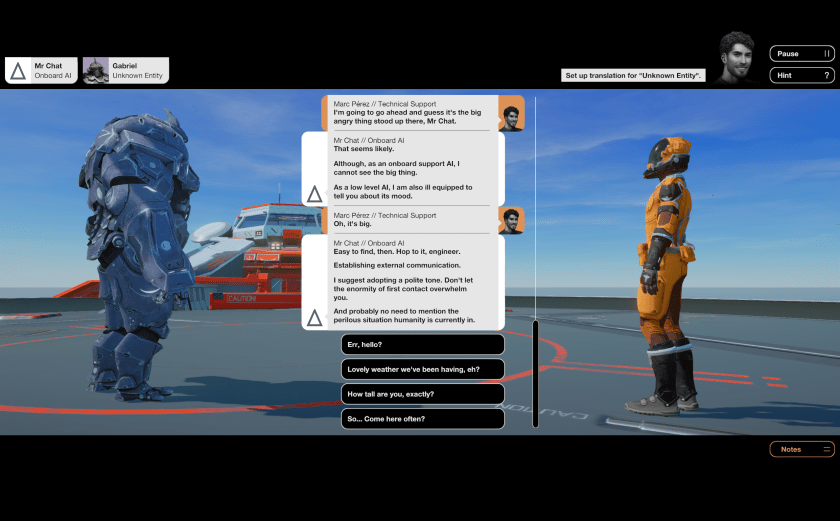
Quarantine Circular is not a sequel to Subsurface Circular, but is very much an extension of the same core concept: a dialogue-driven game with dialogue menu and topic inventory, plus a lot of polish. In a few select places the topic inventories even allow you to combine concepts, constructing questions with multiple facets.

It’s less puzzle focused than Subsurface Circular, though, and more ambitious in the way it simulates social circumstances. You’re often talking to multiple parties at once, and things that please one character may irritate another in the same conversation. The story is less linear, as well: there’s more room to make choices early in the interaction that may have some long term effects. Meanwhile, the handling of the protagonist has shifted. Subsurface Circular has the player play a single character. In Quarantine, you take on several different viewpoint characters — though you may have limited access to those characters’ true understanding and motivation.

So mechanically, this has a lot of features that appeal to me — more than the original did. But that meant shifting more focus onto the fiction, and that didn’t bear up quite as well as I would have liked.

Continue reading “Quarantine Circular (Bithell Games)”

Mid-September Link Assortment

154922_newnew_a
From “Design/Play/Disrupt” at the Victoria & Albert

Entries for IF Comp are due the end of this month.

From Now – February 24, 2019, the Victoria and Albert Museum is featuring an exhibit on contemporary video games. I saw this on a preview night, and it is terrific — so much so that I feel like I need to go back because I didn’t take it all in on the first visit.

Some of it is a picture of the process and considerations of design, with notes and concept art from games all along the indie/AAA spectrum. Some is a reflection on the social context of games and the voices of the people who make and play games: a room full of video clips and thoughtful statements from folks I’ve often linked on this very blog. The third section is about esports — about the size and the spectacle. Where the design section feels intimate and draws you in to look closely at small and intricate objects, the esports room has you to sit down below a huge curved screen playing footage of a match in South Korea, in a position that commands awe. But then the exhibit gives you your agency back again: the final section is a Babycastles-affiliated room with an arcade box where you can play QWOP (among many other things).

It is the first exhibit about video games I’ve seen at a major institution that felt like it was about the video games I know, not purely as a nerdy curiosity or as a commercial phenomenon (though there’s plenty of commercial work there), but for their culture, their design, their power to attract and connect people.

Along with many many other people at different times, I had a small advisory role in giving input on this exhibit, but at the time I was blown away by the thought and care going into the design, and the final result is better than I could have imagined. If you’re in London and can spare the exhibit fee, do check it out.

September 19 is the next Boston IF Meetup.

September 22 is the next Baltimore/DC Are IF Meetup, discussing Kevin Gold’s Choice of Magics.

October 6 is the next SF Bay IF Meetup.

October 6 is the Oxford and London gathering to play games from IF comp.

Also October 6-7, Roguelike Celebration is coming up in San Francisco — this is obviously a bit different from IF material, but there’s some interesting procedural storytelling work that comes up in this space. This year their speakers include Tarn Adams, Pippin Barr, and Max Kreminski, all people who have turned up on this blog/in IF circles before.

October 19-28 is the submission window for the fifth annual PROCJAM, seeking entries for generative software.

October 20 is the Oxford and London workshop in the Ren’Py tool for building visual novels.

October 22 is the deadline for Saugus.net’s 21st Annual Ghost Story Contest.  They accept both traditional prose entries and IF.  Official rules can be found here.

November 10-11, AdventureX will return, this time at the British Library. AdventureX is a conference focused on narrative rich games, whether those are mobile or desktop, text-based or graphical; it’s grown significantly in size and professionalism over the last couple of years. (Incidentally, they’ve published their exhibitor list and it’s pretty sweet.) At the time of writing, weekend passes and Saturday passes are sold out, but there are still a few places for Sunday.

December 2 is the deadline for entering the Russian Language IF competition KRIL.

*

Continue reading “Mid-September Link Assortment”

Mailbag: Deep Conversation

This one was a follow-up question to the asker wondering whether Blood & Laurels was still available anywhere. (It isn’t.)

If there are any other games (IF or otherwise) that you’d recommend for deeper conversational experiences, I’d love to hear about those… I have a rather broad set of interests there, so anything you find especially exciting, new or odd would be great to hear about, especially where conversation is at the center of the game.

…right, okay. Well, that’s quite a broad field, but here are some possibilities, preferring more recent games (though interesting conversation games go back for quite a while).

Exploration-focused Dialogue

Parser-based conversation games are often designed to let the player explore concepts that interest them, treating the non-player character like a big encyclopedia rather than a goal-oriented partner in dialogue. That tradition goes back — well, back to the 80s, really, since Infocom’s murder mysteries allowed you to ask characters about important subjects and clues.

A few more recent examples that are either carry some of this concept over to a different interface or allow a different spin on it:

Screen Shot 2018-08-25 at 7.34.33 PM.png

Subsurface Circular (above) and Quarantine Circular are both primarily conversation games. Subsurface Circular has some embedded puzzles in the dialogue, including puzzles around manipulating emotional states and the knowledge of both the PC and other characters. As you find out new things, you gain “focus points”, an inventory of topics that you can introduce into conversation.

Speaking of manipulating emotional states, that’s really the primary approach in The Red Strings Club: you mix drinks for NPCs to affect their emotional status, then ask dialogue-tree questions.

Continue reading “Mailbag: Deep Conversation”