Tabletop Storygames: Shooting the Moon

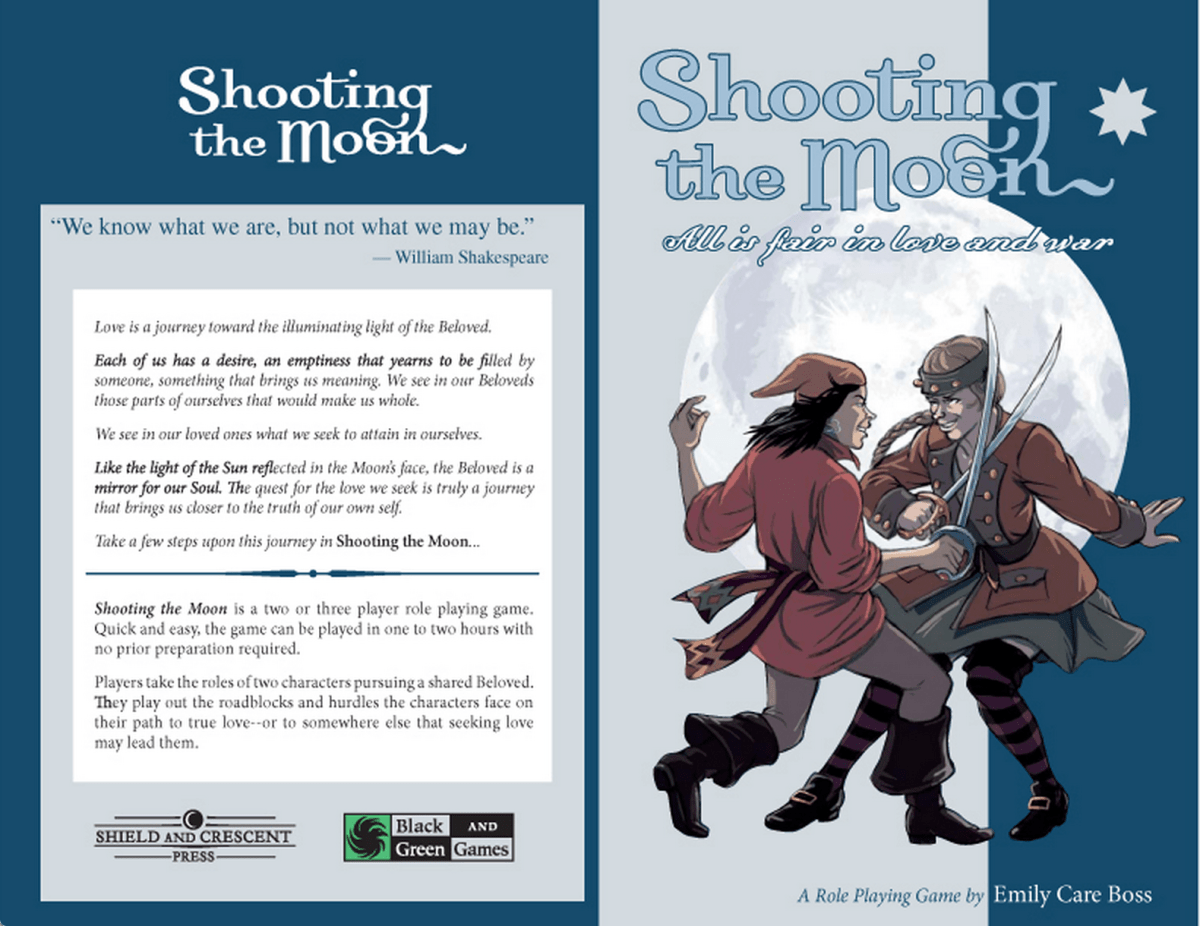
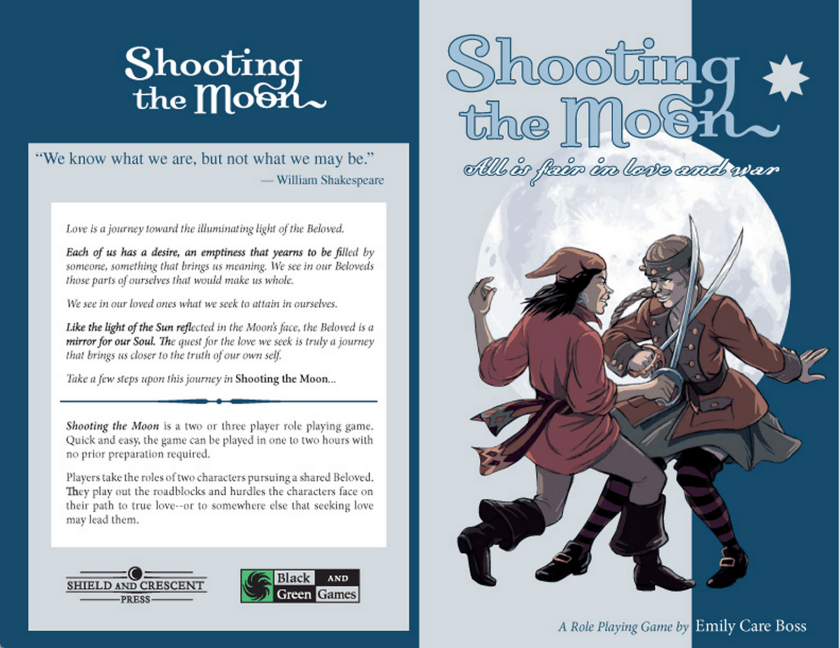
Shooting the Moon is a tabletop storygame about a romantic triangle, which I first heard of on Sam Kabo Ashwell’s recommendation (and indeed played with Sam). The two suitor characters compete to get something (probably love and affection, but conceivably something else) from the third, “beloved” character.

Continue reading “Tabletop Storygames: Shooting the Moon”

Choice-based Narrative Tools: Twine

The prevalence of Twine in the most recent IF Comp, together with some discussions with Porpentine (author of howling dogs), made me give it another try. For those who aren’t familiar with its output, it’s designed for building CYOA or hypertext; it creates a website output that the author can then choose to customize with standard HTML/CSS tools, or leave as-is.

Twine has been around for quite a while. Some time back, I tried it out and couldn’t get it to run properly on a Mac. This time, I had no difficulty installing and running it, so whatever updates have occurred have resolved at least my problems.

Continue reading “Choice-based Narrative Tools: Twine”

Sparkly IF Reviews

Sparkly IF Reviews is a new interactive fiction reviewing site that I have started with a growing list of other contributors. The name is silly, but I’m entirely serious about the aim of the site, which is to provide a safe-for-authors space that focuses on recognizing successful or cool things in IF, cheerleading new contributors, and letting people know what was appreciated. The concept of the site is to feature positive, sincere feedback; short-form and long-form are both totally acceptable.

This project springs from my feeling that the IF community, for all its resources, lacks the nurturing aspect that a lot of fandoms and hobbyist art and craft communities have. Writing IF is hard. Putting IF in public is an act of courage. And while I think it’s important for us to be writing reviews that critique craft and conceptual content, and that curate the best work for the attention of players who might not otherwise find it, we really need the encouraging aspects also.

I want to emphasize, though, that I don’t see this as somehow a kiddie website where people review games that are not good enough to be reviewed elsewhere. Rather, it’s meant to create a different context of discussion — and that can be freeing even when you’re talking about a game that you thought was really strong. Most of my reviews are pitched to potential players as much or more than they’re pitched to the original author, and so they do a lot of explaining and describing, and attempt to catalog thoroughly any flaws or issues that I think might affect a player’s decision to play that game. Sometimes it’s very pleasant to be able to step aside from that and just write about what I liked, for the ear of the author. Possibly other reviewers will find they like that too.

And from an author’s point of view, it’s meant to create a safe context of discussion. I’ve released enough games to know what it’s like seeing a link to a review of your game and to hover apprehensively before clicking, nerved against feedback that might be exciting… or might make your heart sink. This is meant to be Not That.

Currently on the site, you’ll find reviews by me, Zach Samuels, and Sam Kabo Ashwell. They touch on Changes, Valkyrie, Escape from Summerland, howling dogs, J’dal, Signos, and Fish Bowl from the current IF Comp as well as the Ectocomp game Beythilda the Night Witch and the Andromeda Legacy game Andromeda Dreaming.

If you choose to comment, please respect the concept of the site. I will moderate as necessary to keep it a safe place. There are plenty of other places suitable for critical and unmoderated discussion.

Finally, if you like the idea, more contributors are welcome; let me know if you’d like to be involved in the project. I’d be especially pleased to get coverage of the remaining IF Comp games this year.

I would also welcome positive content about things other than games. So if you have a beloved tool, extension, feature, etc. that you want to praise, that would be suitable too. (That reminds me I should write a post entitled David Welbourn’s Walkthroughs Are Freaking Awesome.)
Rat Chaos (j chastain)

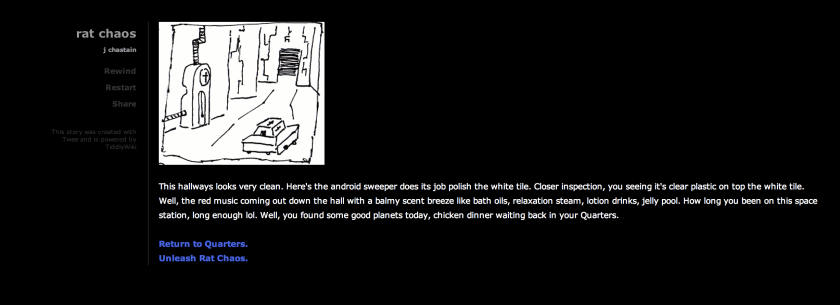
Rat Chaos is a very short Twine piece. It plays with agency not in the usual ways (discovering you have none, playing with how the protagonist refuses to claim agency, or revealing that the only meaningful agency the player can have is to quit the game). Instead, Rat Chaos explores the idea of surface agency as a distraction; the notion that solving the more obvious problems might be a way to shut someone up, to avoid listening to the deeper things they have to say. The first couple of screens may seem bewildering, but it’s a quick play whose significance reveals itself after not too long.

Winterstrike (Yoon Ha Lee)

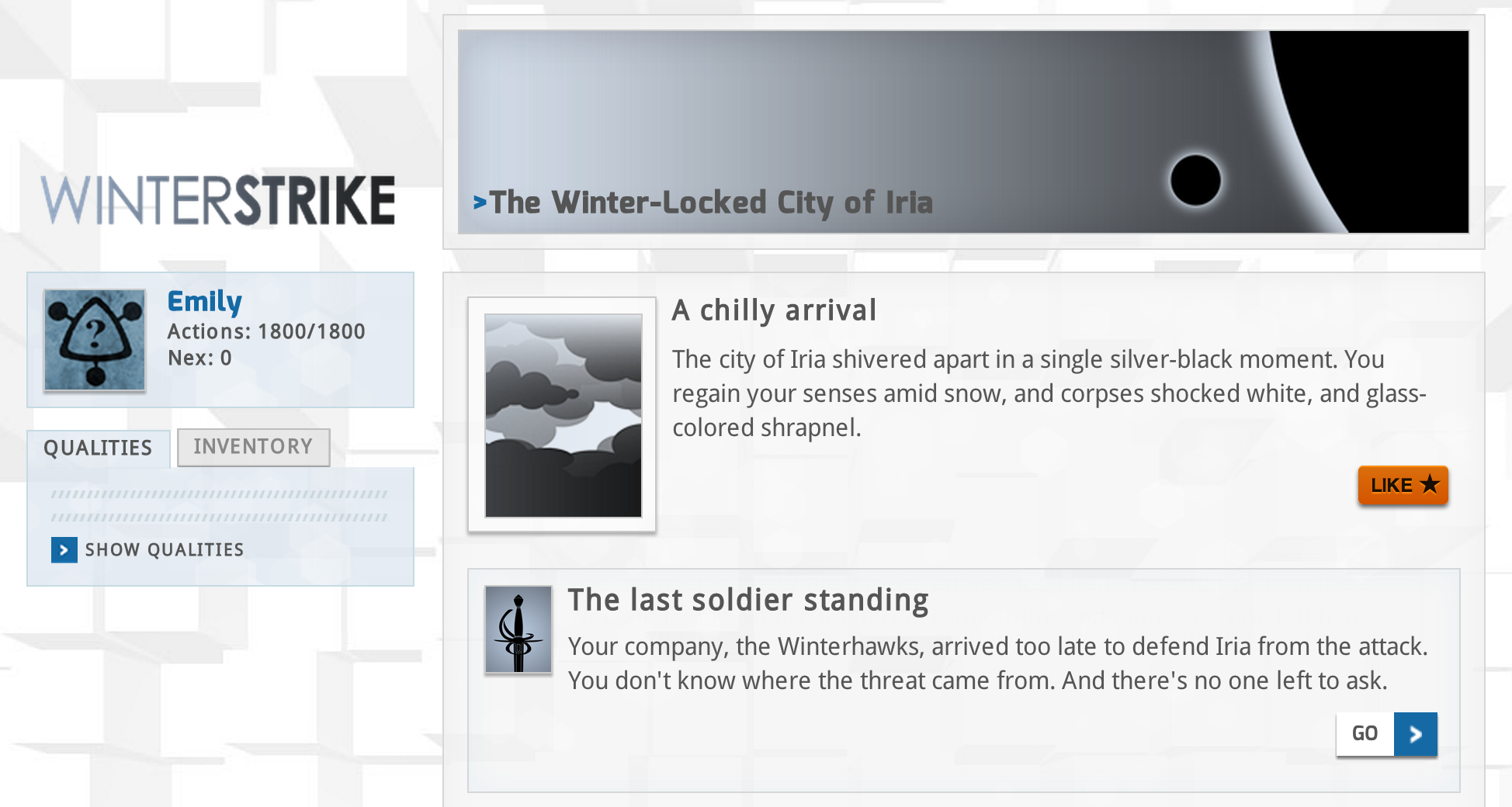
Winterstrike is a StoryNexus world by Yoon Ha Lee, the SF/fantasy author whose previous IF work includes the art-show piece Swanglass and the evocative, elegant The Moonlit Tower.

Winterstrike takes that same gift for imagining a strange and alien world and presents it via StoryNexus mechanics: Iria is a city of etiquette and technology. It used to have spaceships and dueling clubs, architects and soldiers. Now suddenly it is oppressed by a heavy unnatural winter, the result of an act of war, though it is not clear who made such an attack, nor how. Bodies are frozen; buildings are broken; there isn’t enough hot food to go around. It’s not immediately clear how many races of creatures inhabit the city, let alone what their allegiances might be. Hints about the nature of the world accumulate slowly.

Plot grips less strongly here than in Samsara — at least during the opening stages. There are fewer of the pinned cards that represent ongoing plot threads. Some come in time, but to start with there aren’t many options of that kind. Instead, playing Winterstrike resembles exploring a foreign city when one has no special agenda of one’s own. A market, a street performance, an attempted crime, an interesting ruin capture the protagonist’s attention and then let it go again.

Meanwhile, the action bank is very generous, which means you can play more of Winterstrike at a time than you can of some SN games — a good move, I think, because it allows the player a little more scope to begin putting together clues and fragments before an enforced hiatus helps her forget them again.

As with Fallen London, the player character seems to be intentionally short on allegiances and long on self-preservation. Sometimes you have opportunities to act altruistically, take a side, help someone in trouble, but there’s also plenty of freedom to cross the lines and combine multiple strategies. It grows on me more slowly than Samsara did, I have less clear sense of what my character might in the long run wish to accomplish, but in the meantime the worldbuilding and imagery are intriguing, and there seems to be a lot of content to explore.

And a side note which is not really about Winterstrike per se:

I am not quite sure how I feel about StoryNexus’ recurrent use of a pool of iconic images. Playing Winterstrike one finds the same bridge over a river, the same sword, the same flag that make constant appearances in Samsara: now tinted a grim blue-grey rather than Samsara‘s heated gold, but with the same forms. This is a much better outcome than having no art for StoryNexus games — the concept of interchangeable cards more or less requires the player be given some visual distinction between options. And the available set is fairly evocative while at the same time not committing itself too firmly to any one genre. Nonetheless I found myself struggling with the imagery set more in Winterstrike precisely because those images already had meanings for me; it was like trying to hang a second coat on the same peg, associating this new set of story options with the same pictures.

Ectocomp 2012

Ectocomp is a Halloween-themed IF comp, which takes entries just before Halloween and then runs judging through the month of November. All of the games are written in 3 hours or less, which means that they tend to be very brief and a bit on the buggy side. Even with that caveat, though, several of this year’s crop were rather entertaining, and of course none takes very long to play, so it’s worth a look.

If you’re interested, there’s still time to play and vote!

Continue reading “Ectocomp 2012”