Endearing semi-bugs(?) aside, my recent Sims playing has been comparatively uneventful. I played a family through several generations; then, on advice to interact more with the non-active households to watch how those evolve, I set up a larger neighborhood, moved in every family I’d ever created, and spent a lot of time having my active Sims visit the ones that were running by themselves.
The result seemed to be that all the Sim families I wasn’t actively playing immediately got a new baby — presumably by adoption, since none of them acquired new romantic partners or spent any time pregnant as far as I can tell — but that otherwise they seemed rather static. The evil, mean-spirited Lars and humorless, snobbish Lisa still had fights, but still continued to live together until their family left the neighborhood entirely for no reason I could see. They didn’t seem to make changes to their houses, either. Maybe they can’t buy things when I’m not there to buy them new stuff. Or maybe it was just that they weren’t very proactive about job-finding on their own, so didn’t have the cash to make changes.*
Anyway. I’ve spent far more time playing with this than I originally intended to do, and I am still finding lots of neat and unexpected interactions; the amount of detail and care that has gone into the whole game is phenomenal. Many short-term interactions in it turn out to make good anecdotes, too — sometimes because they run into odd corners of the simulation, but not always.
I continue to think that it doesn’t tend to produce good long-term story, because there’s no arc structure. In this respect, it’s being true to what it is trying to simulate: my life also yields the odd anecdote but overall lacks narrative structure.
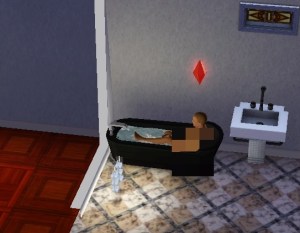 But one day in his early teens, Fred had a mishap: he tried to take a bath when already extremely tired. This led to a strange, locked-in cycle: he kept passing out from exhaustion, then resuming his bath, then passing out again… and he never seemed to finish either task. Eventually he also needed to use the bathroom and get something to eat, but these other needs couldn’t overpower the bath/passing out cycle. I tried various things to snap him out of it — gave him different instructions, tried to cancel some of his orders, sent Dandelion in there to talk to him (and, I hoped, rescue him). No good. After a solid day or so of bathing, Fred started to starve to death, and I reconciled myself to his doom. I did throw Rose a birthday party, hoping that that would at least catch his attention — Sims seem to come running from all over when there’s birthday cake to eat — but instead there was just the rather ghoulish spectacle of the family and friends partying down while upstairs Fred scrubbed and splashed away his last three hours, his starvation clock ticking away.
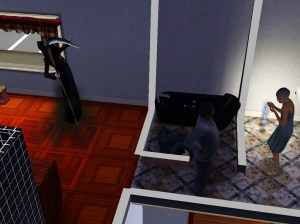 Alas, that bricking up turned out to be all that was needed to snap Fred back to awareness. He got out of the tub and died in his tiny, airless, lightless enclosure. I had to sledgehammer a hole in the new brick wall so that he could be found by his relatives and laid to rest properly.
 Emily Short's Interactive Storytelling