The Harbinger’s Head (Kim Berkley / Choice of Games Hosted)

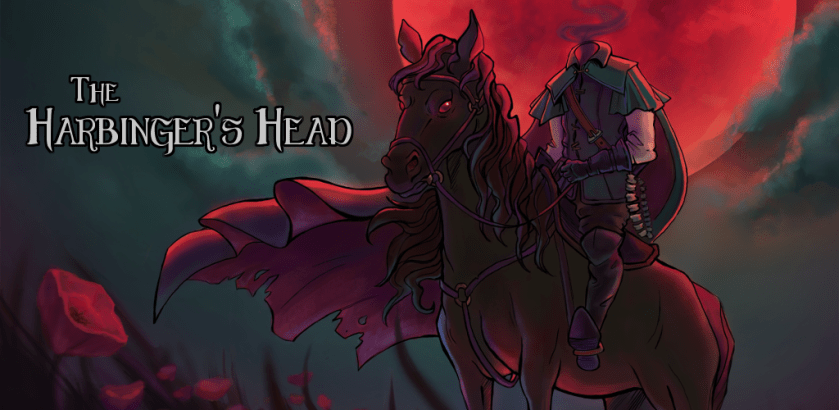
Harbingers Head promo landscape 01 final.png

The Harbinger’s Head is a fantasy horror story from Kim Berkley, in Choice of Games’ Hosted Games category.  It’s set in 1820s Ireland, in which the player encounters a supernatural creature — a kind of headless horseman character — and has to agree to help find his missing head.

The story that follows is focused on action and folklore. You’re partly collecting stories to try to piece together what has really happened in this supernatural situation, but there’s also quite a bit of violence, and one moment where it felt like my protagonist was implicitly under sexual threat, though this passed quickly. Descriptions often focus on the physical, and the game’s text doesn’t hesitate to tell you when you’re supposed to be feeling afraid.

The diction of The Harbinger’s Head sometimes feels substantially more modern than its period — there’s a reference to cutting and pasting something, for instance, and while both concepts individually certainly existed in the past, the paired idiom belongs to the computer age.

But for the most part it does deliver on the folkloric feel. There are several types of faerie creatures, but not your standard vampires and werewolves. Promises are made in desperation and redeemed in less than ideal circumstances. Old bonds of family come into play; so does the conflict between Church and Faerie (though fairly lightly, in the playthrough I experienced).

Continue reading “The Harbinger’s Head (Kim Berkley / Choice of Games Hosted)”

Wonderbook (Jeff Vandermeer)

wonWonderbook is a book about writing — not specific to games, but not unaware of games, either. It takes on many of the standard topics of general-purpose fiction writing guides — plot, character, world-building, revision, the life of the writer, how not to grow to hate yourself in this artform — but with an approach focused on speculative fiction, fantasy, and play. It’s also lavishly, vividly illustrated, with maps and diagrams, portraits and photographs, excerpts of medieval manuscripts, and quite a lot else. There are writing exercises, of several kinds. There are cartoon characters who introduce advice and tips. There are inserted essays and tips from other authors. There are reflections on the history of imaginative literature.

Also, Vandermeer is a good prose stylist, and this is something that cannot be said of all writers of writing books. (You might think…? But no.)

It’s the kind of book that will delight the curious and frustrate the conscientious — since there’s a perennial feeling one might be missing something as one reads. I read it with pleasure, and just a tiny bit of panic that I might be reading it incorrectly and missing things. To be clear, I think this is my problem and not the book’s.

Actually, the book calls me out on precisely this, in its way:

Inherent in this idea of “play” being immature and frivolous is the idea that just like business processes, all creative processes should be efficient, timely, linear, organized, and easily summarized.

Almost certainly there are some diagrams, sidebars, etc., that I did not fully digest before writing this review. I think the book considers that okay, though.
Continue reading “Wonderbook (Jeff Vandermeer)”

End of July Link Assortment

August 15, London IF Meetup hears from James Wallis on tabletop RPGs and storygames. This is a field where some of the most interesting narrative design is happening right now, and Wallis is an expert. As always, the event is free and there are drinks and hanging-out afterward.

inkle studios has announced ink jam, a jam for people writing in ink, running August 31-September 3.

November 10-11, AdventureX will return, this time at the British Library. AdventureX is a conference focused on narrative rich games, whether those are mobile or desktop, text-based or graphical; it’s grown significantly in size and professionalism over the last couple of years, and last year pretty definitively outgrew its previous venue. I am mentioning this well in advance because they’ve mentioned that tickets will be cheaper for early bird buyers — so it’s something to keep an eye on if you think you’ll want to go.

MEXICA (Rafael Pérez y Pérez)

MexicaCover.jpg

MEXICA: 20 Years — 20 Stories is a book of twenty machine-generated stories plotted by the program MEXICA. These have been rendered into natural language, both in English and in Spanish, by the machine’s designer Rafael Pérez y Pérez.

The stories concern characters of Aztec legend: a jaguar knight, a princess, a warrior, a lady, the god Huitzilopochtli. They fall in love, they get into fights, they pursue or evade one another, they run away to hide beside the volcano Popocatépetl. They experience subtler things, too: lust, jealousy, inner conflict, mingled love and hate, even embarrassment at having been inconsistent.

The stories were produced as plot descriptions by the machine, and their human readable descriptions are both translations of those plots — so the Spanish is not a translation of the English, or vice versa. There are, I’m told, subtle differences between the Spanish and English versions of the stories, though my Spanish is not good enough to appreciate this deeply. But even from the most basic reading Spanish, it is clear that sometimes elements are named differently in the two versions.

At the same time, the versions are narrated in a way that retains the evidence of their machined nature. For instance, here is a passage:

The princess was a proud native of the Great Tenochtitlán City.

The competition between the princess and the eagle knight had reached levels of strong animosity.

Quickly, the princess and the eagle knight were immersed in a fight.

This is perfectly readable English, but it suggests an outline for a longer piece, a short story or even a novel, in which these things we are being told are rendered more fully. Performing that more extensive rendering, though, would have concealed what exactly the machine was doing — and it is extremely interesting to have this clearly evident. Besides, as the afterword indicates, we might consider that writing in this way is simply the style and voice of MEXICA the generator.

Continue reading “MEXICA (Rafael Pérez y Pérez)”

My Lady’s Choosing (Kitty Curran, Larissa Zageris)

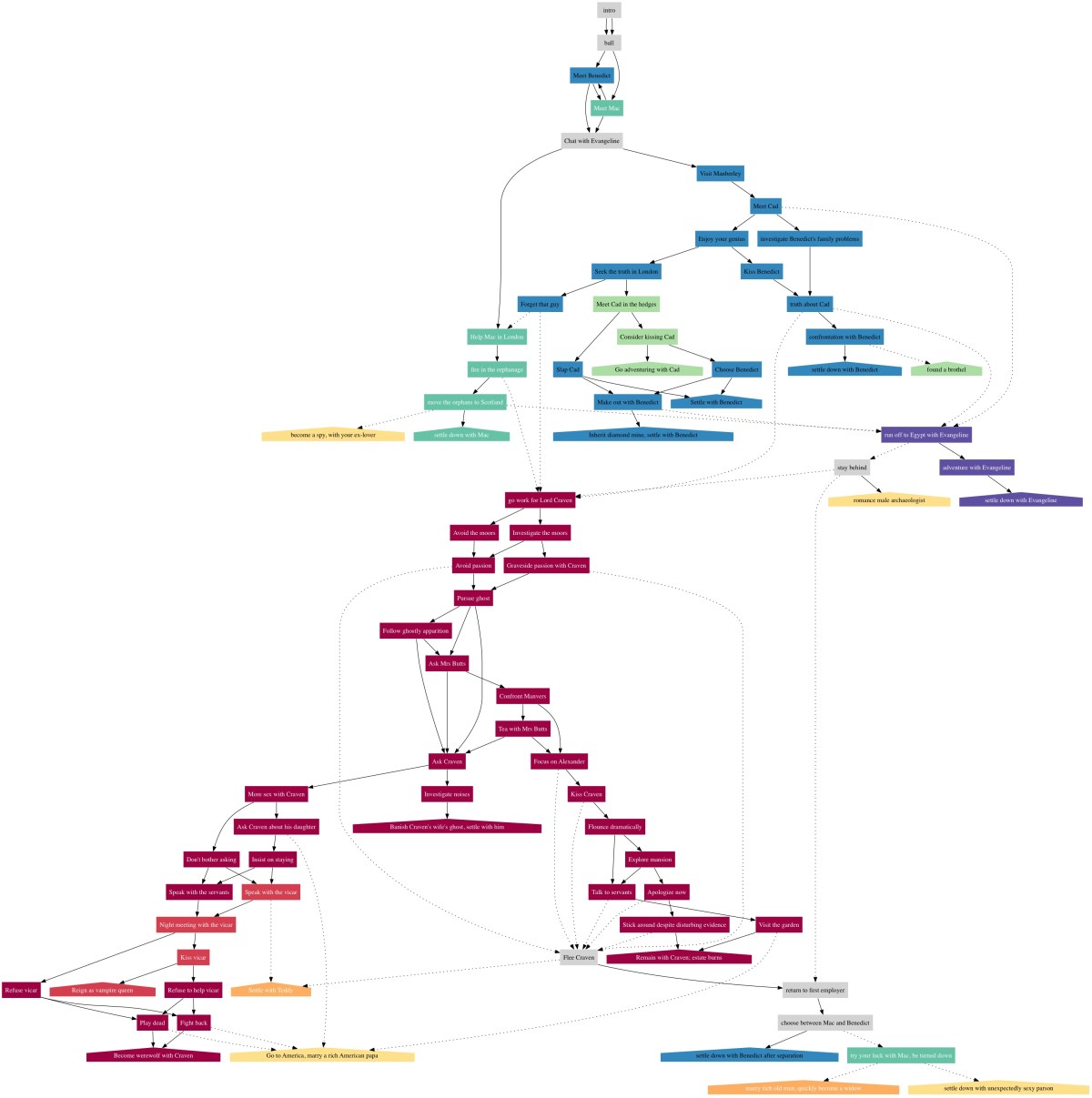
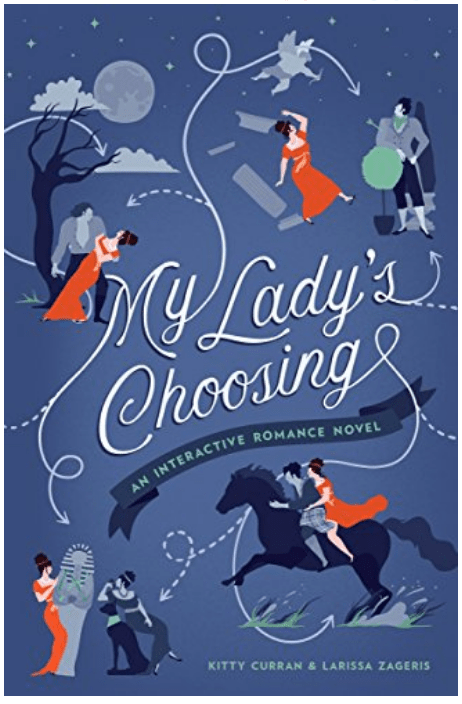
Screen Shot 2018-04-29 at 2.43.30 PM.pngMy Lady’s Choosing is a branching romance novel — or, arguably, spoof of romance novels. It begins with the heroine as a just-about-penniless lady’s companion, then immediately introduces her to two eligible bachelors and one wealthy and outrageous female friend.

From there, we are offered a buffet of standard tropes. There’s your obligatory Scottish hero with a castle and a lot of dialect-speaking servants who’ve known him since his youth. There’s a Mr Darcy-minus-the-serial-number whose estate is called (I am not making this up) Manberley. There’s a Jane Eyre plot strand with the brooding Man With A Past and a surviving child (and an optional Distraction Vicar if you want to go that way). There’s a subplot with Napoleonic spies and another subplot involving raising the lost tomb of Hathor in Egypt. There’s a side character who is a callback to a side character in Emma, and a sinister servant who owes a lot to Mrs. Danvers, and an obligatory call-out to that summer on the shores of Lake Geneva with Lord Byron. The encyclopedic approach to tropes reminded me of Tough Guide to Fantasyland, as transported to another genre.

Continue reading “My Lady’s Choosing (Kitty Curran, Larissa Zageris)”

Mid-July Link Assortment

July 15 is the next meeting of the Boston/Cambridge PR-IF.

July 21st, 3-5 p.m. at Mad City Coffee in Columbia, the Baltimore/DC group meets to discuss The Wand.

July 31st in Canterbury (UK) there is a session on how to build escape rooms for libraries.

Gothic Novel Jam is a jam for games or works inspired by the gothic novel in any fashion, and is running throughout July. IF and related narrative games are welcome.

Screen Shot 2018-06-10 at 4.20.43 PM.pngIntroComp is now accepting intents to enter. IntroComp is a competition in which you can submit just an excerpt of an unfinished interactive fiction game, and receive feedback from players about what they liked or didn’t like about it. If you’d like to participate as an author, register with the site immediately (this closes June 30, so today). Games themselves must be submitted by July 31 and judging will occur during August.

Entry registration and prize donation for IF Comp are now open as well, if you’re expecting to have something more complete in the near future.

August 4 is the next meeting of the SF Bay IF Meetup.

August 15, London IF Meetup hears from James Wallis on tabletop RPGs and storygames. This is a field where some of the most interesting narrative design is happening right now, and Wallis is an expert. As always, the event is free and there are drinks and hanging-out afterward.

inkle studios has announced ink jam, a jam for people writing in ink, running August 31-September 3.

November 10-11, AdventureX will return, this time at the British Library. AdventureX is a conference focused on narrative rich games, whether those are mobile or desktop, text-based or graphical; it’s grown significantly in size and professionalism over the last couple of years, and last year pretty definitively outgrew its previous venue. I am mentioning this well in advance because they’ve mentioned that tickets will be cheaper for early bird buyers — so it’s something to keep an eye on if you think you’ll want to go.