Having come up with an idiosyncratic terminology (Venom, Beeswax, Mushroom, Salt and Egg) for talking about some aesthetic aspects of procedural literature that matter to me, I now find myself reverting to the same terminology even when talking about other people’s work.
Fallen 落葉 Leaves is a procedurally generated poetry cycle in this year’s IF Comp. It draws on sample texts from Confucian poetry, and combines them and other elements densely, producing couplets with a great deal of strangeness per line. In my terms, it’s therefore heavily applying the principles of Venom (particularity, color, surprise) and Beeswax (varied, allusive, culturally rich source material).
The effect is indeed a bit like reading the translation of something whose metaphors, idioms, and cultural references are outside one’s personal ken:
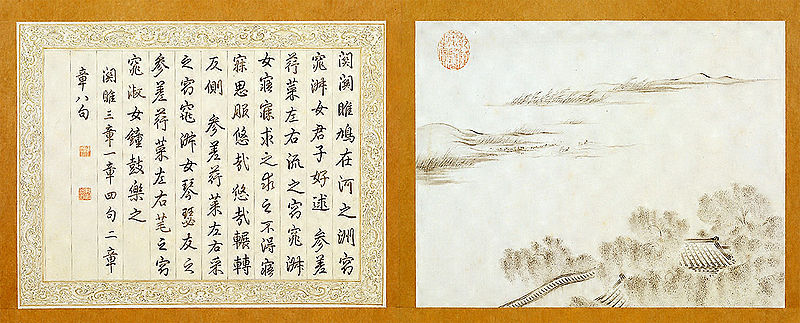
Some phrases sampled from the Shījīng (詩經),
the Confucian Book of Songs, the Classic of Poetry,
as translated by Arthur Waley. — author’s note for Fallen 落葉 Leaves
To start, you select an adverb from a menu and a verb from another menu; then a poem is generated in couplets, with your adverb and verb plugged into one of the couplets. You may repeat this loop as many times as you like, your adverb and verb changing the contents of the cycle overtly and perhaps also in more subtle ways. The author suggests that a hundred or more moves might be appropriate, and that one might want to pull out specific couplets. Looking at the source code reveals that there are many variables being tracked, perhaps iteratively across repeated builds of the poem.
Because the phrases are so allusive, it is not always easy to extract even a notional meaning from them. More often, I found that I could come up with something but that it was a general rather than a precise interpretation:
You sniff oil — writing home about our walks on the terrace —
Your sailing moon, your arrival — sing my pulse.
The first line is easy enough to imagine: the correspondent stopping mid-letter to breathe in the scent of a perfumed oil, possibly. “Your sailing moon, your arrival” perhaps refer to the time when the lover is to set out and rejoin the poet; “sing my pulse” indicates, presumably, that the poet’s life and heartbeat are in some way responsive to the lover’s movements, or else described by them.
Taken as a whole, though, across multiple sonnets, the experience becomes suddenly Mushroomy: overtly repetitive and generative, not concealing how much it is the result of mechanical operation. The grammar that generates sonnets seems to hit the same major points in each couplet, with allusions to erotic time the lovers spent together in the middle, and then a disagreement (with the player’s adverb/verb choice) toward the end, and the lover departing. (Sometimes on a “well-dressed horse,” which I thought was particularly good.)
Continue reading “Venom, Beeswax, Fallen 落葉 Leaves”
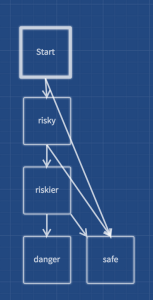 Confirmation-required Choice. One of the things Jon talks about sometimes is the use of text to let the player opt in to doing something profoundly stupid, through a series of escalating choices. Are you sure you want to do this? It looks like the monster is getting angrier. Are you still sure you want to attack? Yes? You notice that the monster’s bite is poisonous. Are you going to attack now?
 Track Switching Choice. A variant on the Confirmation-required choice is one where the player is allowed to change their mind in either direction for several beats. Later beats might introduce some potential drawbacks and warnings about whatever track the player is currently pursuing. Like the confirmation-required choice, this is a way to give some extra weight to a decision and emulate a situation where the protagonist might be genuinely conflicted about what to do next.
 Psychomanteum
 Last night I gave a talk in Vienna at the
  Emily Short's Interactive Storytelling