Windhammer Prize for Gamebooks

The Windhammer Prize is a prize for short traditional-style gamebooks: distributed in PDF, but designed to be played with a pencil and paper and sometimes dice. Windhammer contestants have to be short — no more than 100 segments allowed — and the contest is run yearly. It feels a bit odd, especially now that the IF community itself produces so much choice-based literature, that there’s so little discussion of gamebooks or awareness of the surrounding community. So as part of my continuing mission to cover IF-adjacent material, I tried out a bunch of Windhammer contestants.

Some highlights follow.

Continue reading “Windhammer Prize for Gamebooks”

Three Fourths Home ([bracket]games)

Screen Shot 2014-11-26 at 3.10.18 PM

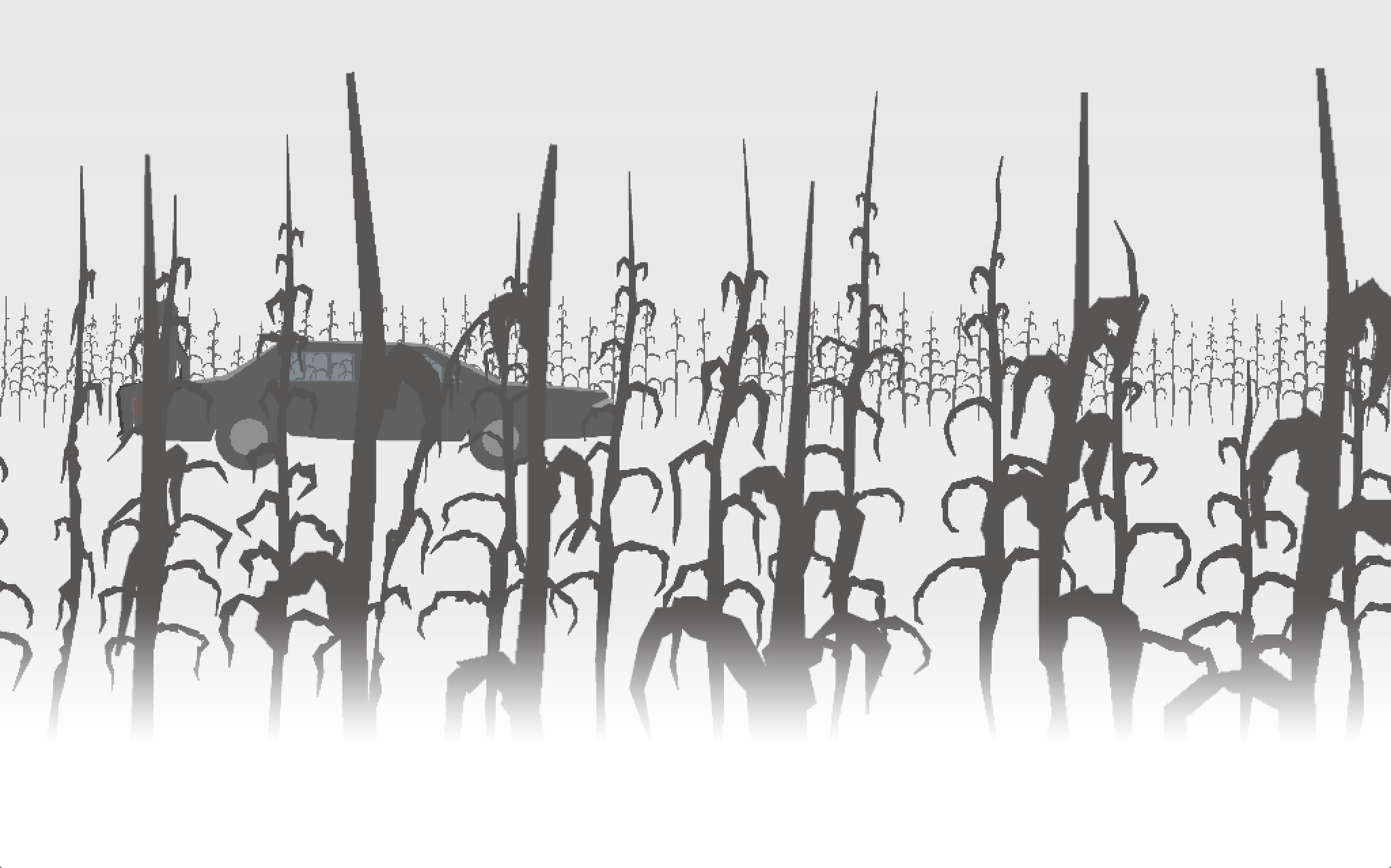
Three Fourths Home is a choice-based interactive story about a young adult named Kelly driving home through the Nebraska rain while carrying on a telephone conversation with her mother (and, as Mom passes the phone around, other members of the family). With music, sound effects, and illustration, it’s more lushly constructed than the average Twine game, but offers the same general style of play.

The conversation is simple menu-based stuff, usually with two or three available options, but — a little like Coming Out Simulator 2014 — Three Fourths Home also uses animation and location imagery to remind you constantly of where you are, as your car slides down the road between corn fields and past water tanks and into gathering darkness. While you play, you have to actively keep driving your car, or the whole story slides to a stop. Driving only consists of holding down a single button, but I found this was a good physical representation of being slightly distracted by an ongoing task. Sound effects also present some environmental distractions.

Continue reading “Three Fourths Home ([bracket]games)”

Loose Strands (Darned Sock Productions) and Mapped CYOA

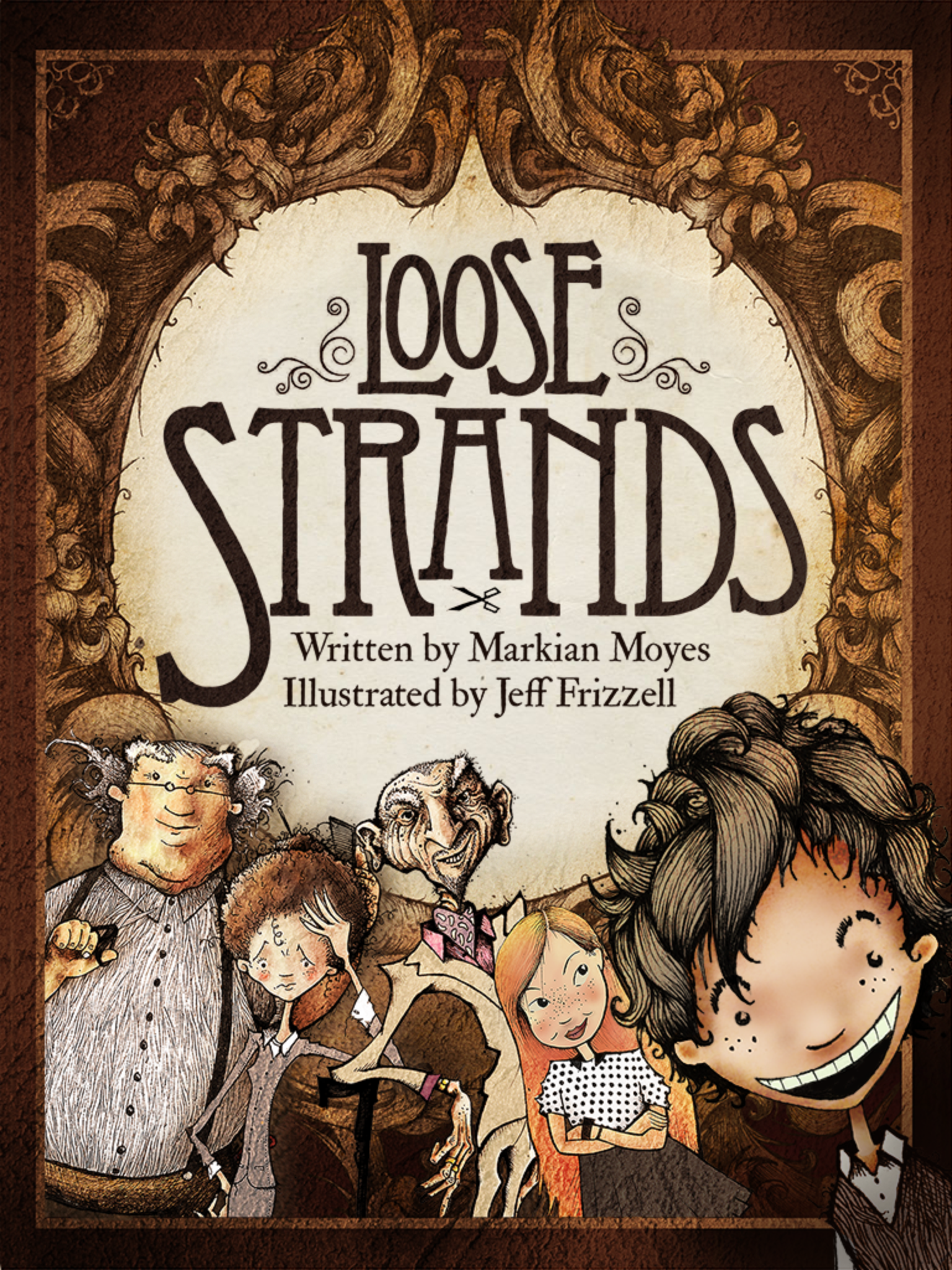
coverphotoLoose Strands is a choice-based interactive story app for kids ages 9+. It tells the story of Roland Bartholomew Dexter the Third, a boy who lives in an impoverished barbershop and is never allowed to go outside. His parents fashion clothes and even food out of hair leavings. Since he can’t go outside to school, he reads books about history and dinosaurs and airplanes, but these books have been so rigorously censored that they aren’t much fun. It never seems to be his birthday.

The only bright spot, if you want to call it that, is that Roland has unusually vivid dreams about the might-have-beens, the things that would have occurred if only he’d made a different decision from the one he did take.

Loose Strands is a story about regret: about being debilitated by the desire to erase the past, or, conversely, plagued by the inability to learn from our mistakes. It handles this with a kind of Lemony Snicket gloss. The villain is cartoonishly evil, the world a fantastic rendition of a totalitarian dystopia. The characters are charming, but not enormously nuanced. Now and then the narrator addresses the reader in a condescending Let Me Tell You About The World fashion, and the pacing around the end of part 1 felt a bit slow to me. Nonetheless, it’s a story about the nature of choices that makes a strong use of the choose-your-path structure.

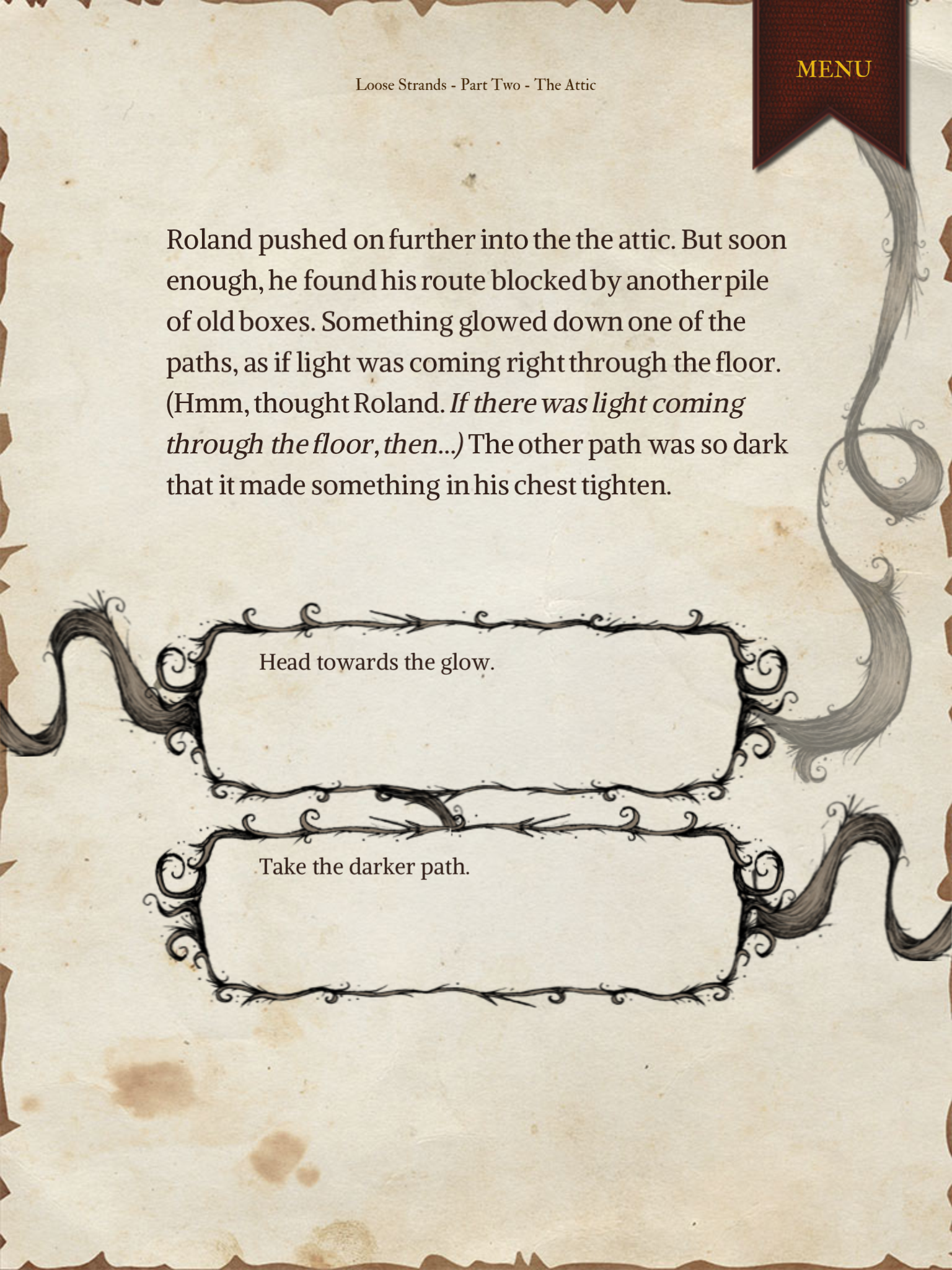
Whenever you get to a choice point, you can swipe the page in one of two (or occasionally three) directions in order to proceed to the next portion:

choicephoto

And when you’ve made a choice, the book immediately zooms to the overall story map and blacks out a bunch of spots — showing you how your decision has prevented you from ever seeing certain possible futures. It’s partly a reminder that what you do matters, a “Clementine will remember that” tag — but it’s expressed in an explicitly negative way.

Loose_strands_photo

Likewise, you can sometimes use the map to go to an earlier page, but if you’re trying to rewind too much, you’ll get a message saying you’re not allowed to go back.

Continue reading “Loose Strands (Darned Sock Productions) and Mapped CYOA”
if (Nicholas Bourbaki)

bourbaki“This author sent me a review copy of his CYOA novel.” I took the book out of its wrapper and held it up.

“Nicolas Bourbaki doesn’t exist,” my husband said. “He’s an invention.”

Someone had handwritten the enclosed note. I shrugged. “Maybe this guy really has that name.”

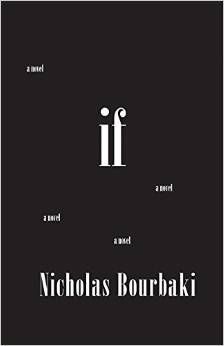
We were both wrong, as it happens; as this interview explains, Bourbaki-the-author assumed, with an extra h in the first name, a shadow of Nicolas Bourbaki the collective of pseudonymous mathematicians. His book, If, is a print choice-based novel — hefty, printed on thick paper, with “a novel” appearing multiple times on the cover as mark of both its multiplicity and its literary seriousness.

If sometimes embraces, sometimes rejects standard CYOA practice. It’s written in the second person, mostly, except when a first-person narrator crops up by surprise and many pages into the story: this first-person character is a bully, and for as long as we remember that he exists, the whole narration feels like a mean-spirited harangue against the protagonist. The main character also floats between characterization and Faceless Protagonism: he has a gender and passes through a specified series of ages, but some characteristics are intentionally withheld. On page 192, a character refers to him by name, though on page 194 we discover that this was a false identity anyway.

But having a name would probably pin the protagonist down in the wrong way. If belongs to that particular subgenre of IF whose overt hook is the opportunity to reach radically different life outcomes from the same starting point: works like Life’s Lottery, Pretty Little Mistakes (Sam Ashwell’s analysis), and Alter Ego (Jimmy Maher’s analysis).

Continue reading “if (Nicholas Bourbaki)”

Coming Out Simulator 2014 (Nicky Case)

Screen Shot 2014-11-13 at 4.58.40 PM
Coming Out Simulator 2014 is a semi-autobiographical story about how the author came out to his parents. Interaction takes the form of menu-based conversation — conversation with the narrator in the framing story, and then a series of conversations with his past boyfriend and parents. The whole thing is illustrated in a streamlined, elegant way, and lightly animated, in a way that keeps you aware of the living breathing presence of your interlocutors even though most of what happens happens in text.

There are two things about this piece that particularly struck me. One is a piece of story content: when you’re discussing your sexuality with your mother, there’s a point at which she actually vomits from disgust. This sounds pretty extreme, and some of the subsequent references back to the moment are on the flippant side, but the moment itself did not strike me as totally unrealistic. Indeed, this captured something I have experienced myself in a different context: the sensation that it’s impossible to argue with someone because of the strength of their visceral reactions, together with guilt at making them feel that way (even when I felt that I was in the right). It also reminded me of Jonathan Haidt’s writing on conservative and liberal “moral foundations”, which argues that a strong sense of disgust tends to be associated with conservative values. Where one party feels disgust at something the other party does or thinks or wants, this is a very hard communication gap to bridge, because it is located somewhere other than the head.

Continue reading “Coming Out Simulator 2014 (Nicky Case)”

Appointment with FEAR (Tin Man Games)

Screen Shot 2014-11-14 at 8.16.05 AMAppointment with FEAR is an adaptation of a Steve Jackson gamebook, available in various mobile formats and also on Steam for desktop machines. It’s been polished up into a graphical-novel style interface — a juicy one that slides panels into place and makes stats expand bouncily when you click on them – but it retains a slightly disorienting early-80s mentality: there are jokes about “Michael Jixon”‘s new release “Chiller”, and “Vulture Club”‘s lead singer “Georgie Boy”. This kind of thinly-veiled reference is symptomatic of its sense of humor.

Content-wise, it’s straight parody superhero fiction. You have an alter ego who has a newspaper job (which you rarely have time to attend), and when you’re “in disguise”, your avatar wears a pair of Clark Kent-style glasses. There are various villains with various unlikely costumes. For yourself, you get to pick from a roster of jokey auto-generated names. I played first as “Sparse Manifestation”, a mind-reading black female superhero with amazing breasts but no other body fat, and then as “Apathetic Chicken Leg”, a flying white female superhero with amazing breasts but no other body fat. Once I had a fleeting chance to name myself “Absolute Chaos”, but I misclicked the show-more-options button before I could select it; that was pretty much the least bizarre title I was ever offered.

Screen Shot 2014-11-14 at 8.44.40 AM

Goofiness aside, I’m struck by the colorful energy of the interface here; it really feels as though it has projected you into a superhero universe with BAF and BOW animations. The mechanics are on the simple side, but have been carefully blended into the story. There are combat sequences, in which you can pick from a range of easy-but-weak or risky-but-powerful attacks, and these get some context-appropriate narration. There is a detection component to the game, in which you gather clues from various events and use them to solve additional problems you run into: when there’s something you might be able to resolve with clues, you go to your clue notebook and pick the clue you think applies, in good Phoenix Wright style. There are some simple stats: luck, stamina (hit points by another name), and Hero Points, which track successes along the way.

I never played the original gamebooks, so possibly I’m about to take issue with something that is fundamental to the whole historic experience. But despite the surface polish and the similarity to a number of games that I do enjoy quite a lot, I found myself pretty frustrated by this as both a game and a piece of narrative design.

Continue reading “Appointment with FEAR (Tin Man Games)”