IF Comp 2012: howling dogs (Porpentine)

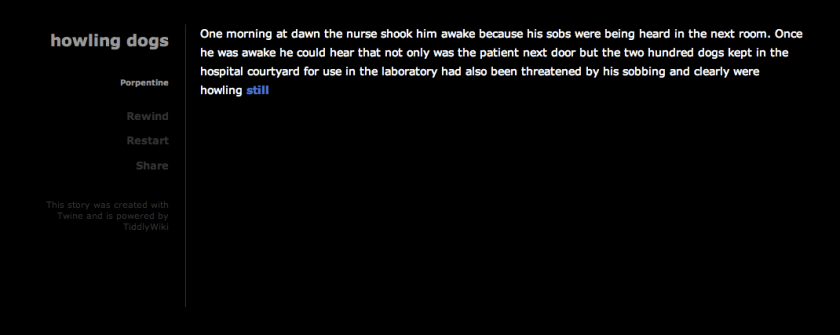
howling dogs is a Twine-based CYOA concerning… I’m not sure quite what, but it involves repeated sessions with a virtual reality. Per tradition, I will put my spoiler-free comments after the jump, then spoiler space if there is anything spoilery to follow.

Continue reading “IF Comp 2012: howling dogs (Porpentine)”

IF Comp 2012: Living Will (Mark Marino)

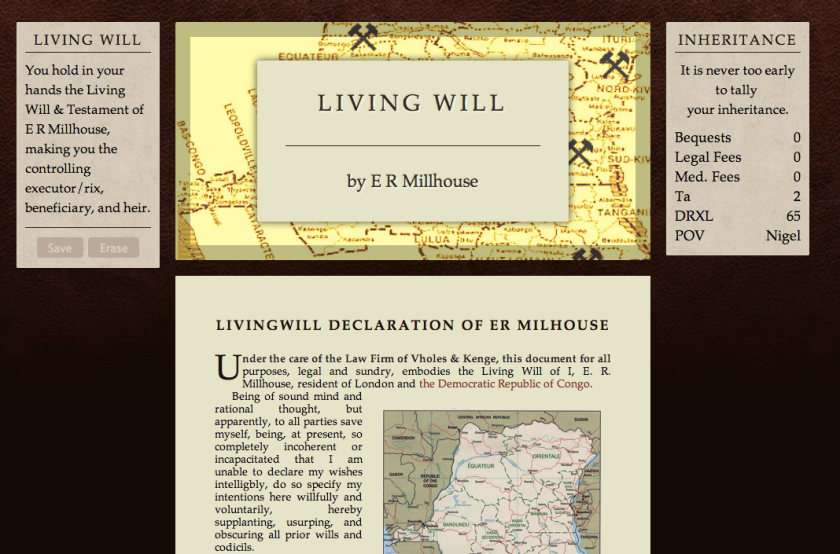
Living Will concerns a will that changes dynamically in response to the reader, with the possibility that taking different paths through the will may result in different legacies and messages from the deceased.

Per tradition with my IF Comp reviews, I will have some non-spoilery content after the jump; then if there’s anything spoilery I wish to discuss, it will be separated from the rest of the review with spoiler space.

Disclaimer: I saw this game originally in an unreleased version prior to the comp, at which time I gave some feedback on it. I didn’t bang on it long or hard enough to really claim the title of beta-tester, but nonetheless my comments should be read in light of this favorable predisposition.

Continue reading “IF Comp 2012: Living Will (Mark Marino)”

Choice of Games: Eerie Estate Agent (Gavin Inglis)

Eerie Estate Agent is a newish piece from Choice of Games, created by writer Gavin Inglis. The premise is that you’re an estate agent (or realtor, in American terms) and you’re responsible for getting 57 Crowther Terrace rented out. Your unpleasant boss is just looking for an excuse to fire you and the other employees around the office don’t exactly have your back, so the stakes are high. The problem is that no one seems to want to stick around the place for long, possibly because of all the spooky stuff that happens there.

Inglis identifies as a writer more than a game designer, and that shows, in ways both good and bad. I’ve often thought that the actual prose quality was a bit of a weak spot in many Choice of Games offerings: the text in Choice of the Dragon, for instance, is typically utilitarian, and though some of the later works become more ambitious, the results are not universally happy.

Eerie Estate Agent has a much more distinctive and engaging voice than these: breezy but well-controlled, lightly humorous, sometimes casting the protagonist as a not entirely nice person. There’s a good sense of the Edinburgh setting (not perhaps surprising, as Inglis seems to know the place well). In the eerie happenings, he tends to hit a good middle ground between the creepy and the funny, going for paranormal indications that are amusing but that would probably be distinctly unnerving if they happened a lot in real life. (Rooms that periodically fill up with the scent of tea? Indications that seem to resemble the scurrying of a dozen ghostly rodents?)

A down side is that Eerie Estate Agent doesn’t deliver very strongly on Choice of Games’ traditional strength: lots and lots of agency.

Continue reading “Choice of Games: Eerie Estate Agent (Gavin Inglis)”

Choice-based Narrative Tools: inklewriter

A little while back I did an interview with Rock Paper Shotgun which included, among other things, a question about what I thought of inklewriter, the branching narrative tool from inkle studios. That interview was published in a funky CYOA format, which was cool, but it means that it’s hard for me to point people at my answer to that question. And people ask me pretty frequently about different branching-narrative tools that might be out there.

Fortunately, Cara Ellison who did the interview was kind enough to say that I could reprint my answer here. It is attached below, along with some extra thoughts based on a little more work I did with inklewriter after the interview. (Also, if you’re here because you’re interested in checking out a variety of related tools, see the list in the interview as well as my previous thoughts on writing for Varytale.)

Continue reading “Choice-based Narrative Tools: inklewriter”

Several Interesting Projects

The Silver Tree is a new, Kickstarted project by the Failbetter people: it’s to be short and self-contained, and explore what happened to the 13th century Mongol city of Karakorum in the universe of Fallen London. Since I remain hugely fond of the Fallen London/Echo Bazaar universe and lore, I’m excited about getting a peek in at another piece of it, this time in a slightly more focused gameplay form. The project site has some preview art and an interview with Yazmeen Khan, who is doing the writing.

I not-very-secretly hope this represents a successful approach for Failbetter, as I am not crazy about the way Fallen London generates revenue (make gameplay grindy, then charge players micro-amounts to make it go faster). I would much rather see stories funded through direct purchase and/or prefunding. It’s been a very successful campaign, which is encouraging. Also, they’re offering one of my all time favorite types of backer reward, a deck of custom cards. I am a total sucker for those for some reason.

Dominique Pamplemousse in “It’s All Over Once the Fat Lady Sings!” is a stop-motion musical adventure by Deirdra Kiai (The Play, Life Flashes By, assorted other projects). The whole concept is pleasingly off the beaten path.

Finally, if you’re interested in what Chris Crawford is doing these days, he also has a project on Kickstarter, a Balance of the Planet simulator that asks you to set tax prices for various types of pollution and then calculates a final score based on 58 years of result. It’s a curiously uninteractive experience, in that you set some sliders and then wait to see what happens (or, alternatively, read through the many pages of explanatory articles on different environmental factors).

Chris’ own description suggests that this is meant to be a forensic experience: run the simulator, then stare at the graphs to work out what went wrong, then try again. And you can, indeed, backtrack a bit through the graphs, breaking them down into components and checking out the things that contributed to those components and so on, in a way that is much more in-your-face about numbers than, say, Electrocity or some of the other educational or persuasive energy-policy games I’ve looked at in the past: it’s trying to make the argument quantitatively and crunchily.

And it’s quite hard to get things to balance, so I come away thinking, “hrm, we’re all dooooomed,” not “here’s how to save the planet.” (Except that I also don’t buy some of the game’s premises, such as the baked-in assumption that whatever taxes we set in year 1 we then cannot change at all for the next decades, other than to phase them in gradually.)

All that said, I like the concept of mathematically rigorous simulations to teach these problems; I also like the implication that the player will be able to experiment with different assumptions about the world model. I do wish that there were a more appealing front end and that the challenges were taught gradually, however.
Alfe Clemencio on interactive narrative in Don’t Save The World

Alfe Clemencio of Sakura River Interactive is the author of highly branching visual novels in Ren’Py. His previous work Fading Hearts features a wide range of possible player paths and outcomes; now he is working on an ambitious RPG project called Don’t Save the World. His Indiegogo page describes Don’t Save the World thus:

Don’t save the World: An RPG is a game where the effect of player’s choices are so strong they can change the genre of story and game. Live a life of adventure (RPG gamplay) or a normal life of running a shop (management-sim). Say “No” to saving the world!

…Near the end of the game gamers might be given the chance to slow down or stop the hero from defeating the dark lord.

I will guarantee that some players trying to be “good” will try to stop or slow down the hero.

In this scenario you are not the hero and won’t be defeating the dark lord. If the dark lord isn’t stopped then all the lands will be flooded with monsters that will bring the cities and towns to ruin. The hero is definitely a good person and is trying to do good.

It’s because moral choices like this that morality meters won’t work for this kind of game. Can you figure out why gamers trying to do good would do something like stop the hero?

Here he talks about that project, about the challenges of managing highly-branching narrative, and about the moral elements he is hoping to explore in his new work.

Continue reading “Alfe Clemencio on interactive narrative in Don’t Save The World”