Rock Paper Shotgun’s Cara Ellison interviewed me, Adam Cadre, and Andrew Plotkin, and then assembled the result into a CYOA. We talk about interactive fiction primarily, but also text-based gaming more generally. I have a long riff about inklewriter and related tools, and another one about the project I’m working on now for Linden Lab, to the extent that I can talk about that publicly.
Category: CYOA
Phrontisterion, and some more thoughts about tools and the art
A couple of weekends ago I went to Phrontisterion 7, a living-room-sized conference on interactive storytelling run by Chris Crawford at his home in Oregon. Participant comments from that are now available.
For context for people who weren’t there: it was a really wide-ranging discussion about what projects currently exist in interactive storytelling and how/how well they work (Saturday) followed by forward-looking stuff about what to do next (Sunday). On Saturday, we talked about (among other things) Prom Week and Storybricks, Storyteller, LA Noire, Chris’ plans for Storytron 2.0, StoryNexus, ChoiceScript, and the project that I’m working on for Linden Lab. Though there weren’t formal presentations on these items, people also talked a bit about conventional interactive fiction, and about Varytale and StoryDeck.
Sunday was directed more at the question of “well, what next?” — and that was a more challenging discussion, one that I think frequently frustrated Chris. We generally agreed that we’re not trying to reproduce the Holodeck as such, at least not in its full technicolor, surround-sound, smell-o-vision glory, and quite possibly not in most of its other aspects either. I may possibly have gone on a short rant on the value of text, darn it, you know, with words, and how text is not inherently a second-class citizen and a cheap substitute for the greater expressivity of visuals. (Visuals are cool, and if there were to be a Holodeck that could conjure up a 3D immersive sensory experience, you bet I would want to try that thing out for sure. But. The art I personally want to create is made of language.)
Continue reading “Phrontisterion, and some more thoughts about tools and the art”
Writing for Varytale

As mentioned in a previous post, Varytale is a platform for interactive stories. It’s put together by Ian Millington, the same person who created the Undum tool, but Varytale goes quite a bit further.
Writing Tools
Undum provides a slick front-end and a way to build a few choices and otherwise leaves everything up to the author (hey, you don’t mind learning some javascript to code your story, do you?). It’s been used for a couple of neat IF works, including Deirdra Kiai’s 3rd-place Comp 2011 winner The Play and Andrew Plotkin’s The Matter of the Monster.
By contrast Varytale comes with a complete authoring tool; a website where books are showcased and attractively presented online; the capacity (eventually) to use one of several payment schemes to charge for content; and feedback and statistics tools that allow the author to collect ratings and comments on content, and to see which story choices are especially popular or unpopular. These tools require vastly less coding than traditional interactive fiction, but they do allow for world state and player stats-tracking. (Some time back, I described why CYOA without world state is a bit too restrictive for most of what I want to write.)
Varytale Analytics
So Bee has been out for a couple of days now in reader beta, and my analytics page overflows.
The Varytale system includes a mechanism by which readers can rate and comment on any individual piece of the story as they go along, giving a one to five star ranking and displaying the average of those ranks as the book’s quality score. The commenting part is well-hidden and of course requires more effort on the part of the reader — I’ve gotten only a handful of comments, mostly to inform me of localized typos or bugs — but the ratings part is almost intrusively prominent.
As a reader, I’m not sure how I feel about being asked to grade what I just read every few paragraphs, so I haven’t actually had the nerve to grade anyone else’s Varytale books; and for that matter even just being asked, “hey, how did you like that?” so frequently relentlessly draws my attention back to an evaluative process when I might prefer simply to experience the story for the time being.
So I have mixed feelings about it as a reader, but it’s the authorial perspective I want to mostly talk about here.
As an author, you get a big chart that ranks all of the ratings of all of your storylets. Analytics results also break down further details about how many people chose each of the several paths through a branching storylet, in what order, and so on. You can see exactly how many people read each storylet, and on which dates. There’s no way to tell for sure when a given reader stopped reading your book, because in theory they could just not have finished it yet, but lots and lots of other metrics are visible.
This is the first time I’ve been able to collect that kind or level of feedback on any of my work, and I am morbidly fascinated. I’m going to show the top and bottom ends of the chart for Bee, which will necessarily be just a tiny bit spoilery for the names of sections in the story.
Bee out in Varytale Reader’s Beta
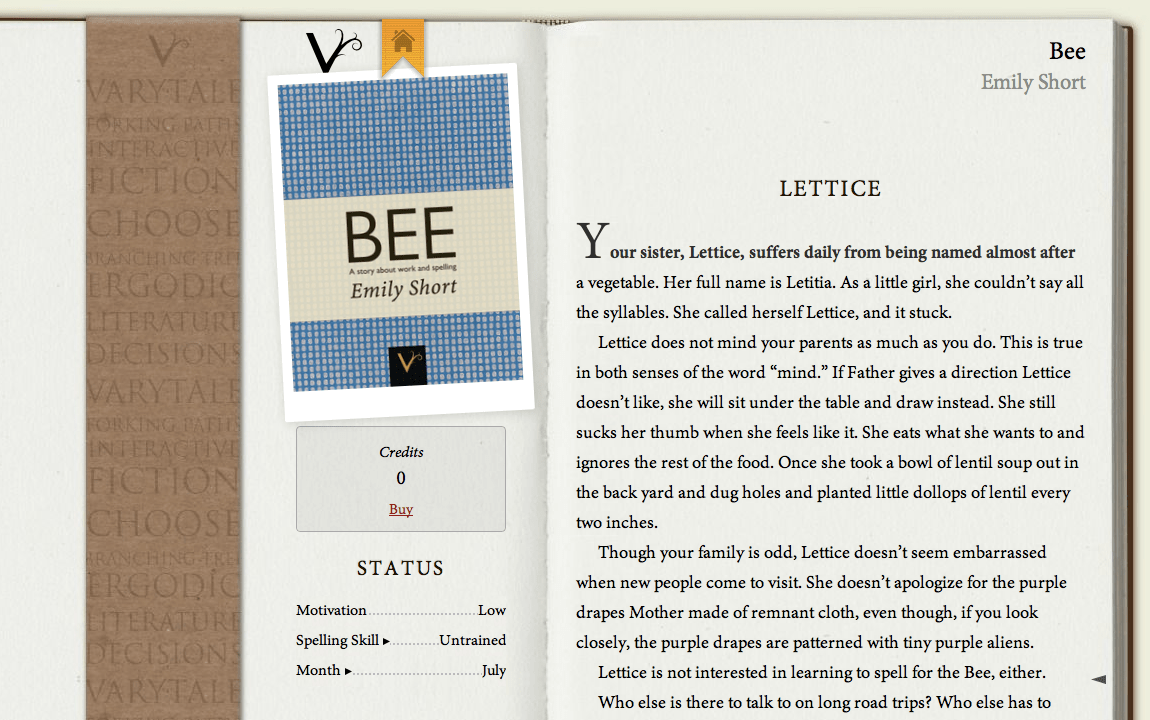

Varytale is a platform for interactive stories that fall somewhere on the spectrum between stateful CYOA (like Choice of Games) and quality-based narrative (like Echo Bazaar).
As you can see from the screenshot, the experience is intentionally booklike and lushly textured. Varytale borrows or improves on the attractive qualities of Undum. There are visible stats if the author wants them (or else not). Choices can appear as links embedded in the text or a list of options immediately following it. You can keep track of your place in a book with one or several bookmark ribbons, which grow longer over the cover of your book the more you’ve read.
Currently the reader’s beta offers access to four official books:

I haven’t gotten very deeply into Fighting yet, but How to Read is a tidy, brief introduction to how to use Varytale and is likely also to be interesting to anyone thinking of writing Varytale books in the future. Hymn and Shanty is more like interactive poetry, allowing the player to choose stanzas to add to a song. There’s also a growing collection of reader-submitted stories.
Bee is a new work of mine, written for Varytale: it’s the story of a home-schooled girl preparing to compete in the national spelling bee, dealing with various small crises with family and friends, and gradually coming to terms with the clash of subcultures involved in belonging to a family like hers.
Bee is not reviewed anywhere that I know of (unsurprising given it’s only just out), though one reader had this to say:
It’s fascinating to me, how the family dynamics and cultural dynamics–and the growth of the main character–weave in and out with the concentration on learning how to spell strange and unusual words. The protagonist has a distinct personality, but the choices she (well, you) make are constrained and opened both by earlier choices, and cultural indoctrination, and all sorts of other things. And it often comes back to spelling: as a concentration tool, a mode of defiance against parents, a meditation on spiritual matters.
If you heard about the Varytale beta before now and went to have a look, you may have encountered a version that was action-metered so that you could only play a few steps at a time. I don’t feel like that was perfect fit for the book. The platform has been revised so that it’s now possible to remove that requirement, and I’ve done so; if you want to read Bee in pieces, that’s still possible, but you can also go straight through if you want. (Though the screenshot includes a bit about “Credits”, Bee is currently free and requires no purchase.)
There’s quite a bit to say about the Varytale authoring tools as well: unlike its predecessor Undum, Varytale offers a fairly significant set of tools for putting a book together. But I’ll save that for another post.
Edited to add: some additional comments on Metafilter, Free Indie Games, IFDB review, Gamespite thread.
Frankenstein, by Dave Morris with inkle studios

Frankenstein, written by Dave Morris and implemented by inkle studios, is an iPad app retelling Mary Shelley’s original tale in a new interactive format.
Morris’ Frankenstein follows the essential plot of Shelley’s, with a couple of key deviations. Victor Frankenstein’s experiments take place in revolutionary Paris rather than at the university of Ingolstadt; the narrative frame of the original story is peeled off, so that it no longer begins with Frankenstein meeting a shipful of adventurers in the north Atlantic, and the meeting on the ice occurs only at the end.
Removing the frame gives the story a certain immediacy. Victor’s experiments are told in the present and the horror of them is more directly present than they would have been via flashback; and flashback is notoriously tricky in interactive narrative because it often makes the reader question how she can possibly be affecting events that are, from the point of view of the frame narrative, already in the past.
Continue reading “Frankenstein, by Dave Morris with inkle studios”
 Emily Short's Interactive Storytelling