Short essay question:
Suppose someone handed you a brand shiny new library for implementing conversation in IF. What kind of thing would you want to use it for? What options do you want to make sure have been accounted for? [more inside]
Short essay question:
Suppose someone handed you a brand shiny new library for implementing conversation in IF. What kind of thing would you want to use it for? What options do you want to make sure have been accounted for? [more inside]
Have uploaded to the Inform extensions page updates of Locksmith and Facing, and a new extension called Approaches. Approaches implements a GO TO… command as found in the manual, but produces somewhat more elegant output, coping with cases where the player’s movement is blocked by a door or some other kind of movement requirement. For instance:
You go north to the aforementioned unwelcoming hut, north again to the unattended pathway, north again to Paris and west to Bois du Boulogne.
or
You go north to the dusty street, then head west to the church. Entry into the church is barred without a hymnal, though.
or
You go north to the open field, then head north again to Seamus’ Hut. Unfortunately, you find you lack a key that fits the hut door.
or
You go to Crimson Chamber by way of Grooved Channel, Shallow Jade Amphitheater, Silver Filigree Prison and Mandarin Casket Room.
or… well, many other variations of your own devising, really. If you try it, though, remember to make sure you have the new Locksmith, too.
As die-hard I7 authors may know, I’ve had available for some time a Room Description Control extension which allows for greater control over how room descriptions are printed — in particular, what we want to leave out, and what order we want to print descriptions in.
Room Description Control requires, though, a kind of front-end extension as well, to form the paragraphs of the description. Until now, there have been two options, neither of which really conforms to the default Inform description.
I have now released a third version, Ordinary Room Description, which tries to stick as close as possible to the way Inform prints descriptions by default, allowing the author to use the special abilities of RDC without giving up other aspects of Inform’s room description printing.
After the break there are examples of output from all three variations: Single Paragraph Description, Ordinary Room Description, and Tailored Room Description.
For a while I had posted a property checking extension for I7, intended to make sure that all objects and rooms in the game at least had some description defined. This turned out to be buggy because of the way the standard rules handle room descriptions, so I took it down for a time until I got around to figuring out what was wrong with it.
I have now solved this, so version 2 is up in the usual place. Apologies for the inconvenience/delay/etc.
People often ask me for examples of Glulx multimedia designs; and since I happened to be working on something with an easily extracted lesson, I’ve taken out the relevant code and made a separate project of it.
The idea is that we have a graphical sidebar along the left side of the screen that functions in place of the game’s status line. At the bottom of that sidebar, next to the command prompt, is a clickable compass rose that displays the available exits in each room, and indicates which of the exits lead to already-visited locations. (This is pretty much a combination of the screen layout from City of Secrets with the color-coded compass from Bronze.)
In a finished game, there would be cool pictures and stuff in the upper part of the status bar, or maybe a clock indicating the game time, or some kind of score-counter, or a whole glistening dashboard of steampunk gears and dials tracking seven simultaneous kinds of progress…
But for this example, we just do the compass rose. Here it is, with green letters for new places and white letters for familiar ones:
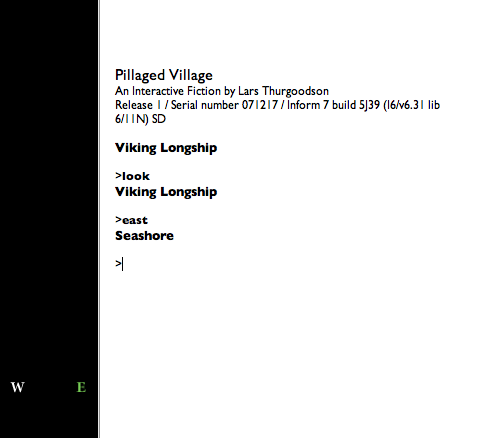
Anyway, if that all strikes you as interesting, you can try out the gblorb file. Or you can run it for yourself:
(Edited to add: the gblorb file produced will probably not run correctly under Gargoyle or Spatterlight, because they do not use the most up to date version of the Glulxe interpreter. For these purposes, I recommend Zoom on the Mac and Windows Glulxe on Windows.)
Another build of Inform has been released; this one is less dramatically changed than the last, though it does get rid of a bunch of bugs. It also introduces lists, so you can have a growing sequence of numbers (say) without having to know how many there will be when you create the property or variable.
My favorite new example uses that feature and several features of the previous build to create Robo, an NPC who can learn action scripts and perform them back on command.
The syntax document has also been re-updated with the new syntax for list-management.
 Emily Short's Interactive Storytelling