Category: interactive fiction
Putting together a play-test
Recently read an interesting article by some Microsoft playtesters that suggests playtesting studies using 25-35 participants focusing on a single hour of gameplay, followed up with standardized surveys. The idea is that this could be done repeatedly during the course of a game’s development in order to drive gameplay improvements and then confirm that the changes have had the desired effect. This method contrasts with usability tests (an hour to two-hour interview one-on-one with testers, usually conducted with a group of eight or so) in that it is more statistically reliable though not so in-depth.
This is something I’ve been thinking about a lot lately.
Alabaster feedback
As Alabaster is in large part an experiment with the underlying conversation system, I would very much welcome feedback about how the system behaves so that I can refine it for future use.
As background: how much the system prompts the player is already an adjustable feature (up to turning off quip prompts entirely, for a standard unprompted ASK/TELL experience). Likewise, it will be possible in the final version of the library, though not demonstrated here, to use a numeric menu to offer the player options.
So what I’m particularly interested in at the moment is how to improve the player experience when the game is using the same library settings as Alabaster. Some things that have come up already:
A common misapprehension seems to be that it’s necessary to retype an entire quip name verbatim, whereas in fact the game parses quip names in the same way that it parses object names: the first few words of the quip, or any unique word, will do. The system does not, perhaps, do a good enough job of teaching new players this fact, especially when the tutorial mode is turned off; so perhaps there should be a mechanism to notice if the player is typing in very long commands and mention (once) that these can be shortened. (Also, perhaps, to point out that the whole ASK INTERLOCUTOR ABOUT structure can be shortened to A.)
I’ve also had a request for tolerance of spare question marks (which some players find themselves typing even after an indirect question such as ASK ABOUT WHETHER SHE IS COLD).
Another point is that Alabaster doesn’t give good feedback when the input is
>SNOW WHITE, [valid quip name here]
In general, I’m not sure I want to encourage players to approach things that way because it encourages them to think there’s actual natural language processing happening — which there isn’t. But there could be better error messages in response.
Anyway, comments are welcome; it would also be useful to have transcripts that demonstrate interaction with the game, since these would provide also some idea of how often commands are failing, and what kinds of commands. If you have one you’d like to send in, I’d appreciate it: emshort@mindspring.com.
Alabaster status
 Currently there’s a release 3 available here. Release 3 addresses several bugs and adds new vocabulary for certain actions. It also plays significantly faster on slow machines, especially under Windows.
(I haven’t built a Windows installers for this yet, so that installer still contains release 1. I’ll update that when I have a chance.) (All the installers now contain release 3.)
Jay is Games kindly carried a review. There’s also a discussion on the Legendary blog (which covers various forms of mythical creature) on the game’s premise. (Image by Claire Beauchamp.)
Official Release
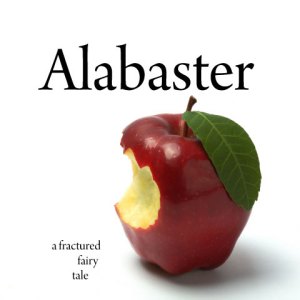
The Queen has told you to return with her heart in a box. Snow White has made you promise to make other arrangements. Now that you’re alone in the forest, it’s hard to know which of the two women to trust. The Queen is certainly a witch — but her stepdaughter may be something even more horrible…
There are some eighteen possible endings to this fairy tale.
Some of them are even almost happy.
A fractured fairy tale by John Cater, Rob Dubbin, Eric Eve, Elizabeth Heller, Jayzee, Kazuki Mishima, Sarah Morayati, Mark Musante, Emily Short, Adam Thornton, & Ziv Wities.
Illustrated by Daniel Allington-Krzysztofiak.
Available now from
http://www.inform-fiction.org/I7Downloads/Examples/alabaster/
(Changed because the old site went over its traffic allowance.)
Please note — as the site also points out — that you’ll want the latest available Glulx interpreter to play (Git 1.2.4 for Windows, Zoom 1.1.4 for Mac). Alabaster is processing-intensive and makes use of the latest Inform optimizations.
Another warning: some of the comments here get spoilery.
Random shout-out to IF in The Guardian
Ran across a somewhat unexpected editorial promoting IF, including Blue Lacuna and Everybody Dies by name.
 Emily Short's Interactive Storytelling