Mailbag: Two letters about IF and language

This Mailbag post we have two related letters, and I don’t have a super-long answer to either, but I suspect readers may be interested and perhaps have their own comments to contribute:

Are you aware of any IF that has been produced in any endangered, minoritized, or indigenous languages? The only example I’ve come across is Harry Giles’ work in Scots: https://aitch-giles.itch.io/raik

I’m not very familiar with the IF world, and your site has been very educational. I’ve tried a few keyword searches to locate works that might not be in the IF databases, but found no other results.

IF would seem to be a useful format for sharing and learning underresourced languages. I’m currently working with folks in the Cherokee and Lakota communities on a handful of translation and localization projects, and I can’t imagine I’m the first to be exploring this area. I would be grateful for any insights. Thanks in advance for your time.

It would be fine to post my note, especially if you thought others might be interested. I’m writing a bit (and curating writing) about work in this area here: medium.com/r12n

— Derek Lackaff, Ph.D., Associate Director, Center for the Advancement of Teaching and Learning, Elon University

Continue reading “Mailbag: Two letters about IF and language”
Notes on the Direction of Inform

Yesterday Graham Nelson spoke to the Oxford/London IF Meetup about what he has been doing with Inform recently, what has and has not been successful (in his view), and where the project is going next. The slides and text are now available here.

Because the talk is intended for a mixed audience, it does explain some things that readers of this blog may already know well, but by the later part of the talk is introducing some new elements.

A Beauty Cold and Austere (Mike Spivey)

beautycoldandaustere.jpeg

A Beauty Cold and Austere is a parser-driven text adventure about the awe-inspiring loveliness of mathematics. Its set-piece puzzles range from basics of arithmetic and geometry, through combinatorics and probability, up to linear algebra, calculus, and a wonderful interactive toy that explores the concept of divergent vs convergent series. Along the way, you encounter a number of historical mathematicians, math-related poetry excerpts, and mathematically-relevant settings (Trinity College Cambridge puts in an appearance, as does the Library of Alexandria). There are also obligatory Zork and Adventure references.

Puzzle-driven exploration of a surreal, conceptual space is less common in IF than it was circa twenty years ago, and indeed this game feels like it would have been a smash hit in the IF community of the mid-90s. The implementation is meticulous, the puzzles ingenious and pleasingly crafted, the state space free of unwinnable situations, the hints neatly coordinated with your progress, and the sense of humor pretty much exactly on point for the rec.arts.int-fiction days. Though there are lots of NPCs, all of them are there for puzzle-related purposes, and none of them really disrupt the player’s sense of splendid solitude. The author credits Curses! with acquainting him with the genre, and that makes plenty of sense: ABCA has fairer puzzles and less cruelty than Curses!, but it shares in that game’s gleeful juxtaposition of modern, historical, fictional and surreal locations. I liked A Beauty Cold and Austere immensely: I still have a great fondness for that type of game, and this is a superb example. I am glad the IF world still produces this kind of game, and also glad it no longer produces only this type of game.

I don’t want to suggest that ABCA‘s appeal is exclusively nostalgic. There are parser puzzle games written these days that exist mostly as a nod to bygone tropes, but A Beauty Cold and Austere has something of its own to say. Compared with the 2017 average, the game may be light on story and characters, but it’s strongly and elegantly themed. This is a game about intellectual awe, about the attraction of abstract and intangible subject matter, about human response to more-than-human truth. The final imagery is moving, sublime, and all the more meaningful because it feels earned, both by the protagonist and by human intellectual progress overall.

Continue reading “A Beauty Cold and Austere (Mike Spivey)”

Narrative Design for Indies (Edwin McRae)

narrativedesig.jpgNarrative Design for Indies: Getting Started. This is a brief Kindle book published in October of last year.

Edwin McRae is a writer and narrative designer who specializes in indie projects, and has written some blog tutorials and guidance for ink, as well. His book is designed to help aspiring indies figure out what they might need in the area of story, whether they need to hire a writer, and what expectations they should have going into that process.

McRae’s approach is very much conscious of resource constraints. Voiceover is expensive: what can you do without it? What methods of delivering story are affordable and easy to sneak into your story? How can you manifest important story information through gameplay and flavor text that you needed to create anyway?

Continue reading “Narrative Design for Indies (Edwin McRae)”

End of May Link Assortment

June 2 is the next meeting of the SF Bay IF Meetup.

June 9, the Oxford/London IF Meetup hears from Graham Nelson about Inform 7’s latest progress, and we look at the parser game space.

June 16, the Baltimore/Washington DC group meets to talk about Grayscale (ideally, play in advance).

*

New Releases

I reviewed it earlier, but I recommend Katherine Morayati’s Human Errors; you can also read her interview about its themes.

Continue reading “End of May Link Assortment”

Human Errors (Katherine Morayati)

Screen Shot 2018-05-15 at 6.44.13 PM.png

Human Errors is a new piece on Sub-Q, by the author of (among other things) TAKE and laid off from the synesthesia Factory.

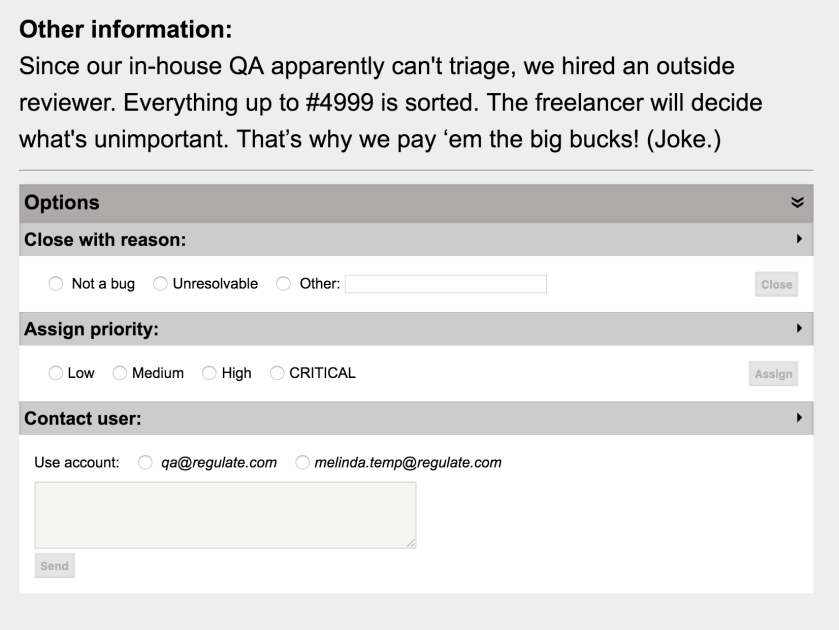
Human Errors describes a world in which human attention (and empathy, care, and understanding) are a severely limited resource. The player plays the role of a contractor brought in to triage support tickets on a product that (we quickly realize) has a rather alarming range of functionality. What you’re supposed to do is close as many tickets as possible, while prioritizing only the undeniably critical ones.

You also have the option — not preferred by the company — to follow up with particular users and try to get more of their stories. Here, you can engage either as a nameless QA figure or via personal email.

But engage too much, with too many people, and the company will start to view you as inefficient, or as going outside the proper parameters for engagement, and your access to the system will be cut off entirely. So you’ll have to budget your sympathy, dole it out cautiously, try not to get in trouble too quickly.

A single interaction node looks like this:

Screen Shot 2018-05-15 at 6.52.54 PM.png

There are, of course, other games out there working through the interface of simulated email or other computer-mediated messaging — I recently covered Grayscale, which puts you in the role of an HR employee resolving complaints, for instance. Several of Christine Love’s pieces act similarly.

But what I particularly like about the system in Human Errors is the way it combines the guided and the open-ended, the effective and the reflective choices. If you choose to close an issue, it goes away, is no longer your problem. If you write an email to a user, you get a brief time — enough to type a short sentence or two — to type whatever you want before the text box fades to “Sent.” It’s not expressive in the sense of a parser input, because you’re not constructing a complex command all of whose aspects will be understood by the game; but it does allow and indeed encourage the player to express something. Continue reading “Human Errors (Katherine Morayati)”