Mid-May Link Assortment

May 16 is the next meeting of the People’s Republic of IF (Cambridge, MA). The agenda is to play something from Spring Thing.

May 19, the Oxford/London IF meetup does a workshop on Tracery and building your own Twitter bots. This is a great introduction to basics of text generation, if you’re interested in that.

Feral Vector is May 31-June 2 this year. This is a joyous, playful indie conference in Yorkshire and has always been delightful when I’ve been able to attend. (I can’t make it this year, alas.)

June 1 is the deadline to vote in the final round of 2017 XYZZY awards.

June 2 is the next meeting of the SF Bay IF Meetup.

June 9, the Oxford/London IF Meetup hears from Graham Nelson about Inform 7’s latest progress, and we look at the parser game space.

June 16, the Baltimore/Washington DC group meets to talk about Grayscale (ideally, play in advance).

*

Competitions

illuminismocoverCongratulations to Michael Coyne for winning Spring Thing 2018 with his parser puzzle game Illuminismo Iniziato (my review here, and he has also written a postmortem).

Robin Johnson has a postmortem for Zeppelin Adventure, and Karona for House, also from Spring Thing.

Congratulations also to all of the finalists for 2017 XYZZY Awards, including Best Game finalists

  • American Angst (m3g1dd0)
  • Eat Me (Chandler Groover)
  • Known Unknowns (Brendan Patrick Hennessy)
  • The Owl Consults (Thomas Mack)
  • The Wizard Sniffer (Buster Hudson)

Articles

Katherine Neil has written up a medium post comparing a lot of basic features between Twine 2 and ink, for those who are curious about what it’s like to write in each of those systems.

Crowdfunding

Aaron Reed is Kickstarting a new tabletop storygame called Archives of the Sky. He also talks more about the game on DelveCast.
http://kck.st/2rd0N5h

Mailbag: Applying Filters to Character Dialogue

The following letter fits right into this month’s topic on procedural generation. I’ve edited (just a little) for length:

Hi Emily! I read your chapter in the Procedural Generation in Game Design book, and was really impressed. I tried to follow up on some of the sources you mentioned (e.g. the Spy Feet game) but I wasn’t able to get a lot of details, and we have a pretty specific use case, so I’d love to beg a moment of your time to get me pointed in the right direction. Or, if answering my question properly takes more than a moment, I’d be happy to talk about a consulting fee…

We’re doing a bunch of what I’d call dynamic writing, which you can read more about here or on our wiki if you’re interested in the specifics. We have procedurally generated characters (heroes in a fantasy setting) with personality stats tied to their histories, and our system allows writers to take those personalities (and other details) into account in 2 main ways. The first is by picking who takes what role in any given story, (e.g. the highest goofball stat in the party might be picked to be telling the joke in a particular story) and the second way is by inserting markup in the text to add variations for specific personality traits (or relationship status, class, age, etc..) For example we can say things like, if the leader is more bookish, they’ll say something academic, but if they are more hothead, they’ll say something aggressive. This markup is also how we handle gendered words and attraction.

One of the things our game supports (due to the 2D art style and just the stories we want to tell) is really dramatic character transformations, like, to take a simple example, you might find a wolf shrine, and make a deal with the wolf god, and get your head replaced with a wolf head. Now you have a bite attack, cool. But it would be great if we could alter the character’s speech to reflect their condition. Likewise for other conditions or origin stories, or frankly (eventually, maybe) personality quirks.

Continue reading “Mailbag: Applying Filters to Character Dialogue”

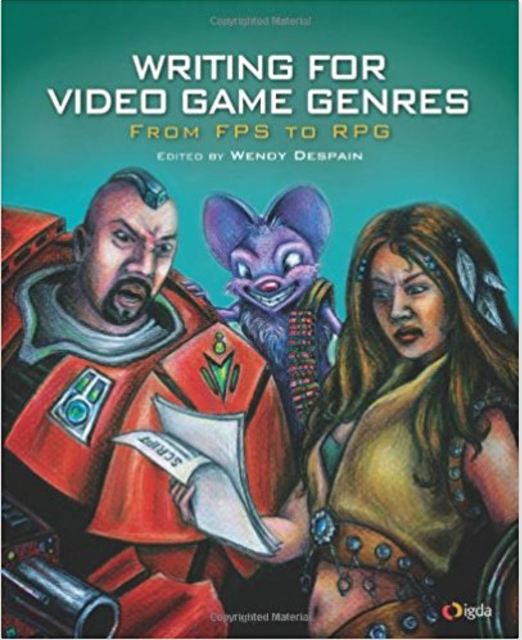
Writing for Video Game Genres: from FPS to RPG (Wendy Despain)

Screen Shot 2017-08-04 at 9.20.39 PM.png

I’ve mentioned this book before; it’s been around for a while, published 2009. Writing for Video Game Genres is (as the name might suggest) divided up into chapters by genre, with contributions by writers experienced in different areas.

As the introduction explains, it’s not a book about how to write in general, or even a guide to getting started in games; it’s meant to provide a deeper dive into the specific challenges associated with various genres, which are often very unlike each other. That said, these chapters are often rather introductory: genre-specific observations, certainly, but likely to be most useful to people who are first considering engaging with that genre, or who want an overview of areas where they haven’t worked before.

The book includes a section on parser interactive fiction, written by J. Robinson Wheeler. Some of the other genres covered are what we might think of game genres (MMOs, sports games, action games, adventure games, platformers, casual games, alternate reality games, serious games…); some are book genres (science fiction/fantasy, horror); and some are focused on particular platforms (handheld, mobile). These days, I’d probably expect to see an additional chapter on writing for augmented and/or virtual reality (and perhaps less about ARGs).

Continue reading “Writing for Video Game Genres: from FPS to RPG (Wendy Despain)”

End of April Link Assortment

May 5 is the next meeting of the SF Bay IF Meetup.

May 7, voting closes for the games in Spring Thing, so there’s still time to play and vote on some games if you’re interested in doing that.

We actually have two Oxford/London IF Meetup events this month, both centered on procedurality, text, and dialogue, but aimed at different skill and experience levels:

spiritCE.png

May 12, we have a workshop on Spirit AI’s Character Engine, which will get comfortable authors who are comfortable using Unity up and running with the tool, and allow them on-going use of the SDK. This is a first introduction to this engine, so no prior experience authoring with Character Engine is expected, but technical comfort with Unity and some experience writing procedural text will both be useful.

May 19, the Oxford/London IF meetup does a workshop on Tracery and building your own Twitter bots. For those who are interested in just getting started with procedural text generation and doing something fun with it in a short amount of time, this is ideal for you.

Feral Vector is May 31-June 2 this year. This is a joyous, playful indie conference in Yorkshire and has always been delightful when I’ve been able to attend. (I can’t make it this year, alas.)

*

I talked with Dark Pixel about NPC interaction in games, what we can do with AI, and what we’re currently working on at Spirit AI:

*

Continue reading “End of April Link Assortment”

Illuminismo Iniziato (Michael J. Coyne, Spring Thing 2018)

illuminismocoverIlluminismo Iniziato is a parser-based puzzle game in Spring Thing 2018, and a sequel to Risorgimento Represso (2003). The protagonist has come from our world, but been drawn into a universe of wizardry. You’ve got an overarching quest to solve, but getting through it requires breaking into various locations and getting access to various objects, as well as relying extensively on tyromancy, the art of scrying via cheese. Your protagonist bumbles around a bit, and while you’re able to do good things for some of the NPCs, you’re also responsible for assorted farcical mishaps.

The puzzles are fair and reasonably clued. I got stuck and had to ask for help once, and it was totally my own fault for not thinking enough about one of my existing inventory items. In general, nothing was too ferociously hard, and several of the puzzles are of the farce-puzzle sort where you will get them wrong in goofy ways before you get them right. I’d say overall it took me around three hours to play through.

The implementation is very solid. I ran into one tiny cosmetic bug once, and it was the kind of error (not having a custom response to looking at the floor in a particular room) that wouldn’t even arise in a game that was less ambitious about its world model. The NPCs have lots to say and a multitude of reactions to what you do, without overpowering the rest of the game. The world state feels complex, and your actions feel consequential, but until a timed sequence in the end-game, I never ran into a place where I’d gotten myself into a dead end by doing the wrong thing. This is quality parser-craft.

Continue reading “Illuminismo Iniziato (Michael J. Coyne, Spring Thing 2018)”

Zeppelin Adventure (Robin Johnson, Spring Thing 2018)

Screen Shot 2018-04-14 at 8.35.32 PM.png

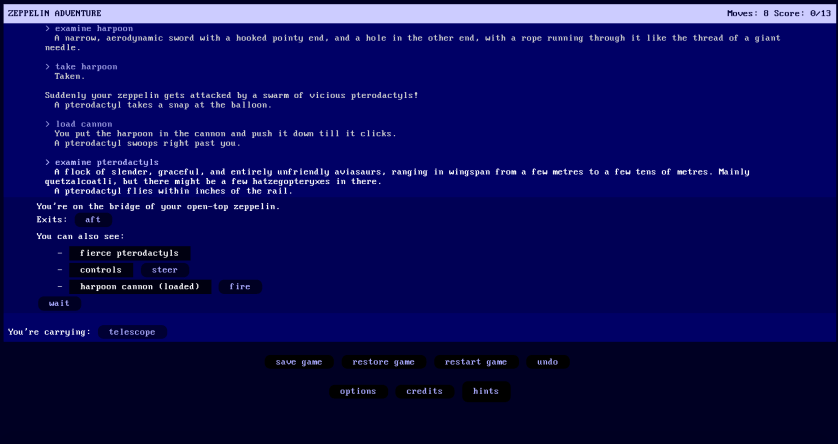
Robin Johnson’s Versificator engine is designed to give the player access to a parser IF-like world model but a choice-based interface, free of verb-guessing. The two previous games in this space, Draculaland and Detectiveland, feature navigation and inventory puzzles that feel quite text adventure-like, but in a more accessible format.

At any given time, the player has quite a few choices available — usually one or several movements between rooms, as well as ways of examining or interacting with environmental objects, and then some things that you can do with your inventory items. But these aren’t listed all in one place; instead, choices associated with something in your inventory become visible only when you’re carrying that inventory item. So there are partially hidden options, and you do generally have to draw some connections yourself before being able to execute a puzzle solution.

zepellincover.jpgFeatured in Spring Thing 2018Zeppelin Adventure continues that tradition, set this time in a wacky-explorer universe where people are plotting out Mars from their giant balloons. Yours, however, suffers an accident and crash-lands on a planet dominated by robots, and you have to go on a quest to find repair parts for your engine.

As the cover art suggests, this is a pulpy kind of story that leans into certain genre conventions both present and historical.

Continue reading “Zeppelin Adventure (Robin Johnson, Spring Thing 2018)”