Venience World (Daniel Spitz, Spring Thing 2018)

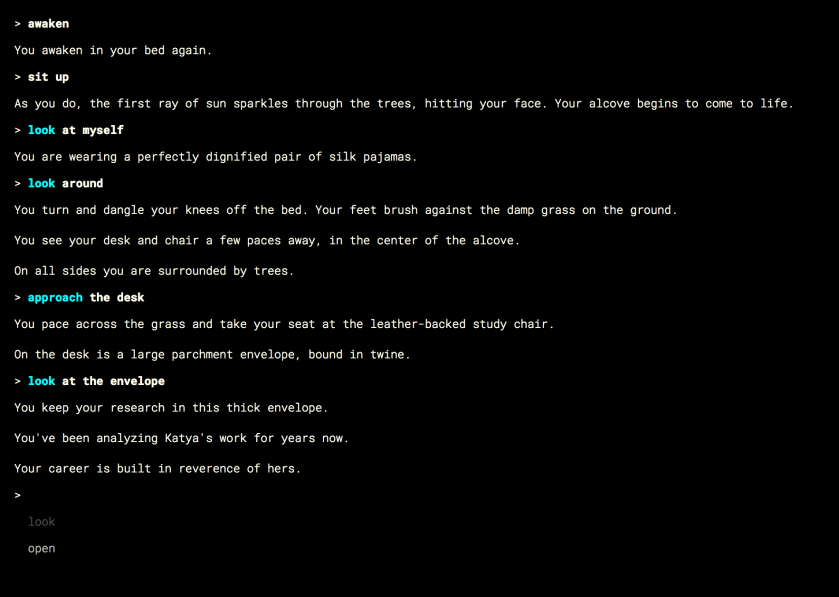
Venience World from Spring Thing 2018 offers another possible revision on the parser. Every turn, you have a command line, but listed below it are suggested autocompletions, one word at a time. You can select an autocompletion with up/down arrows, or you can click on one, or you can type out the contents. After you’ve picked the first word, you get options for the next word or phrase, and so on until you’ve completed a line of input.

Below, for instance, we’re offered the opportunity to start with “look” or “open”:

Screen Shot 2018-04-15 at 1.42.38 PM.png

These parser training-wheels mean that the game can allow the player fairly unusual commands, like BEGIN INTERPRETATION, with no fear of verb-guessing. In this regard, it builds on the author’s previous work Niney, also using unusual parser commands.

Venience World prevents you from reentering a previous command verbatim even if it seems like that command ought to be currently available, and that has results that can feel straight-up buggy. (At one point I repeatedly tried to type LOOK and it would just not register the K keystroke at all, in a weird and disorienting way. I tried several times before I realized that I wasn’t allowed to enter the word LOOK right then, but this feels like the least intuitive way to communicate that to the player.)

There are a handful of previous pieces that have played with similar methods.

Continue reading “Venience World (Daniel Spitz, Spring Thing 2018)”

Life in a Northern Town (People + Places, Spring Thing 2018)

Screen Shot 2018-04-16 at 9.04.33 AM.png

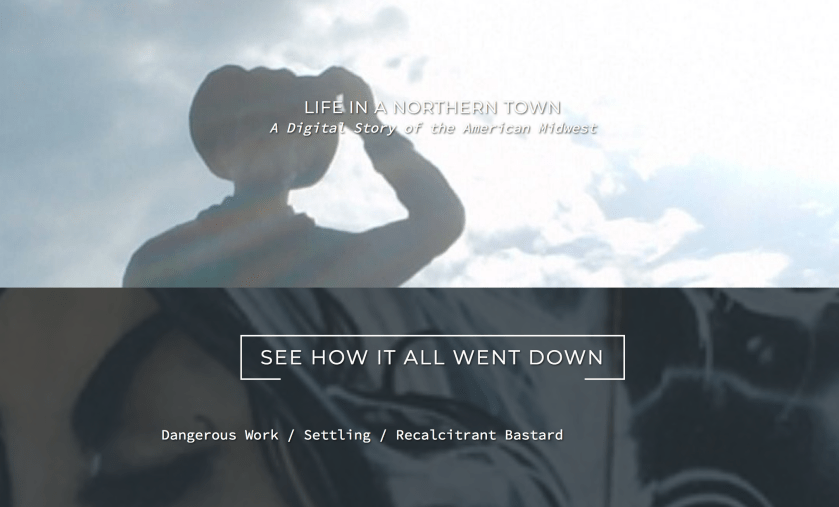
From Spring Thing 2018, Life in a Northern Town is what sometimes gets called dynamic fiction as a subset of interactive fiction: a piece in which, for most characters, you’re never making a single choice that changes an outcome or modifies the shape of a narrative. (Brianna’s chapter, in inklewriter, is an exception: she has actual agency over who she chooses to engage with. But the vast, vast majority of this story is about people making dangerous decisions while the player has no opportunity to intervene or prevent them from doing so.)

For most of the elements, a majority of the clicks are click-to-continue options, and some of the sub-stories in the piece are presented in formats such as groups of images on Instagram, where branching would be very hard to arrange. Other elements are told in Twine or on WordPress, eight different people’s perspectives on the same story — though it’s not really trying for a mimetic effect here. It’s not ARG-ishly pretending to actually be the blogs of all these people. Here and there, images are included, especially on the Instagram segments, but elsewhere it’s almost all text, including the largest chunk of the story which is presented in unstyled Twine.

Still, it’s not the same story it would have been if it had been written into a book. The work of reading it is part of the point, for one thing. This is a story about labor, and the labor is recaptured in the way of reading.

For another, the dynamic-fiction presentation fractures the temporal sequence of scenes, especially in the Twine segments. Often there will be a short scene of dialogue between characters, and then clicking through a link will reveal another beat in the same conversation, another interaction, which might be chronologically before or after the first. It doesn’t really matter how they’re joined up, temporally. I never found this to be confusing. Rather, it gave me a sense that I was getting the overall impression of the interaction and then a couple of other key moments from that interaction, in the same way I might when going over a memory in my head. A handful of times the revealed secondary beat actually overturns the sense of the initial interaction.

So I can see reasons for the way it’s presented, but this is a long piece of work — took me some hours to read, and I’m a pretty fast reader — and by the end I would really have appreciated a more comfortable, less laborious reading experience. Other markers are missing, too: there aren’t chapter breaks, so sometimes the story ratchets forward to a new scene or location without an explicit division. There’s no progress indicator, either, which I really miss when I’ve got a multi-hour work on my hands.

Something like this stands or falls on the quality of its writing. In my initial encounter with the first of its linked stories, “Dangerous Work”, I was a little discouraged by the styling and structure — of course it’s not always the case, but standard, unformatted blue-and-white-on-black Twine sometimes goes with low-effort authoring. But I found myself continuing to read screen after screen, connecting with the luckless protagonist and her precarious life in and around Minneapolis.

Continue reading “Life in a Northern Town (People + Places, Spring Thing 2018)”
The 39 Steps (John Buchan remade)

Screen Shot 2015-10-01 at 11.12.38 AM

The 39 Steps app is an adaptation of the book and movie of the same name, available on Steam. It gets a lot of comments about how it is not a game, which is probably unsurprising given the Steam audience. Some of the things written about it make defenses about how it’s really meant to be an enhanced book, and therefore the lack of gameplay is to be expected.

I don’t demand recognizable gameplay elements in my interactive stories, but I do want some consistency in how the interface works and how it’s engaging the audience.

39 Steps uses interaction and gestures for pacing: click to move the story onward and read more text. Rotate the mouse to move the text forward or backwards. (I hated this one. I don’t have a mouse; I’m using a trackpad. I never quite worked out whether I was doing the gesture correctly.)

It also uses interaction to create a sense of place and context. Sometimes the text narrative will pause and put you in an environment with two or three interactive objects you can look at more closely. This is a bit like Gone Home with less walking or looking for pale pixels in dim corners, which, in my view, is a net positive. The main narrative is full of pompous, stalwart-colonial stuff about going to South Africa and establishing diamond mines, or the protagonist’s friend deciding to try his luck in the Congo. This is true to its original period but hard now to read without at least an undercurrent of distress. So when in the protagonist’s club we find objects such as this:

Screen Shot 2015-10-01 at 11.09.14 AM

…they serve to ground the story more concretely in its particular time, and to suggest that the app doesn’t uncritically approve of all this empire-building. (Unless, that is, you’re the sort of person who can look at that map and think “Rah, the good old days!”)

All the same, though, it felt like an adaptation without a strong understanding — as though someone had looked at the original story and asked where they could stick in some pictures and clickable bits, rather than reimagining it from the ground up as an interactive story.

This piece was recommended to me by someone who finds most traditional interactive fiction disappointing, because they’re looking for more audio-visual richness.

(Confession: I found this piece sufficiently irritating to interact with that I did not complete the whole thing.)


Spy EYE (The Marino Family, Spring Thing 2018)

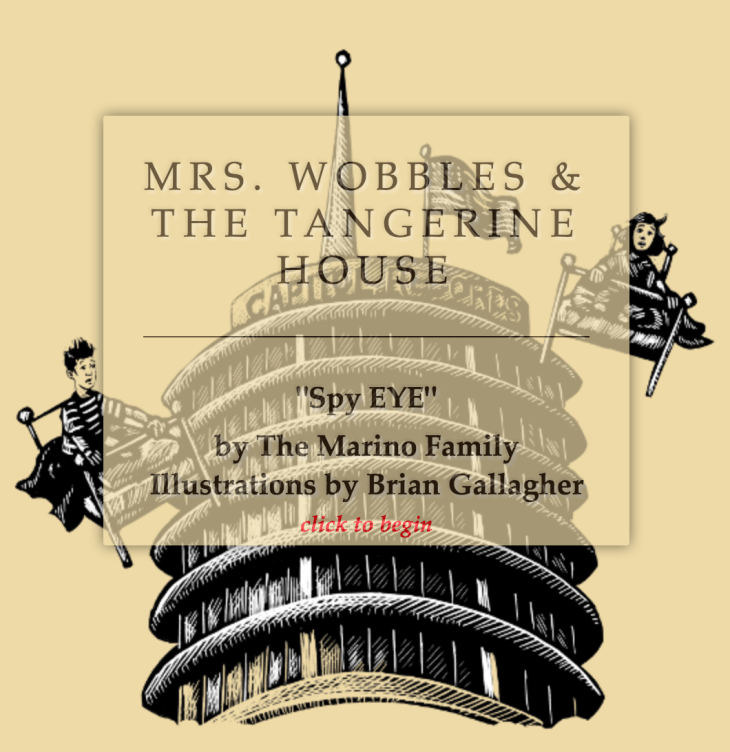
Screen Shot 2018-04-15 at 1.06.05 PM.pngFrom Spring Thing 2018, Spy EYE is a continuation of the Mrs. Wobbles series (Mysterious Floor; Parrot the Pirate; Switcheroo). Like the earlier pieces in the series, it’s an Undum work that tells a part-fantasy, part-reality story about children in foster care. (I also highly recommend Lucian Smith’s guest post about Switcheroo.)

In this case, the protagonists are a Latinx brother and sister whose parents are missing, and the story revolves around going to look for them and rescue them.The story lets you play as either Juan (the older brother) or Ichel (the younger sister), and they have different takes on whether to expect their parents back any time soon. That touch reminded me of a few other stories where the choice of viewpoint character is meant to shed some light on a family situation — Stephen Granade’s Common Ground, most notably.

Continue reading “Spy EYE (The Marino Family, Spring Thing 2018)”

Known Unknowns (Brendan Patrick Hennessy)

knownunknownsKnown Unknowns is a four-part Twine series by the author of Birdland and set in the same universe. The protagonist is Nadia, a Toronto teenager who is trying to deal with her sexuality, fraught relationships with several of her classmates, various annoying teachers, and the real possibility that she has just encountered a ghost raccoon.

Like Birdland, this is Y/A queer romance — but this time the choices are less about self-characterization and more about how you’re going to interact with the side characters. (And, as in Birdland, the core plot remains the same regardless. This is not as far as I can tell a heavily branching story, but the interpretation of individual scenes can vary a good bit.) Known Unknowns is immensely charming and accessible, solidly structured and well paced — and as it’s now available in its complete form, there’s no waiting between episodes.

Continue reading “Known Unknowns (Brendan Patrick Hennessy)”

Mid-April Link Assortment

April 18 is the next meeting of the Oxford/London IF Meetup, where inkle studios’ Joseph Humfrey will talk to us about making interactive text look good and flow well — and in my view there’s no one better to learn that from.

April 23 is the next gathering of the Dublin Interactive Fiction Meetup.

April 25 is the next meeting of PR-IF, the Boston/Cambridge IF Meetup.

May 5 is the next meeting of the SF Bay IF Meetup.

Also May 5, the Baltimore/Washington DC IF meetup looks at Sherlock Indomitable.

Spring Thing 2018 games are available to play, and judging continues through May 7.

Exact date is still TBD, but May’s Oxford/London IF Meetup will be a workshop on using Tracery for Twitterbots.

Feral Vector is May 31-June 2 this year. This is a joyous, playful indie conference in Yorkshire and has always been delightful when I’ve been able to attend. (I can’t make it this year, alas.)

*

At the risk of Overthinking It, I’ve been loosely theming blog content on different topics each month, and also trying to align content with what the Oxford/London IF Meetup is doing that month. Here’s what you can expect around here for the coming several months:

  • This month we’re looking at user interface and different types of IF experience in that sense.
  • Next month, May, is about procedural text and generated meaning. The London IF Meetup date for this is still TBD, but the subject matter is known: George Buckenham will be leading a workshop on using Tracery and building Twitter bots.
  • June is all about parser IF and expressive input. Graham Nelson will be talking to the London IF Meetup about what he’s been doing with Inform lately.
  • July, quality-based narrative approaches. Leigh Alexander will talk to London IF Meetup about narrative design for Reigns: Her Majesty. (There may be spreadsheets. I get very excited about spreadsheet talks.)

*

A number of the talks from GDC 2018 are now available on the GDC Vault, some of which are free. Some interesting items from there:

AI Wish List: What Do Designers Want out of AI?

Exploring Helplessness in Games with ‘Bury Me, My Love’ — I’ve mentioned this game a few times previously, but it tells a story about Syrian refugees.

Game Design Patterns for Building Friendships — not so much an IF topic, but an interesting systems design question.

Procedurally Generating History in Caves of Qud — cool stuff if you are into procedural text, procedural backstory, and simulation-heavy games.

Queens of the Phone Age: Narrative Design of Reigns: Her Majesty. As mentioned above, we will be hearing more from Leigh about writing this game at a forthcoming London IF Meetup.

Writing Modular Characters for System-Driven Games — Tanya Short talks about how you structure and write for procedural characters.

This doesn’t cover nearly everything interesting that happened at GDC, but some of the other talks remain paywalled for the time being.

*

You can find out more about inkle’s forthcoming Heaven’s Vault at Verge, with trailer videos and a discussion of their constructed language used in gameplay.

Jason Grinblat shares some amazing procedural map generation examples.

My talk from the Malta Game Jam is available here.