Grayscale (D. Fox Harrell et al)

Screen Shot 2018-03-31 at 7.01.51 AM.png

Grayscale is a short piece about harassment and appropriate behavior in the workplace, conducted through an email interface (which makes it one of a smallish category of epistolary IF). As the HR representative, you choose which of several responses to offer to each complaint you receive. Do you intervene between coworkers? File harassment reports when you have only tenuous evidence to work with? Allow employees special assistance because of issues in their personal life?

The framing of the game implies that many of these would be tricky judgment calls:

Tales of sexism, sexual harassment, and sexual assault are bubbling angrily through the wires. In late 2017, the media attention to this perpetual ill and the harrowing #metoo stories sparked us to share our own computational tale of fiction that we humbly hope can participate in this dialogue… The experience is intended to provoke players to reflect critically on sexism in the workplace, both overt & hostile and more subtle.

In practice, I found myself relatively unambivalent about most of the events in the story. Where I was uncertain, it seemed as though a real person in this situation would be aware of applicable laws and corporate policies. (It’s possible that I’m not quite the target audience, of course: as a female manager, I’ve had occasion to think about a variety of sexism-in-the-workplace issues from multiple angles by now.)

As to the characters — they came through distinctly enough to keep me engaged for the (short) duration of the game, but there wasn’t really enough time for them to develop extensively.

In terms of interface and pacing, though, I found it worked very well for me. The email interface means it’s easy to review past interactions. There are times when several urgent emails arrive at once, and others when things feel relatively quiet. The protagonist’s private experiences are tracked in a “notes” section (which also includes a diagram of the company hierarchy — useful when you want to double check whether one character is the boss of another, or merely a sniping colleague). As UI, it sufficiently replicates UI I’m already using all the time to feel comparatively transparent.

Mailbag: Viewpoint for Cut-Scenes

I’m working on a Twine game with a similar storytelling style to the 1995 Lucasarts game Full Throttle. 

I noticed a storytelling element within the game, and I was wondering what type of story/narration the game could be considered to have. 

The game opens with the protagonist, Ben, saying a few lines that set the scene and set up the story. It almost sounds as if he’s telling the player a story. 

But then, the cutscenes involve events that Ben is not present for and may not logically know about. Examples, which involve spoilers, are: All events while Ben is passed out in a dumpster in the game opening, a lot of the hovercraft police officers dialogue, the murder of Malcolm Corley, Ripburger’s henchmen chasing down the reporter who photographed the murder and attempting to murder Maureen, and a few more, further into the story, that I’m missing. 

But the game also has the live element that comes with being a game, and it involves Ben’s narration and comments based on the action menu, as well as through conversations. 

I’ve been trying to figure out how this storytelling style would work within a text-only game. It seems like it could be a type of frame story? Many important details would be missed if the perspective stuck solely to Ben, as it’s also, in a way, the story of the other major characters in the story. 

I know I can’t perfectly translate it because while they have similar natures, they’re also significantly different styles of games. But I also feel that to capture the feel of FT, I should employ a similar writing style, which to me seems like a sort of framed, first person semi-omniscient type of thing. 

If you have any advice, I’d love to know!

This question feels like it’s asking several things at once:

  • Terminology. What do we call the viewpoint of a game that sometimes shows you things that the player character is not present to see, especially in the case that the player character is otherwise the narrator?
  • Canon. Are there other text-based games that do anything like this? How do they handle it?
  • Craft. How would one introduce these scenes in a way that feels natural, considering they don’t include the protagonist?

Continue reading “Mailbag: Viewpoint for Cut-Scenes”

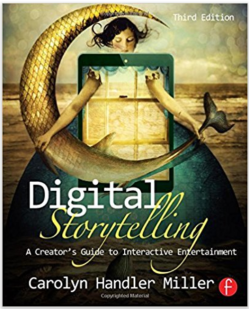
Digital Storytelling: A Creator’s Guide to Interactive Entertainment (Carolyn Handler Miller)

Screen Shot 2018-02-03 at 2.59.40 PM.pngDigital Storytelling: A Creator’s Guide to Interactive Entertainment. This book has gone through several editions, the most recent the third edition from 2014.

ETA: There is now a new 4th Edition available, which readers may find more relevant. It is not the same edition reviewed here, but it is more current.

Miller is interested in works that are digitally delivered, interactive, non-linear, narrative, with distinct characters, participatory and navigable. Each of her chapters ends with some idea-generating exercises to help you brainstorm about the topics she’s just raised.

Unlike many of the books I’ve been surveying recently, this one is not specifically focused on games or the game industry; instead, it’s looking from a storyteller’s perspective at how to deliver experiences for which the page of a book is not necessarily sufficient. That in itself gives it a rather different flavor: many games writing books are quick to identify the ways in which their game genres are constraining or limiting, or present “challenges”. By contrast, Digital Storytelling is about what interactivity can add to the writer’s toolkit. (I feel this very much myself, and feel the absence of these options when I’m working in a more linear medium.)

At the same time, the book is directed at readers who might be writers in linear media but have barely considered interactivity before, and therefore need to be taught canon and craft entirely from scratch. It also anticipates a different set of prejudices and concerns: the chapter on video games spends half a page on the concept of AI and considerably more space on issues like video game addictiveness and whether violence in games is a serious problem.

Continue reading “Digital Storytelling: A Creator’s Guide to Interactive Entertainment (Carolyn Handler Miller)”

End of March Link Assortment

April 1 is the date to submit games to Spring Thing 2018, and they’ll become available for people to play on April 5. Bonus link: here’s a history of Spring Thing, for those who are new to the competition.

April 6-8 is Now Play This in London, a curated show of experimental gameplay that coincides with the London Games Festival.

April 7 is the next meeting of the SF Bay IF Meetup.

April 7 is also the next meeting of the Baltimore/DC Meetup. The topic there will be Papers, Please.

April 18 is the next meeting of the Oxford/London IF Meetup, where inkle studios’ Joseph Humfrey will talk to us about making interactive text look good and flow well — and in my view there’s no one better to learn that from.

And further in the future but worth planning ahead for: Feral Vector is May 31-June 2 this year. This is a joyous, playful indie conference in Yorkshire and has always been delightful when I’ve been able to attend. (I can’t make it this year, alas.)

Really far in the future, IFTF has announced work on an IF/narrative games conference to take place in Boston in 2019.

*

New Releases

Nicholas Brakespeare is crowdfunding a new parsery game called The Pilgrimage, in a home-made engine.

MyLadysChoosing_WebCatalog.png

Coming out this month from Quirk Books is My Lady’s Choosing, a CYOA-style Regency romance.

Worldbuilding America: Where the Water Tastes Like Wine

Screen Shot 2018-03-10 at 1.13.52 PM.png

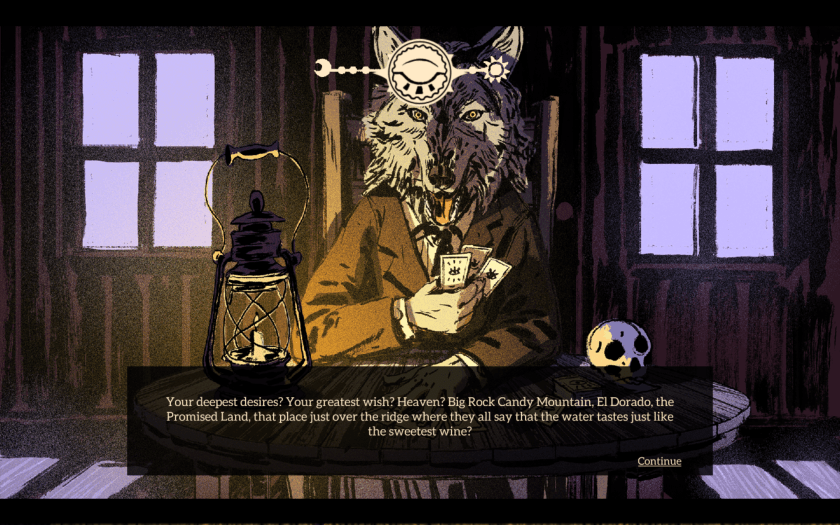
A country made of stories. Where the Water Tastes Like Wine is a game about the shining lie of America: about the dream of freedom and justice and opportunity, and the darker, more tarnished truth. Stories are currency and resource and the means of unlocking connections with other players. And Johnnemann Nordhagen, the creator of the project, decided to collect those stories from many writers of many backgrounds, making it genuinely multi-vocal.

It was delightful to be asked to contribute, and I knew as soon as I played the original trailer that this was something I wanted to be part of.

The request came when I was getting used to being an immigrant outside America, looking back with a mixture of homesickness and anger, sadness and relief. I live now in a country where I don’t fear being SWATted or shot, and where my health care is free. Meanwhile, UK citizens ask about the American health care system the way you might ask to be told a ghost story. Let us hear how you paid a thousand dollars for an unnecessary ambulance ride of one mile; let us shiver pleasantly and then relax knowing that we will not suffer the same fate. It gets darker when we get to “Also, I have friends who died of cancer because they couldn’t afford to see a doctor about their symptoms until it was Stage IV.” I choose how I tell the story of America on a daily basis.

And I listen to the stories of the UK with the same doubts. You say you had a great Empire and relinquished it, and now you look on American imperialism with the smug compassion of a sober alcoholic. You say you’re not so racist and your police aren’t so brutal. You say you have a safety net for your citizens, and that you’d never let your streets be full of homeless people the way they are in San Francisco. There’s some truth in all that, but also a good measure of lie. I can see the rough sleepers in London; I can see them in Oxford. They’re not invisible.

Stories lost. Johnnemann gave me a character prompt: Bertha, a Dust Bowl survivor who leaves Oklahoma for California.

As it happens, I had a grandfather who was born in Oklahoma and moved to California — and I know very little about the circumstances, except that his personal trajectory was inflected more by the war than by weather or crop failures. I never had a single conversation with him about it.

When I was old enough, my mother passed a few things on to me that he’d told her while she was growing up. They were mostly explanatory notes. Your grandfather is like this because. His friends died and he survived and he didn’t understand why either of those things happened. He went into Germany in 1945 and he saw very bad things. Don’t ask him about it. There was a child he met that he tried to save and he couldn’t. Don’t ask about that either. He came back from the war and his sisters were surprised he had lived through it. They weren’t expecting him back and they’d spent the savings he left with them. Definitely do not mention this. Keep it out of your mind when you see or hear about your great-aunts.

The past was a wound fifty years old, still too raw to touch. The stories could not safely be passed on. I only write this now because my grandfather and his sisters and my grandmother are all gone.

Other stories in my family’s history were lost in other ways. I have Native American blood from several parts of the family tree, but I don’t know the languages, the cultures, the religions or histories of any of my Native ancestors. Something of value was stolen from me — by a different set of great-grandparents. What reparation can I, a woman of European appearance and culture, offer myself, a descendant of displaced Native people? There’s no resolving that.

Stories borrowed. For Bertha, I had dots on a map of Oklahoma where my grandfather’s parents and grandparents had lived. I had some vague outlines of how they got there — including the Cherokee ancestors who had walked to that location, in the worst of circumstances. But I needed more specifics, and I also needed to get a sense of the flavor of period speech: this time, place, and character are well outside my personal idiom.

So to find Bertha’s experiences and her voice, I immersed myself in period sources. Reread Grapes of Wrath, of course, but also Whose Names are Unknown, a rather less-read work by Sanora Babb that provided more specific details, and which felt like an especially good inspiration for writing about marginalized and unheard voices:

Sanora Babb’s long-hidden novel Whose Names Are Unknown tells of the High Plains farmers who fled drought and dust storms during the Great Depression. Written with empathy for the farmers’ plight, this powerful narrative is based upon the author’s firsthand experience.

Babb submitted the manuscript for this book to Random House for consideration in 1939. Editor Bennett Cerf planned to publish this “exceptionally fine” novel but when John Steinbeck’s The Grapes of Wrath swept the nation, Cerf explained that the market could not support two books on the subject. — Sanora Babb website

I also read interviews with Oklahomans and song lyrics by Woody Guthrie and a few repositories of stories about the inhabitants of my great-grandparents’ town. It didn’t make it into the final game, I believe, but we were asked to provide a bit of local folklore. The one I wrote up was a story recounted about an ancestor of mine who supposedly fell into what he thought was an open grave during a black-out dust storm.

Continue reading “Worldbuilding America: Where the Water Tastes Like Wine”

Worldbuilding in Immersive Theatre, and the Punchdrunk style

Earlier this month I took a one-day design masterclass with Punchdrunk, the immersive theatre company. I’ve previously written about seeing their work Sleep No More and Against Captain’s Orders. Their work has been a design inspiration especially for thinking about narratives where the characters are all in motion and the player is choosing which to track.

Going into this session, I was curious whether I’d learn methods of environmental storytelling that would cross over into game applications. I was also curious how they approach developing a physical space around a story concept, and what questions they ask in order to develop the character.

If you’re considering signing up for a class — I think they’re on hiatus now, but the opportunity might reopen in the future — I’ll cut to the chase and say that it was a fascinating, fun day and totally worth doing; that I enjoyed the activities and instruction and had a great time meeting the mix of other practitioners in the same space, who included museum curators, drama instructors and students, other game designers, and a few “I just love Punchdrunk and was curious” types.

Punchdrunk2
Our group decorated a space (with only paper and string) to evoke a character from a short story (being intentionally a little vague here to avoid spoilers)

At the same time, I should acknowledge the news about the harassment of actors at Sleep No More productions. This didn’t come up in the course of the workshop, and I had scheduled mine before that news item broke, but I mention it in case that information affects your desire to engage with the company’s work.

The rest of this article will be talking specifically about what we learned in the context of video game design and story-telling — some items that I found expectedly or unexpectedly useful, and also some places where I’m not sure the inspiration would successfully cross over.

Continue reading “Worldbuilding in Immersive Theatre, and the Punchdrunk style”