Spring Thing 2017: Not Quite a Sunset

notquitecoverNot Quite a Sunset describes itself as a hypertext opera, a research project into allowing the player to influence how the music changes and evolves, together with the plot of a story. I had a weird time with it, and I’ll describe what that experience was, but I’m not sure the results deserve to be called an actual review.

I am not an expert in music, and post-Wagner opera I would identify as particularly a weak point of mine: I’ve seen Akhnaten in person, heard a little other Glass here and there, and that’s about it. I don’t feel equipped to comment on the form of the opera, nor about how interactivity might affect that form.

What I can say, in my musically uninformed way, is that the music in this game had a primacy that soundtracks usually do not. Individual instruments stand out. There is an articulate quality to the tune. The game’s blurb describes it as “a story with a soundtrack,” but what I experienced from it was very much not that; soundtracks fade to the back, supporting. What I experienced was a musical piece sufficiently interesting that I had a hard time concentrating simultaneously on the longish blocks of science fiction that accompany the opening.

Continue reading “Spring Thing 2017: Not Quite a Sunset”

More from Spring Thing 2017

Looking at a couple more Spring Thing games: this time, it’s Ted Strikes Back and Enlightened Master.

Ted Strikes Back is a sequel to Anssi Räisänen’s Ted Paladin and the Case of the Abandoned House, which I reviewed when it was in the 2011 IF Comp. The conceit is that the protagonist is aware of being the hero of a text adventure, and must struggle with the resulting constraints. In Ted Strikes Back, some of Ted’s verbs have been stolen from him, which leads to exchanges like so:

> open wardrobe
The verb ‘open’ is not in your vocabulary.

Flabbergasted, you stare at the error message above. You certainly do know the verb ‘open’. What has
happened?

The puzzles, in other words, are about how to deal with situations that could only arise in the context of a text adventure.

This is definitely a piece aimed at parser IF fans who’ve been around since the rec.arts.int-fiction days. It responds to XYZZY; it features an old-fashioned maze with a trick solution; it jokes about parser game surrealism in a way that’s likely to make the most sense if you played For a Change (Dan Schmidt, 1999), So Far (Andrew Plotkin, 1996), or some of the other lesser-known works that borrowed the same ideas. I also ran into easter egg references to Christminster (Gareth Rees, 1995) and The Meteor, The Stone, and A Long Glass of Sherbet (Graham Nelson, 1996), and I suspect there’s probably more of that kind of reference to be found.

Continue reading “More from Spring Thing 2017”

Spring Thing 2017

Spring Thing 2017 is now launched, with fifteen Main Festival entries and seven Back Garden items, including Twine, ink, Inform, Quest, Texture, ALAN, and Squiffy works. I haven’t been through nearly all of them yet, of course, but here are thoughts on two: Bobby and Bonnie and Niney.

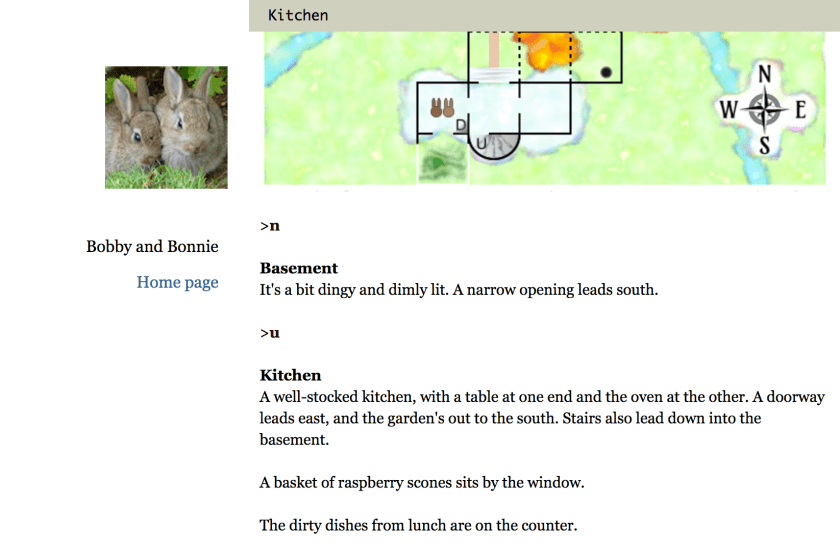
Bobby and Bonnie is a parser IF game with a couple of rabbit protagonists, illustrated with map and compass to help you follow along:

Screen Shot 2017-04-08 at 2.00.14 PM.png

Continue reading “Spring Thing 2017”

Small Plotting Trick for Choice-of Work

Choice of Games pieces also very often involve multiple romantic or career options; and in my WIP, I found that there was kind of a risk of making all the romances be variants of “…and then you ride into the sunset with person X.” From a storytelling point of view, though, I don’t find that very satisfying, because it makes those characters interchangeable and makes it harder for them to have distinctive arcs in the body of the text.

Recently I tried an exercise that helped with this. It is really pretty trivial but I shared it with a few people who found it useful, so now I will share it more widely. The exercise:

Continue reading “Small Plotting Trick for Choice-of Work”