Conference access, and related topics

This post started out as part of my monthly link roundup, but it turned into its own thing. The link roundup will still appear, but for ease of digestion I have separated the two.

ICIDS, the International Conference on Interactive Digital Storytelling, has a call for papers for this year’s conference, and will also be hosting an exhibition of related works. The deadline is June 17, and the conference itself will be November 15-18 at the Institute for Creative Technologies, University of Southern California, Los Angeles, USA. Discussions of interactive narrative systems and/or specific works are often appropriate for this conference.

Likewise, there is now a creative track for the ACM Hypertext conference, which would be an appropriate place to submit Twine, Undum, or similar hypertext works for display. The deadline for that submission is May 6, 2016, and the conference itself (which contributors are expected to attend) is 10-13 July 2016, in Halifax, Canada.

Students traveling to the Hypertext conference may be interested in this support application to help defray travel costs. Except for invited keynote speakers, I am not aware of any financial provisions to support non-students in traveling to either of these events if they don’t have institutional support to do so. (Indeed, most academic conferences do not waive your registration fee even if you are speaking, unless, again, you’re doing an invited keynote. Those fees are usually on the order of hundreds of dollars rather than thousands as at GDC, but it is inevitably something to be aware of.)

More distantly but still relevant to some readers of this blog, there’s also

  • the meeting of the Electronic Literature Organization (Victoria, BC, June 10-12, submissions closed)
  • ICCC, the International Conference on Computational Creativity (Paris, June 27-July 1, submissions closed)
  • (Edited to add:) nucl.ai, artificial intelligence in creative industries, which this year has tracks on procedural content generation and dynamic storytelling (Vienna, July 18-20, submissions still open through April 15).
  • DiGRA/FDG, a joint meeting of the Digital Games Research Association and the Foundations of Digital Games conferences (Dundee, August 1-6, submissions closed)
  • IEEE Computational Intelligence in Games (Santorini, September 20-23, still accepting papers and demos)
  • AIIDE, Artificial Intelligence and Interactive Digital Entertainment (Burlingame CA, October 8-12, still accepting papers).

Yeah, I probably can’t go to those either. Accessibility of conferences is an issue. So is the fact that in some subfields of games, one is “expected” to go to X or Y conference in order to be taken seriously in that particular subfield, which is taxing for people who are busy and not independently wealthy.

Mattie Brice has written about boycotting GDC this year because it does too little to support marginalized creators who contribute content; and one of the reasons John Sharp withdrew from IndieCade was out of concern about whether it was really helping people at the edges to do their work in a sustainable way.
Continue reading “Conference access, and related topics”

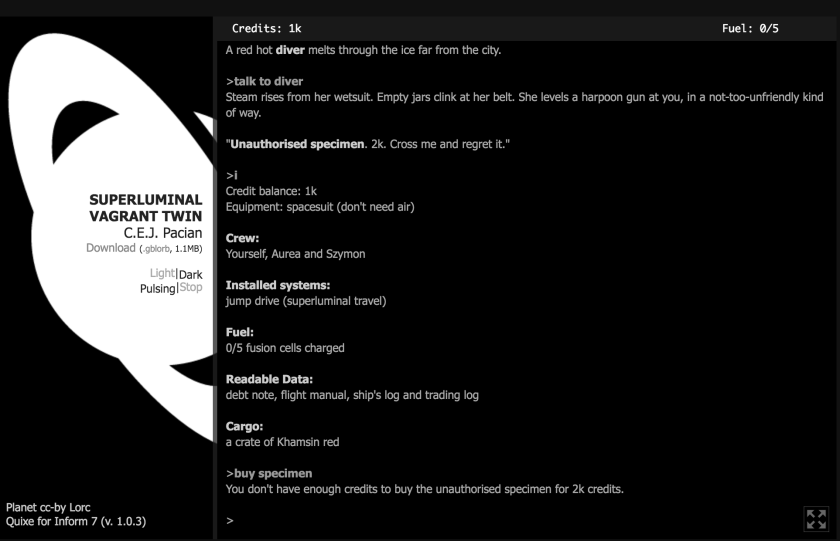
Superluminal Vagrant Twin (CEJ Pacian)

Screen Shot 2016-03-27 at 5.12.11 PM.png

Superluminal Vagrant Twin is a new parser piece by CEJ Pacian, an exploration-and-trading adventure set in a universe of bizarre and evocative planets. The premise is that you’re trying to collect five million credits — an amount that seems frankly impossible given your initial resources — by jumping your hunk-of-junk ship from one planet to the next in search of odd jobs.

With large-scale solar system engineering, terraforming, and bioengineering, the setting reminded me a little of both Sun Dogs and Hoist Sail for the Heliopause and Home; but Pacian’s universe is populated with more characters than either of those.

Pacian’s past work includes the exploratory fantasy Weird City Interloper, the partially procedural Rogue of the Multiverse, the ant simulator Dead Like Ants, the on-rails puzzle shooter Gun Mute, and the conversation game/love story Snowbound Aces, among others.

As wildly varied as those pieces are, they tend towards a few common features: a light, focused world model that prioritizes a few verbs and sets aside the rest; characters and settings communicated in a few quick and evocative strokes; a sense of a world never completely explained.

Superluminal uses these techniques to create a fairly simple but very novice-friendly and well-directed parser experience. The verbs the player will need are all listed up front. Important nouns are in boldface, and there are rarely more than four or five to interact with in any given location. A couple of status commands keep notes on everything the player has encountered so far, which makes notetaking unnecessary; and the hyperjump premise of the story means that there is no map in the traditional sense, but that most locations are accessible within one or two moves at all times. I found that I could play in a more casual mode than I usually bring to parser IF.

Meanwhile, Superluminal does as good a job as I’ve seen at a trade-and-exploration parser game, even including a little light grinding but without becoming too dull or frustrating. Sometimes you’ll find or be able to buy objects and then need to figure out who else in the universe might be interested in paying you for them: this is complex enough to reward the player for actually reading the text, but no so complex that you’re likely to get stuck for long. And there are lots of ways to win — I completed the main plot arc without getting anywhere near 100% of the money-earning side quests. Among parser IF games with a monetary score, Superliminal offers just a bit more of a story development than in Captain Verdeterre’s Plunder, but it’s not nearly as hard to win as Gotomomi, whose much more intricate world model sometimes felt a bit overwhelming.

And while we never interact long enough with any NPCs to get to know them very well, there’s enough here about the different cultures, politics, and art styles of the various planets to make for a very entertaining playthrough.

I got through it in probably around 90 minutes of play time, but it would take longer to find every detail. Online and downloadable versions are both available.

GDC Highlights, Thursday/Friday

(Belatedly, because I was in a place without good wifi for a few days after the conference, apologies:)

Thursday was the day of Lost Levels, when folk coalesce in the Yerba Buena Gardens for unconference-style talks about subjects dear to them. It’s a good place to find altgames conversations; and as it happens, Kate Compton had organized a Lost Levels section about AI use for altgames purposes, and even put together a zine introducing various tools. So that was pretty excellent, though I wasn’t able to attend all of it, as I also had lunch plans. It made for very different types of discussions from the utility scoring examples, combat and pathfinding solutions that tend to make up most of the main AI Summit.

Later that afternoon, we had a procedural text discussion in the park as well, sort of by accident. I’d put out feelers on Twitter looking/expecting to find maybe three or four people who wanted to have coffee and talk about textual procgen. In practice we had such a large crowd that we couldn’t fit into a coffee shop and had to return to the Gardens and effectively be a Lost Level of our own. (I’d feel bad about the unofficial nature of our participation there, except that the whole point of LL is to be unofficial, so hm.)

In any case, that turned into a set of really enjoyable conversations about what people are looking to do with procedural text, whether that’s representing a complex world model, or focusing on the poetic aspects of the language, or combining text and art in evocative ways. Devine Lu Linvega told us a bit about Paradise; the Sproggiwood/Caves of Qud creators talked a bit about using procedural text in a game that isn’t primarily text based; I talked some about Annals of the Parrigues and also about what I’d like to do with partially procedural dialogue in order to blend emotional aspects better into authored conversation. There were a bunch of other subgroups of the conversation that I didn’t overhear, since there were so many people, but it was great to meet so many people who are into the topic, and I hope to follow up on some of these things more later.

As a bonus, here are Kate Compton’s slides on procedural text using Tracery.

*

Friday morning Squinky spoke about designing discomfort, giving an overview of many of their own works as well as a survey of others in this general space, and talking about techniques such as realtime dialogue that doesn’t give the player time to contemplate their response (or in which pauses are noted); controls that are intentionally awkward in order to represent social discomforts.

*

Friday morning there was also a talk about idle games that sparked some interesting discussion, though I wasn’t able to be at that one. (The talk isn’t available yet, and I don’t know for sure that it will be; however, here’s a talk from 2015 that sets some of the stage.)

*

Friday afternoon, I spoke as part of the Rules of the Game panel, and argued for why we should be thinking about visualization (and visualization tools) early in the process of designing a new system; on the same panel, Liz England gave a great talk about documentation and specifically about knowing the target audience of your documentation so that you can focus on the kind of content and presentation that will work best for them. At the same time, Joe Humfrey was giving an introduction to ink, inkle studios’ newly open-sourced IF tool.

Later Friday afternoon, I also checked out the talk on lost greats from the TRS-80, including Atlantic Balloon Crossing and a few battle/resource-collecting games. I was struck by how much the pleasure of these lies in watching the numbers go up and down and engaging with a simulation as a piece of math. Perhaps this isn’t so far off from the appeal of idle games either.

GDC Highlights, Tuesday/Wednesday

Tuesday: I went to several AI panels; they were fun, but mostly not related to what I write about here, except by loose analogy. (When AI goes wrong, it goes really really wrong, though.)

Richard Rouse III gave a talk on dynamic stories for games, with shoutouts to some IF work, Versu and Prom Week, and Sam Ashwell’s CYOA types. (Gamasutra writeup here.)

Sam Barlow talked on Her Story: the research that went into the project, the use of mystery and player imagination to fill gaps, etc.(Gamasutra writeup.)

To me, the most compelling moment was the slide of the spreadsheet he used to track word use and figure out which elements needed to be changed. I could really have gone for a 20-30 minute deep dive just into that aspect of the writing. (Hypothesis: because Her Story was successful and looks simple, there will probably be ripoffs, and they will probably be terrible. There is a lot of invisible craft that goes into the word choice to make the game function as it does, and someone careless about that issue could get it very wrong.)

Continue reading “GDC Highlights, Tuesday/Wednesday”

GDC Highlights, Monday

pry_textExpand

Today got off to an excellent start with the Narrative Innovation Showcase, which included Samantha Gorman on PRY; Aaron Reed on the Ice-Bound Concordance; Katie Chironis on Elsinore, a time-looping Hamlet game that you play as Ophelia; Nina Freeman on Cibele; and Richard Rouse on The Church in the Darkness. There’s a Polygon article about the panel, though that leaves out TCitD and may also give the impression that the discussion was mostly a tired rehash of the Authorial Intent Vs. Player Agency battle. It wasn’t.

The showcase was curated by Clara Fernández-Vara and Matthew Weise, and it made for a really great overview of some of the current experimentation in interactive narrative. There was new information even about the projects I knew a fair amount about: for instance, that Ice-Bound Concordance contains only 50K words of text, a surprisingly small total considering how richly varied the experience seems when you’re playing; that one single text passage of PRY contains about 45 minutes’ worth of video, accessible if you pull apart the text at the right places; that The Church in the Darkness randomizes the motives of the cult you’re investigating, so that in one playthrough it might prove to be sinister and in another, perhaps, well-meaning or at worst a bit misguided.

Aaron Reed talked about conceptualizing Ice-Bound’s narrative in terms of a sculptural interaction — the player working with clay to shape the story, rather than moving through it as a maze or customizing it as though it were a car with selectable colors. And he referred to Ice-Bound’s use of props as “Chekhov’s dollhouse,” in which the player gets to decide which items take on the role of the gun on the mantelpiece, guaranteed to have an effect later on in the story.

Nina’s talk about Cibele was focused more on the shape of the story: that Cibele is intentionally a vignette, capturing one moment in the emotional development of the characters, and that the abruptness of the conclusion is intentional and designed to create part of the emotional effect.

Anyway, really good talk; well-attended; and it was gratifying looking around from where I was sitting and seeing old parser hands as well as folks from inkle, Choice of Games, and Failbetter in the audience.

Continue reading “GDC Highlights, Monday”

You Can’t See Any Such Thing (Matt Sheridan Smith)


Screen Shot 2016-03-09 at 11.18.03 AM

You Can’t See Any Such Thing is a curious parser work that riffs off standard parser behavior; the opening explains that it is the descendant of a previous game that the author used as part of a gallery show.

The interface is enhanced with fancy typography and elements such as photographs you can mouse over to expand: an unusual degree of elaboration, given that this is Inform under the surface. Screen Shot 2016-03-09 at 12.10.04 PM(Certain library responses are familiar, and if you delve into the source, there’s a telling Release/play.html URL for the playable content. If, however, you type VERSION to verify this, your command vanishes silently into ether, unacknowledged. Asking about the machine producing this text is apparently forbidden, which is consistent with its themes and aesthetic intent [even if also a bit of a license violation].)

[Edited to add: Juhana Leinonen remarks that it is using a Vorple interface.]

The piece focuses on the way that the parser experience lets you control different sensory approaches to a scene. It’s as overt as possible about the interactive elements — interactive nouns are in bold; verbs are specified and particular verbs go with particular rooms.

The writing is literary, and the interaction is about exploring rather than about solving a puzzle or causing certain actions to occur in the plot. Though we are allowed to LOOK, SMELL, TOUCH, and so on, we are still readers rather than actors, and our reading function is reinforced by the narrator’s manner of clarifying things, and by responses to parser errors.

When I played, I was immediately drawn northward, to the Widow’s perspective, and was immediately satisfied with lavish descriptions of perfume notes and a Proustian trip into her girlhood recollections.

In another room, the room for examining, each examination carries the player over to another location, in deepening vistas reminiscent of Lime Ergot.

Continue reading “You Can’t See Any Such Thing (Matt Sheridan Smith)”