Headstart Institute, Now Play This, and other appearances

headstart_logo Aug 31-Sept 3, Antwerp: I’m going to be presenting a workshop and mentoring at the Headstart Institute. This is a week-long summer school for indie game developers, with workshops in a whole range of topics from interactive narrative (me) to sound design, marketing, production, how to quickly put together a custom controller, and lots else. The experience culminates in a game jam (which unfortunately I’m going to have to miss), and the mentors will be around all week to provide feedback. Housing and communal breakfast and lunch are provided. I don’t know of any other programs quite like this, and I’m myself excited to meet my awesome fellow mentors, many of whom I’ve heard of but not had a chance to talk to in person over the years. There are still a few spots remaining, so if that sounds good to you, come to Antwerp!

Sept 4, London (and this is the reason I have to leave Antwerp a bit early): I’m presenting on intimacy in games at Now Play This, alongside Meg Jayanth and Merritt Kopas. This is a ticketed event.

October 7, London Literature Festival: I’m on a panel with Cara Ellison and Naomi Alderman about stories and games.

Later in the year: I will be on the east coast of the US and Canada in the first couple of weeks of November, including doing a couple of talks at WordPlay in Toronto. I know a number of other IF people expect to be at that session as well. After that, I’m spending a few days in Boston and then going to PRACTICE in New York City. My schedule is filling in, but if you want to talk while I’m in town, let me know and I’ll see what I can do.

March 2016: I’m part of a proposed panel for SXSW Interactive on interactive fiction, esolangs, and other juxtapositions of language and code. I don’t know whether this will be approved, but if you would like it to be, you can vote or comment on the proposal.

There are a couple of other items on the calendar that haven’t been announced yet, but when they are I’ll mention them here. And I’m trying to be good about keeping my Contact page updated with information about upcoming events that are announced and open to the public.

*

More generally: I routinely give

— introductions to interactive storytelling
— workshops on choice writing and other IF design skills
— classes in specific IF tools
— in-depth talks on past projects and technical subjects

…and I’ve worked with a range of target audiences, from members of the general public interested in stories to game developers to graduate students working in procedural narrative. If you’d like me to present to your conference, classroom, or studio, please do get in touch and I’ll see whether it’s feasible.

(But if you’re considering coming to Antwerp, you should definitely do that. It will be much cooler than just me talking.)

Scroll Thief (Daniel Stelzer)

scrollthief

Scroll Thief is a game by Daniel Stelzer, set in the Zork/Enchanter universe, though with significant nods to Colossal Cave as well. It’s a puzzlefest built around the same magical spells that appear in the Enchanter series — gnusto to copy things into your spellbook, frotz to make them glow with magical light, blorb to enclose them safely in a strong box, rezrov to open and untie things — to which Stelzer has added a couple of “metamagic” spells, including the lleps reversal-spell from Balances and another spell that strengthens the effect of a given casting. Stelzer released Act One of the game in IntroComp 2014. (My review at the time.)

Meanwhile, though the spells may be ones we’ve mostly seen before, they’re generally being used on situations that we haven’t. The resulting puzzles do well (or at least, did for me) on the originality and explorability axes. Some take longer than others to work out, and for one or two I needed the hints; on the other hand, others are made easier because they have multiple solutions involving different spell combinations.

To make the exploration more fun, Stelzer provides a number of good easter egg responses for using the spells in unusual places or unexpected ways. There are also a lot of nods to IF community figures and institutions, including what I take to be a reference to ClubFloyd and NightFloyd. In keeping with the Infocom originals, the author has provided invisiclues-style hints which you can highlight to view solutions; these are of course themselves full of misdirections and red herrings.

At the same time, Scroll Thief sets itself apart from its predecessors and inspirations with an expanded role for NPCs, especially the Adventurer from Colossal Cave whom you can summon into your world. Your initial interactions with him are quite manipulative (and you really have no opportunity to make them otherwise), but later in the game it becomes possible to treat him more as an equal, someone you can talk to and do favors for. The bird and the snake from Colossal Cave get cameo appearances, and with judicious use of spells, you can get the bird’s insights into its situation. Then, too, the game’s setting gives more time and attention to the training of novices and the organization of the community of spellcasters, making it less a world of lone heroes and more a world of collaborative effort — a point that becomes particularly clear at the transition to Act II.

The result is less lonely and more focused on interpersonal (or inter-creature) connection than the original games — in a lightweight way reminding me of the transition in Endless, Nameless from a puzzle-oriented model to one where NPC conversation is possible.

The game’s story is not complete in itself. Scroll Thief contains two acts of a longer story, which promises to be a trilogy. The end of Act II introduces a mechanic from Spellbreaker which I would enjoy seeing explored further, so I look forward to the next chapter.

Scroll Thief is certainly possible to play with only moderate knowledge of the source material, but I wouldn’t give it to someone as one of their first encounters with parser IF. Technically, this piece is doing some very challenging things — viewing from one room into another via magical scrying glasses, tying ropes to objects, ordering NPCs around from a distance, and other tasks that justly give parser IF authors pause.

A huge amount of work has gone into making this complicated world model easy for the player to manipulate, and providing hints when some unusual bit of syntax is required. The world model works smoothly most of the time despite the difficulty of what it’s trying to accomplish. But the parsing involved in issuing commands and viewing things from a distance is still sometimes tricky to deal with. When scrying, for instance, LOOK IN SPHERE produces a disambiguation about what you want to look at while LOOK INTO SPHERE actually gives the desired room description of the thing on the other side. In other places, it can be necessary to run through several variant phrasings (ASK ADVENTURER ABOUT HELP vs ASK ADVENTURER FOR HELP, e.g.) in order to land on the one that will work. I ran into a few snags that meant I had to look for hints on puzzles I would otherwise have been able to solve on my own. However, Stelzer is releasing new updates rapidly, so it may be that these issues will be less of a concern in a couple of weeks.

And one more thought on the puzzles, post-spoiler space:

Continue reading “Scroll Thief (Daniel Stelzer)”

Neon Haze (Porpentine, Brenda Neotenomie)

Screen Shot 2015-08-11 at 2.12.21 PM

Neon Haze is this week’s release at Sub-Q Magazine.

A side note: If you are interested in IF, especially Twine IF with a speculative fiction focus, you should be paying attention to Sub-Q: it’s an ambitious venture, a website with stories and interviews that pays pro rates for interactive fiction. It provides some resources for matching storytellers with people who can implement content for them, if the author doesn’t already have those skills. The guidelines would allow for parser IF, but possibly they simply haven’t been offered any so far that met the other requirements. Sub-Q is paid for by memberships and donations, but it’s free to read; I’d like to see it continue, though, so I’ve signed up.

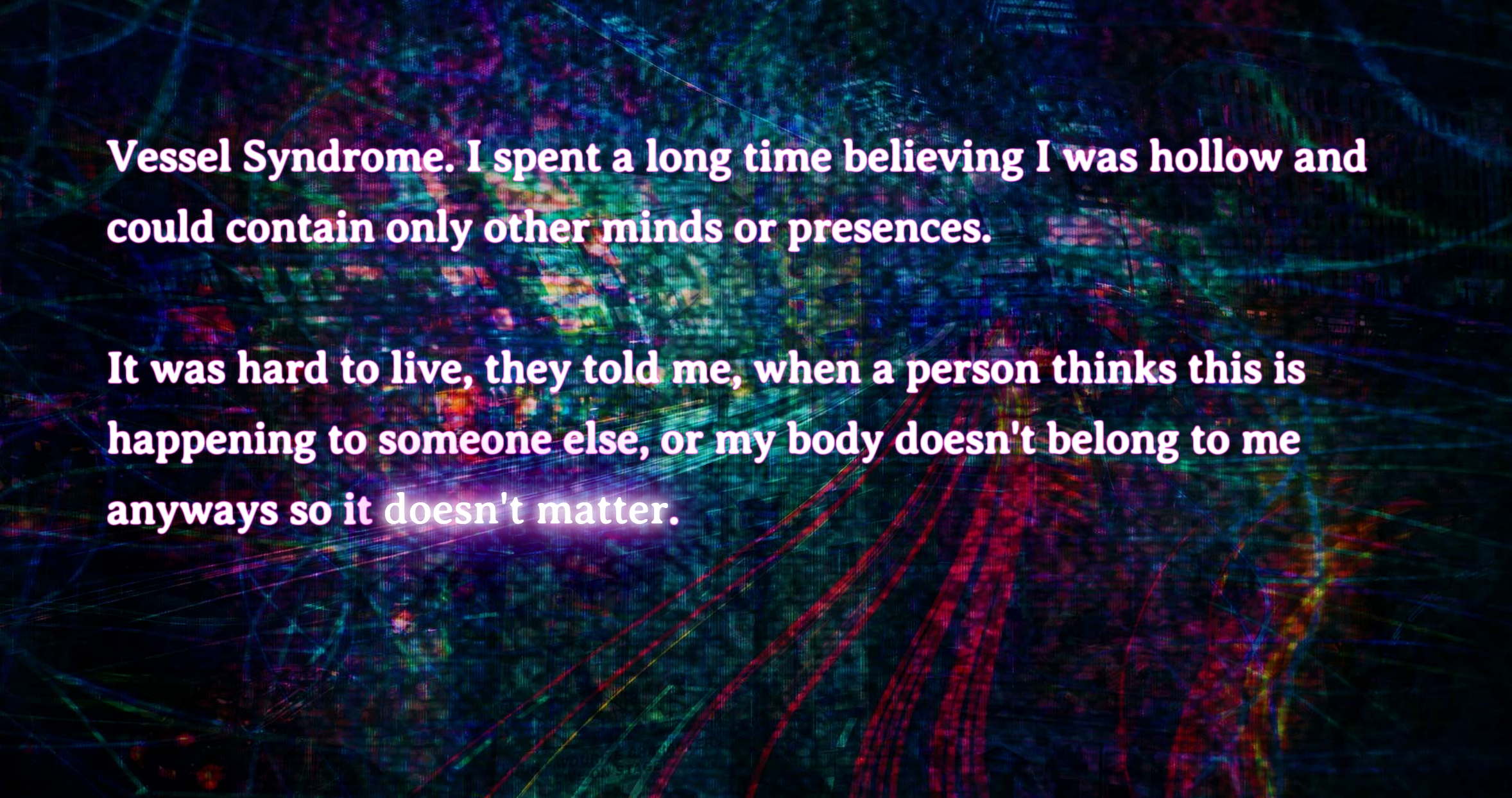
So, Neon Haze. It is the story of someone living in a dark-rainy-night-plus-neon kind of environment. The protagonist suffers from Vessel Syndrome, a condition that produces a sense of not really being oneself, or not being in one’s own body; a sense of being occupied by other spirits. Sometimes they seem to dissociate. Often they use language drawn from therapy sessions to describe their experience.

One of the game’s key moments comes when you’re allowed to choose which of two people you were in a scene: someone safe and surrounded by friends, or an outcast who has gotten into a fight? Whichever you choose, the game does not contradict you, and either way provides an interesting way of understanding the situation. Perhaps the protagonist has always been an outsider and imagining themselves as someone different and safe was a way to escape that experience. Or perhaps the protagonist comes from a background of safety that is now lost, one in which they acted entitled and did not understand how difficult things could be elsewhere, on the outside.

Screen Shot 2015-08-11 at 2.17.38 PM

The story is supported by CSS effects that make the links glow on the page against a dark cityscape, and by Neotenomie’s music, which loops and hums with seductive energy. Sometimes, at least for me, the music was more than a mood-setting device. It communicated hope, or perhaps some not-quite-hope will to live, even when the text itself was describing a bleak situation.

Continue reading “Neon Haze (Porpentine, Brenda Neotenomie)”

Snake Game (Vajra Chandrasekera with Tory Hoke)

Screen Shot 2015-08-08 at 3.08.17 PM

Snake Game is the first new story at Sub-Q Magazine, written by a veteran speculative fiction author turning to IF for the first time. It tells the story of a man who has left the army and returned to his father’s home in the jungle, where the wife he barely knows waits with his young daughter. The story concerns his relationships to all of them, the things we pass down through generations, the way our parents can confuse us about our own identities, and several other things as well. Chandrasekera is Sri Lankan, and I had the impression, though I could be wrong, that the non-fantastical elements of the setting are drawn from his homeland.

Snake Game challenges categorization. It isn’t really choice-based fiction since the player is never making choices for the protagonist, nor does it quite seem like “dynamic fiction”, the term Caelyn Sandel uses for her linear but interactive Bloom. Instead, it is a navigable fiction.

Most of the incidents in the story have three alternate versions, and the reader can choose whether to slither forward through the story or whether to move sideways, considering alternate interpretations and understandings of what is going on. The options — forward, sideways left, sideways right, backward — match the four directions one can take in a game of Snake. Nonetheless, the events are still consistent enough that however much we might turn aside from a moment or an interpretation we dislike, some truth remains truth.

Continue reading “Snake Game (Vajra Chandrasekera with Tory Hoke)”

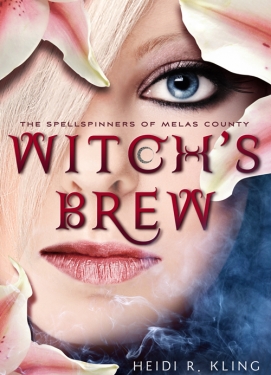
Witch’s Brew: The Spellspinners of Melas County (Heidi Kling)

spellthumb

What’s Cool from Coliloquy: In Witch’s Brew, Lily and Logan’s fate is already decided, but Heidi explores several different possible pathways for how they get there. She shares scenes that wouldn’t normally fit in a book format and gives readers more precious moments between the two young lovers. As the series progresses, you’ll see some normal narrative forms, interspersed with smaller scenes, alternate points of view, and a lot of “what if” scenarios. (Source.)

Coliloquy was a company creating interactive ebooks for the Kindle, which was semi-recently sold to digital publishing platform Vook. Witch’s Brew is the first book of a YA fantasy line of theirs. I’d encountered some articles about Coliloquy in the past, which made it sound as though the main selling point of the platform was that it was able to deliver reader metrics, not that it supported a significantly richer or different reading experience than other interactive fiction platforms out there.

The premise of Witch’s Brew is that the teenage witch Lily is preparing for the Gleaning, a mystical contest/battle against an evil warlock. Long ago light magic was apportioned to witches and dark magic to warlocks, and the Gleaning makes possible a redistribution of powers, which everyone apparently accepts is necessary even though the witches and warlocks who lose are Never Seen Again. But when Lily meets a breath-takingly sexy teen warlock who is able to speak to her telepathically, she begins to question whether she has been told the whole truth, and whether she and her hunky counterpart might not be the key to saving the future of magic. There are enchanted tattoos.

Side-characters include the beautiful, wise, shape-shifting mother figures of the coven (though there are some hints that all may not be completely as it seems there); Logan’s voodoo-using warlock buddy Chance (seemingly sort of a nice guy, though he doesn’t get a lot of character development); Lily’s angelic little sister Daisy, whom I could not stop picturing as Dawn Summers; and Jacob, the lead warlock, who has red-rimmed eyes, exhales toxic dust, and eats eggs whole, like a snake. He runs a pharmaceutical company, in case you weren’t sure of his moral alignment.

Here are some representative quotes:

“Girls,” she addressed us with flashing Indigo eyes, “join me, please.”

After the long hike, the magic eucalyptus smacked my system like a jolt of espresso.

The smell of beer mixed with the jubilant sounds of teenage revelry…

It’s a genre exercise, and it’s directed at people who fantasize about moody 16-year-old boys with chiseled abs and about being able to speak magical Gaelic. I wouldn’t say that it’s quite as far out of my preference zone as zombie horror, but this is not a genre where I tend to hang out just to enjoy the scenery, and this book is very much for people who do want to linger there. The marketing quote above is actually a pretty clear explanation of what interactivity is for in this book: giving you more “precious moments” between Lily and Logan.

Continue reading “Witch’s Brew: The Spellspinners of Melas County (Heidi Kling)”

IF Comp prizes and prep

San Tilapian Studies being played at the Friday Spectacular. copyright Wellcome Collection
San Tilapian Studies being played at the Friday Spectacular. Copyright Wellcome Collection.

My narrative party game San Tilapian Studies seems to have been well received at the Wellcome Collection last month, which reminded me of how much fun I had both playing and making this game. So I’ve donated a kit as an IF Comp prize, meaning that I’ll customize the items and rules for the winner’s choice of genre, scale to desired party size (it was originally designed for 40, but doesn’t have to be), and assemble all the physical elements.

The other thing I’ve donated is a small piece set in the winner’s game world, whether they want that to be a feelie, a short story, or a piece of cover art within the range of my cover art abilities. (I don’t draw well, so it’s usually photography plus typography.) This would then be the winner’s to do with what they liked: keep private, distribute with their game, whatever.

This is an experiment; I don’t know if it’s likely to appeal. But I’ve always admired comp prizes that had the effect of adding resources for a game, such as translations, sound tracks, and artwork, that the community might enjoy. Marius MĂĽller’s German translations of Sunday Afternoon and Patanoir are particularly awesome, even if I don’t know enough German to comment on their quality. I tossed around the idea of donating commissioned work, finding an artist or maybe a fantasy cartographer who might be hired to create some neat materials around a winner’s game, but there were too many unknowns there: you can’t get a quote on art without having some notion of what the image is going to be, and maps can vary enormously in complexity and challenge. And besides, you want to pick an artist when you’ve got some sense of the style of the thing being illustrated. Trying to plan a commission without knowing what it might be for just seemed like folly, in the end.

There’s a bunch of other neat stuff in the prize pool, including books, games, art, and some cash prizes.

Meanwhile: those who read this blog regularly know that for some years I’ve tried to review every IF Comp game that ran on my system and either a) listed beta testers or b) was choice-based. This year I’m changing that policy, in response to feedback that it’s too discouraging for novice authors, and will only cover games here for which my review is a net positive. I realize that still doesn’t accomplish the effect of actively encouraging new authors as some jams do, and I’m open to ongoing feedback about what would help with that, if it’s within my time and resources to address.

The IF Comp site is still accepting sign-ups from authors, as well as prize donations. The same site will be used to handle judge’s votes.