Spring Thing 2016: The Xylophoniad; Foo Foo

I’ve been playing more of the games from this year’s Spring Thing. (You too can play! And vote! And review, if you wish!)
xylophone_coverThe Xylophoniad is a parser adventure by Robin Johnson, a good-natured spoof of Greek mythology with cameos from Achilles, Sappho, Daedalus, the Minotaur, and assorted other crowd favorites. Unlike the author’s recent Draculaland, it’s not relying on a choice-based representation of the parser options, but in other respects the two games are fairly similar in tone and difficulty level: light-hearted, relatively straightforward puzzles that tend to involve thinking of the right item to use in the right situation; an invisiclues-style hint system complete with misleading fake hints; a sizable world map with relatively few items per room, brief room descriptions, and explicitly listed exits. The characters will answer ASK/TELL conversation gambits on a number of topics, but in a fairly old-school style: these are more like Infocom characters than like new-school NPCs, and they don’t have long memories or detailed dialogue scenes. But that suits the genre this is going for.

I found The Xylophoniad took me roughly an hour to play, and that I only had to look at the hints a couple of times, mostly because there were two specific objects whose size and shape I had envisioned incorrectly. However, a couple of the other puzzles amused me considerably, and a couple have multiple solutions. (I was particularly pleased by trggvat n oyvaqsbyqrq oneore gb tvir Zrqhfn n gevz, and also that gur gharf lbh cynl ner Terrx-gvgyrq irefvbaf bs ahefrel fbatf.)

I just recommended ASCII and the Argonauts apropos of Johnson’s last game, but it’s even more apropos here — if you liked this, you might well like that.

*

foofooFoo Foo (Buster Hudson of Oppositely Opal et al) was originally a game for The Ryan Veeder Exposition for Good Interactive Fiction, and in fact it won that competition. It’s not hard to see why: it’s a charming, light puzzle game that honors Veeder’s work in both style and specific content. The protagonist is the Good Fairy of the Little Bunny Foo Foo song, and is trying to collect evidence that Little Bunny Foo Foo is not actually responsible for the massacre of field mice in the area. There’s a cameo from the descendant of Captain Verdeterre; there’s a former flame who keeps a dessert shop, reminiscent of the ice cream shop owner in Taco Fiction; there are stuffed dinosaurs as found in The Island of Doctor Wooby; there’s a rock band called “They Might Be Humans,” a nod to Veeder’s contributions to the They Might Be Giants tribute compilation, Dig My Grave and The Statue Got Me High.

From time to time the narrator addresses the player directly about what you should attend to and what you should ignore.

Your detective instincts are telling you to focus on the establishments on the north side of Lumpen Lane. Of course there are businesses across the street, but you aren’t concerned with them, and therefore they won’t be mentioned.

This kind of thing is a classic Veederism, possibly seen most extensively in Nautilisia but present even in his earliest work I know of, You’ve Got a Stew Going!

I also thought this bit was a good nod to Veeder’s style:

He winks at you in precisely the way you hate being winked at.

Overall, I think Foo Foo is probably the most fun for people who know their Veeder canon well, and it’s hard for me to know exactly how you’ll respond to it if you don’t; but it felt to me like it was well enough constructed that even someone without that background might have a good time.

Writing Novice-friendly Parser Games

On Twitter, a teacher asked me what to tell her students about writing parser games that can be picked up and played by anyone, and therefore will make good portfolio pieces.

This is, in my view, a lot to ask, but there are two basic schools of thinking that people have pursued: the maximalist and the minimalist. (Terminology inspired by A. DeNiro talking about “new minimalism” recently.)

Maximalist: You start by asking if the player has played IF before. (Do not ask if they want a tutorial: they may say no even if they need it.) If they haven’t, give the player a tutorial. Alternatively, thread a mandatory tutorial into your first scene that at a minimum introduces examining, taking, dropping, checking inventory, movement, opening and closing things, and probably instructions on how to save and restore.

Throughout the game, you highlight keywords in output to help them find nouns that they can interact with; ideally, you provide dynamic hints and other features that will help them get un-stuck. You might even provide a suggestions mechanism to identify viable commands.

You might put in parser features that notice if players are trying to use common-but-wrong grammar, such as adverbs or attempts to include their body parts in commands (HIT DOOR WITH FIST, e.g.).

This discussion thread gets into some recent thinking about the maximalist approach.

Examples of the maximalist approach: Bronze, Blue Lacuna. Aaron Reed’s Small Kindnesses extension for Inform and his Player Experience Upgrade implement a lot of these features. These are based on Aaron’s extensive research into transcripting and first player encounters with games.

Minimalist: Instead of trying to make the player comfortable with the full expressive range and genre standards of parser IF, you’re making your game straightforward enough and well enough signaled that they don’t need to understand all that. This is solving the problem through design rather than through implementation, and it is absolutely what I would recommend to students on a short project.

Start by restricting your verb set. Pick just a handful of verbs that are going to work in this context and disable everything else.

Announce your verbs clearly at the beginning, and/or keep them on-screen the whole time. Make sure those verbs are amply implemented and always provide some result for the player: you want to make up for the limited inputs by making sure the player’s experience with those inputs is always juicy.

It may again be useful to highlight interesting nouns in the text as well.

Examples of the minimalist approach: What Fuwa Bansaku Found, Superluminal Vagrant Twin, Treasures of a Slaver’s Kingdom, You Can’t See Any Such Thing. In general, Chandler Groover and CEJ Pacian are particularly prolific in this area.

Orthogonal to the Maximalist/Minimalist choice is the question of allure — how do you make the parser game look good on screen so that people will perceive it to have value?

And there, unfortunately, Inform is lagging hard behind Twine and other options. If you have a game you can compile in a small enough space for the Z-machine, you can build a game that cooperates with Vorple, at which point you have the resources of Javascript at your disposal and can more or less do whatever you want. You Can’t See Any Such Thing is using Vorple, and so is Guilded Youth. Recent versions of Inform struggle extremely to fit anything into the Z-machine size, though — you have to disable features to get even the most default game to be small enough — so in that case it’s more a matter of using Quixe and then trying to make the stylesheet as elegant as possible. Superluminal Vagrant Twin demonstrates some effort in this direction.

Spring Thing 2016: Dr Sourpuss is Not A Choice-Based Game; Three-Card Trick

dr_sourpus

I’ve been playing more of the games from this year’s Spring Thing. (You too can play! And vote! And review, if you wish!)

Dr. Sourpuss Is Not A Choice-Based Game is a lightly puzzly piece about the destructive nature of standardized testing, the fact that a lot of challenges are really multiple-choice even if they look otherwise, how tests can encode racist standards, and how some things (such as sport) resist such handling — all bounced off the choice-vs.-parser debate. The game includes Twine-like portions mingled with other segments that involve other methods of problem solving, including typing at the very end. The About text suggests that the author means to stake out a position that will annoy people of all political stripes; perhaps I am reading badly, but I failed to be annoyed about its politics.

Continue reading “Spring Thing 2016: Dr Sourpuss is Not A Choice-Based Game; Three-Card Trick”

Chatbots as Narrative Platform

Recently I’ve been running into a fair amount of news/discussion about “conversation as a platform” and “bots as the new apps” — specifically, that people spend so much time texting that chatbots are a viable way to do advertising and storytelling and personal assistant functions all at once.

This means taking in natural language input (as opposed to the Lifeline-style experience, where the user is still pressing buttons to navigate a choice-based conversation). Historically,  I’ve tended to be skeptical about this because the error rate on chatbot output is high enough to make for a frustrating game experience.

All the same, there have recently been some developments on this front, partly because there’s now stronger AI for classifying natural language input, and partly because app discoverability problems make it appealing to embed content within chat platforms. Meanwhile, streaming means that there’s a greater audience for games that produce amusing results and accept idiosyncratic player input: here’s PewDiePie making Facade produce weird results.

What follows is a summary of some existing work I know about in this area. I wouldn’t be surprised to see quite a lot more come along.

Continue reading “Chatbots as Narrative Platform”

Spring Thing 2016: Evita Sempai, Harmonic Time-Bind Ritual Symphony, and Standoff

Screen Shot 2016-04-07 at 10.28.52 AM

The 17 IF games of Spring Thing 2016 are now available! This is a huge crop: historically Spring Thing has tended to have entry numbers in the single digits. I’m delighted to see it, because I think it’s useful having other events that at least somewhat rival IF Comp in size and attention. The trend towards diversity continues as well: there are a mix of Twine and Inform games, but also Ren’Py, a homebrew HTML/javascript game, and a pen-and-paper RPG submission.

So far I’ve had time to look at Evita Sempai, Harmonic Time-Bind Ritual Symphony, and Standoff.

Continue reading “Spring Thing 2016: Evita Sempai, Harmonic Time-Bind Ritual Symphony, and Standoff”

Draculaland (Robin Johnson)

Screen Shot 2016-04-02 at 10.23.58 PM

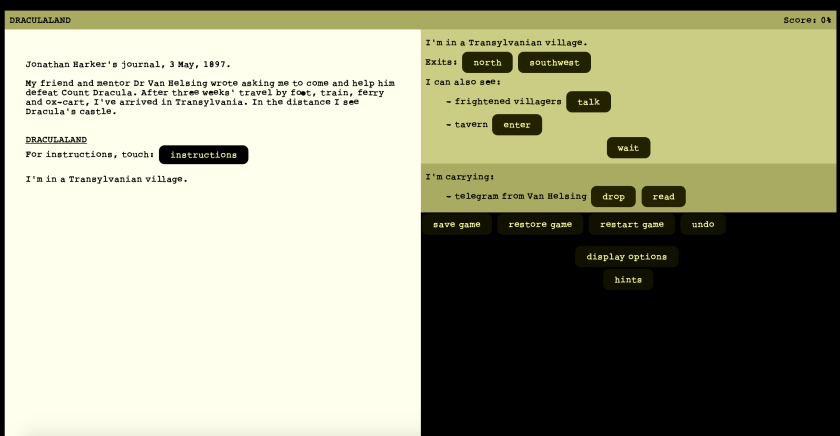
Draculaland is a goofy, tropey piece of medium-length IF: you solve puzzles, you gather weapons, you fight monsters suitable to Transylvania. There are items to collect, and NPCs who send you on quests, and other NPCs who get in your way; there is even one NPC who follows you around. The whole piece feels animated by the spirit of Scott Adams, especially The Count — short, tight descriptions and puzzles that can be solved in a single flash of inventiveness — but it is infinitely fairer. I estimate it took me about 90 minutes, though I think I wasn’t consistently focused on it for that full time. Draculaland was written for The Ryan Veeder Exposition for Good Interactive Fiction, an unusual competition with the sole purpose of entertaining Ryan Veeder, but happily the author has made it available for the rest of us to enjoy as well.

It’s sort of a parser game without the parser: you play by clicking on verbs associated with the various objects in scope.There’s a full parser world model going on under the surface, and the links are being generated procedurally by that model. Occasionally this provided puzzle hints I wouldn’t otherwise have thought of, but mostly this eliminated guess-the-verb experiences without taking away the fun of coming up with my own solutions. Most of the puzzles require you to think of combining objects that appear in different locations, so the experience isn’t over-obvious.

It’s not exactly the first game to experiment with building clickable links out of a parser model world — see also Jon Ingold’s Colder Light, for instance — but there aren’t a lot of examples out there that I think work really well, so I was glad to play this one, and I thought that it did essentially work. Certainly it felt a lot more successful to me than a lot of historic UIs that use drop-down verb menus and other doodads to augment a standard parser game. Things like this Spellcasting UI have, to my tastes, aged much worse than even bare-text parser presentations.Spellcasting_101_interface


Towards the end of the Draculaland, the inventory list gets maybe a little unwieldy. I also found myself wishing for a clickable map, though I’m not sure whether that would actually have been an improvement or whether I was merely wishing for it because I manage to mix up east and west even in a clickable parser game. But for the most part, it worked very well for me.

The writing is compact, as it has to be in this format, and funny; the characters are sketched with as much personality as one could reasonably fit in the available space; and I found myself rather pleased with how the ending turned out, more for the sake of the NPCs than for myself.

There is one thing that the story made me do that I wanted to avoid. (ROT13: Ol gur gvzr V fubg gur jrerjbys, V xarj ur jnf ernyyl gur gnirea xrrcre, naq V jnf ubcvat sbe fbzr jnl gb xabpx uvz bhg be qr-jrerjbys uvz engure guna npghnyyl zheqre uvz. Nsgre nyy, nfvqr sebz uvf jbys unovgf, gur gnirea xrrcre frrzrq yvxr n qrprag fbeg, naq jr nyernql unq bar rknzcyr (va Zvan) bs n zbafgre jub pbhyq npghnyyl or tbbq naq zbfgyl xrrc vgf vzchyfrf haqre pbageby.) But perhaps that is in-genre inevitable.

If you like Draculaland as a tribute to Scott Adams, you might also enjoy J. Robinson Wheeler’s Adams-styled Greek myth game ASCII and the Argonauts; if you’re keen on puzzly vampire tropes, you might want Marco Vallarino’s Darkiss. If vampires sound good but you want to stick with a choice-based interface and go more Rice than Stoker, there’s always Choice of the Vampire.