Superluminal Vagrant Twin (CEJ Pacian)

Screen Shot 2016-03-27 at 5.12.11 PM.png

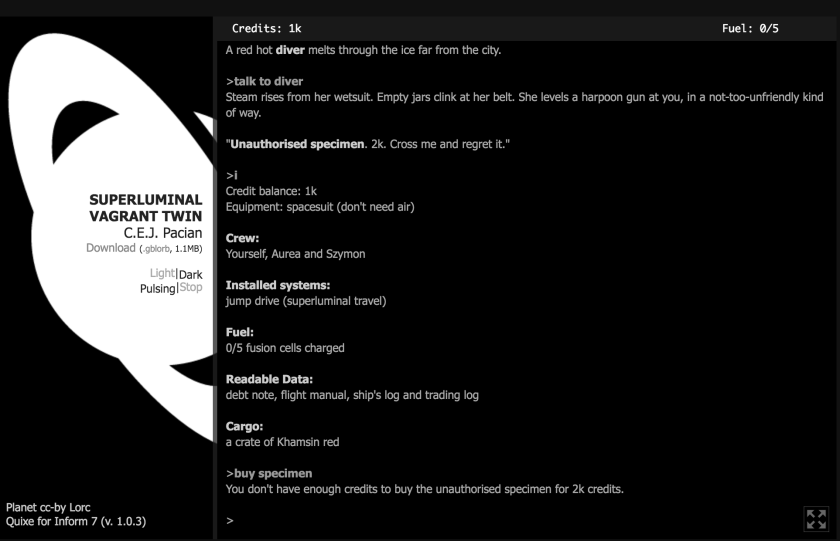
Superluminal Vagrant Twin is a new parser piece by CEJ Pacian, an exploration-and-trading adventure set in a universe of bizarre and evocative planets. The premise is that you’re trying to collect five million credits — an amount that seems frankly impossible given your initial resources — by jumping your hunk-of-junk ship from one planet to the next in search of odd jobs.

With large-scale solar system engineering, terraforming, and bioengineering, the setting reminded me a little of both Sun Dogs and Hoist Sail for the Heliopause and Home; but Pacian’s universe is populated with more characters than either of those.

Pacian’s past work includes the exploratory fantasy Weird City Interloper, the partially procedural Rogue of the Multiverse, the ant simulator Dead Like Ants, the on-rails puzzle shooter Gun Mute, and the conversation game/love story Snowbound Aces, among others.

As wildly varied as those pieces are, they tend towards a few common features: a light, focused world model that prioritizes a few verbs and sets aside the rest; characters and settings communicated in a few quick and evocative strokes; a sense of a world never completely explained.

Superluminal uses these techniques to create a fairly simple but very novice-friendly and well-directed parser experience. The verbs the player will need are all listed up front. Important nouns are in boldface, and there are rarely more than four or five to interact with in any given location. A couple of status commands keep notes on everything the player has encountered so far, which makes notetaking unnecessary; and the hyperjump premise of the story means that there is no map in the traditional sense, but that most locations are accessible within one or two moves at all times. I found that I could play in a more casual mode than I usually bring to parser IF.

Meanwhile, Superluminal does as good a job as I’ve seen at a trade-and-exploration parser game, even including a little light grinding but without becoming too dull or frustrating. Sometimes you’ll find or be able to buy objects and then need to figure out who else in the universe might be interested in paying you for them: this is complex enough to reward the player for actually reading the text, but no so complex that you’re likely to get stuck for long. And there are lots of ways to win — I completed the main plot arc without getting anywhere near 100% of the money-earning side quests. Among parser IF games with a monetary score, Superliminal offers just a bit more of a story development than in Captain Verdeterre’s Plunder, but it’s not nearly as hard to win as Gotomomi, whose much more intricate world model sometimes felt a bit overwhelming.

And while we never interact long enough with any NPCs to get to know them very well, there’s enough here about the different cultures, politics, and art styles of the various planets to make for a very entertaining playthrough.

I got through it in probably around 90 minutes of play time, but it would take longer to find every detail. Online and downloadable versions are both available.

You Can’t See Any Such Thing (Matt Sheridan Smith)


Screen Shot 2016-03-09 at 11.18.03 AM

You Can’t See Any Such Thing is a curious parser work that riffs off standard parser behavior; the opening explains that it is the descendant of a previous game that the author used as part of a gallery show.

The interface is enhanced with fancy typography and elements such as photographs you can mouse over to expand: an unusual degree of elaboration, given that this is Inform under the surface. Screen Shot 2016-03-09 at 12.10.04 PM(Certain library responses are familiar, and if you delve into the source, there’s a telling Release/play.html URL for the playable content. If, however, you type VERSION to verify this, your command vanishes silently into ether, unacknowledged. Asking about the machine producing this text is apparently forbidden, which is consistent with its themes and aesthetic intent [even if also a bit of a license violation].)
[Edited to add: Juhana Leinonen remarks that it is using a Vorple interface.]

The piece focuses on the way that the parser experience lets you control different sensory approaches to a scene. It’s as overt as possible about the interactive elements — interactive nouns are in bold; verbs are specified and particular verbs go with particular rooms.

The writing is literary, and the interaction is about exploring rather than about solving a puzzle or causing certain actions to occur in the plot. Though we are allowed to LOOK, SMELL, TOUCH, and so on, we are still readers rather than actors, and our reading function is reinforced by the narrator’s manner of clarifying things, and by responses to parser errors.

When I played, I was immediately drawn northward, to the Widow’s perspective, and was immediately satisfied with lavish descriptions of perfume notes and a Proustian trip into her girlhood recollections.

In another room, the room for examining, each examination carries the player over to another location, in deepening vistas reminiscent of Lime Ergot.

Continue reading “You Can’t See Any Such Thing (Matt Sheridan Smith)”

IF Comp 2015 Guest Post: Robb Sherwin on Pit of the Condemned

As part of the project to get more reviewers talking about IF Comp games, Robb Sherwin writes for us about Matthew Holland’s Pit of the Condemned. Robb is the author of Cryptozookeeper and Fallacy of Dawn, among other works.

Continue reading “IF Comp 2015 Guest Post: Robb Sherwin on Pit of the Condemned”

What Fuwa Bansaku Found (Chandler Groover)

Screen Shot 2016-01-06 at 9.09.45 PMWhat Fuwa Bansaku Found is a new piece at Sub-Q by the astonishingly prolific Chandler Groover. In it, the eponymous samurai must investigate a haunted shrine: the emperor has sent him there, but the emperor was certainly spurred to do so by Bansaku’s enemies at court. The piece draws on translations of Japanese poetry, plots from kabuki, and images from woodblock prints.

It is a parser game, but a relatively accessible one. As with quite a bit of Groover’s other parser work, Fuwa Bansaku tightens the list of needed verbs to a simpler subset of the usual library. It also gets rid of the standard compass directions and acknowledges ADVANCE and RETREAT instead. This serves the piece well: it’s quite short, and not having to worry about a possible complicated map frees the player to concentrate on other concerns. (Gun Mute also does this, but it’s a comparatively rare feature in parser IF.)

Then, too, a number of the responses specifically prompt what the player should do next:

>x grass
These long grasses resemble hairs
growing from a courtesan’s skull.
They tower around Fuwa Bansaku.
He will search them.
>search grass
Fuwa Bansaku pushes the long grass
aside with one hand at his katana.

In a different context, this kind of guidance might be exasperating. But Bansaku is extremely focused and brief.

These hints also serve as a reminder that the character of Fuwa Bansaku is not the player. He is someone specific and skilled, a man of culture and intrigue and warfare. In fact, he is based on a historical figure, though with considerable embellishment. What’s more, everything he encounters in this haunted shrine receives a short but evocative description. Every item seems to point back to the details of the experience that sent him here.

Even though the piece is quite short, there is room enough in Groover’s story for several surprises. A lovely, eerie meditation on what is truly monstrous.

IF Comp 2015 Guest Post: Duncan Stevens on Koustrea’s Contentment

KoustreaCover

As part of the project to get more reviewers talking about IF Comp games, veteran IF reviewer Duncan Stevens has shared his thoughts on Koustrea’s Contentment. Duncan is one of the prolific reviewers of IF in the late-90s newsgroups, and has previously taken a look at Map for this series.

Continue reading “IF Comp 2015 Guest Post: Duncan Stevens on Koustrea’s Contentment”

Morality and Diegetic Agency in IF (via Radio K on Slouching Towards Bedlam)

Radio K screenshot

Adam Cadre’s Radio K podcast, continuing its coverage of IF games from the early to mid 2000s, now covers Slouching Towards Bedlam, Gourmet, and The Dreamhold.

Part of Adam’s discussion of Slouching riffs on what he says was my view at the time, that this was one of the first IF games to seriously address moral choice. He objects to that view because the player is very likely to explore all the possible endings, and therefore it’s unlikely that they’ll feel much weight in their decision, and also because he doesn’t consider the final question morally all that interesting.

It’s possible I did characterize Slouching that way at some point in a newsgroup discussion – I don’t now recall precisely. It’s not really quite what I would say now, though — and actually it’s not exactly what I say in my contemporary review.

I bring this up not to nitpick Adam’s generally excellent podcast, but because thinking about Slouching Towards Bedlam from the perspective of the current IF scene sent me off on something of a tangent of further thoughts.

So with apologies to Adam, here’s what I would say about it now: Slouching is an early, and still relatively rare, example of parser IF that makes diegetic outcomes depend on a complex set of world model machinations on the part of the player. First you have to figure out how the world model affects the story, and then you have to use that information to bring about the ending you want. You’re likely to luck into several endings you don’t want at the same time.

Continue reading “Morality and Diegetic Agency in IF (via Radio K on Slouching Towards Bedlam)”