Sims 3: The Tragedy of Fred Chilton

Fred was one of three adopted children of Howard, a chubby, rigorously logical Sim with absolutely no romantic ability. As a young adult, Howard frankly assessed his odds of having a family through dating and marriage and decided to start adopting instead. And I have to say that he wasn’t a bad father: played many games of chess with his eldest, Lily, teaching her logic; spent time tutoring his younger two, Fred and Dandelion. He made a much better parent than his half-sister Kumquat, who left her daughter Rose to grow up more or less dependent on various maids and babysitters.
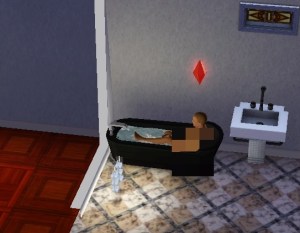
Fred's last bath But one day in his early teens, Fred had a mishap: he tried to take a bath when already extremely tired. This led to a strange, locked-in cycle: he kept passing out from exhaustion, then resuming his bath, then passing out again… and he never seemed to finish either task. Eventually he also needed to use the bathroom and get something to eat, but these other needs couldn’t overpower the bath/passing out cycle. I tried various things to snap him out of it — gave him different instructions, tried to cancel some of his orders, sent Dandelion in there to talk to him (and, I hoped, rescue him). No good. After a solid day or so of bathing, Fred started to starve to death, and I reconciled myself to his doom. I did throw Rose a birthday party, hoping that that would at least catch his attention — Sims seem to come running from all over when there’s birthday cake to eat — but instead there was just the rather ghoulish spectacle of the family and friends partying down while upstairs Fred scrubbed and splashed away his last three hours, his starvation clock ticking away.

But then… miracle! The grim deadline came and went. Fred was now officially dead (his only remaining task being “Expire”, his starvation clock counted all the way down) — but he went on bathing! I had a new idea, a pleasingly gothic idea. I got out the build tools and bricked Fred’s bathtub away so that none of the rest of the household would see him. He could go on bathing eternally in there, I figured, but everyone else’s life would go on.
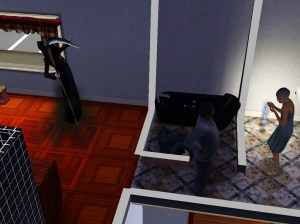
Screenshot-11Alas, that bricking up turned out to be all that was needed to snap Fred back to awareness. He got out of the tub and died in his tiny, airless, lightless enclosure. I had to sledgehammer a hole in the new brick wall so that he could be found by his relatives and laid to rest properly.

Howard was devastated. A team of local scientists sent an offer: they would let Howard see Fred again, if Howard brought Fred’s remains to the lab. In the dead of the night, Howard crept out of the house with the coffer containing Fred. The procedure went ahead. The scientists said it was a failure, but Fred’s ghost materialized and began hanging around the house, with all his old goals and skills still working. Except for the transparency and the creepy eyes, the guy’s as good as new.

The first thing Revived Fred did was have a big meal.

More Sims 3 experiments

Experiment the second (and a considerably longer play this time than Doofus vs. Delores). To introduce the cast:

Harry. A Good, Frugal, Neat Bookworm whose life goal was to become a secret agent.
Lisa. A snobbish woman with no sense of humor whose life goal was to have a net household worth of more than 100,000 Simoleans.
Lars. An evil, mean-spirited character with a good sense of humor whose life goal was to become emperor of evil.

These were all siblings, and I figured that the good/evil dichotomy between Lars and Harry, and the funny/unfunny between Lars and Lisa, would produce plenty of conflict (always the basis for a good plot, I figured). And indeed they did fight a lot. Lars enjoyed picking on Lisa, but also found her so boring that they didn’t interact for long. Lars and Harry enjoyed one another’s company at first, but soon Lars’ evil nature made it impossible for them to get along. Rather pathetically, for a while Lars had a goal of becoming friends again with Harry, but I eventually cancelled this when it became clear that it was simply impossible.

Because they were all created at around the same time, they all died at around the same time too. Lars went first, then Lisa. Unfortunately, Lisa happened to die while Harry was cooking. The pan was forgotten on the stove while Harry watched Lisa being Reaped. The inevitable fire ensued. The Reaper noticed the fire but said he’d be back later because he didn’t feel like doing any more reaping on an empty stomach. And come back he did: the fire got extinguished, but Harry died anyway later the same evening. He was the only one not to get his life’s wish fulfilled, incidentally — possibly because he’d spent so much of his neat-freak life making beds and cleaning toilets.

Continue reading “More Sims 3 experiments”

Experiments in Sims 3

So I’ve been playing Sims 3, specifically with an eye to exploring the emergent narrative side of things.

My first concoction was the pairing of a sim with commitment issues and a hopeless romantic. The former was a young adult named Delores, the latter a balding elder named Doofus. (Lest I seem not to be taking the experiment seriously: the name was a suggestion from the person who was looking over my shoulder during character creation.) Doofus’ life goal was to become a chess master. Delores’ was to become the girlfriend of ten sims. I figured Delores was going to be Doofus’ trophy wife, then break his heart by sleeping with half the neighborhood.

Continue reading “Experiments in Sims 3”

Hall and Baird on Polti again

Have now had a chance to read more thoroughly the article I mentioned last post, Improving Computer Game Narrative Using Polti Ratios, by Richard Hall, Kirsty Baird.

The idea of the article is that the amount of drama in a game can be arithmetically calculated by counting the number of different Polti situations one can recognize in the game, then calibrating against the total number of events and the number of major and minor characters required to bring these events about. They further use these calculations to argue that games with no characters (“unembodied” games) may not reasonably be interpretable as stories. They propose that games in production should be improved by restructuring the story to include more Polti situations and to decrease the number of characters.

I’m in general pretty skeptical of anything that claims to be a recipe for narrative construction, but some are still more plausible than others. This one strikes me as especially doubtful, since the natural limit of the proposed equations is a story in which all 36 Polti situations are included in a tale with just two characters and a minimum of distinct events. A sense of fitness in the narrative development, thematic coherence, etc., do not enter into the equations.

The authors offer a sample revision of a game which does demonstrate concern for thematic coherence in that they eliminate a certain number of Polti situations at the outset, and they do arrange the game to convey a specific message; which looks like an acknowledgement that good narrative is characterized by something other than an optimization of their proposed equations, but they do not account for this theoretically. Nor does the article attempt to distinguish between narrative, story, and plot, though these terms are often treated as distinct in other game/narrative literature.

The most interesting part of the article to my mind is the part that suggests that story depends on how many situations the player recognizes:

We’re going to… initially propose the theory that if people can explain what is going on in terms of at least one of Polti’s units then the object that they are engaged with can be labelled a story.

Even this is a little vague, but let’s assume that by “people” we mean “the player”. This would suggest that a game’s emergent behavior begins to appear as emergent narrative iff the player can recognize the action as corresponding to some fundamental narrative element. But the article raises an important question at the end:

Do people in general (with an understanding of Polti’s units) detect exactly the same units in the same story?

This becomes even more pointed with something like The Sims in which the interaction of characters might be construed to be “about” any of a number of things: one can observe the apparent emotional content, but there’s no verbal dialogue. (This may become more complex and richer in Sims 3; I’ll come back to this point when I’ve had a chance to play the PC version rather than just the cut-down iPhone edition.)

Anyway: the point is that emergent behavior might be construed by the player as corresponding to different narrative elements depending on the kind of arc the player already thinks he’s building. (See: Alice and Kev.) On the other hand, the game has no way of “knowing” which situations the player is recognizing as narratively significant and thus no way of trying to produce episodes that follow (thematically or causally) on those the player has already recognized.

I wonder whether the process of narrative building would tend toward more coherent structures if the player’s interpretation were actually polled and then used to refine the character behavior model.

Whether Polti’s situations are remotely useful for this purpose, I’m not sure. But that’s a separate point.

More on the emergent narrative issue

Thinking about this more, and I ran across an article at gamestudies.org from September of last year, which seeks to quantify the narrative density of a game by how many Polti premises one might recognize during play.

I’m not sure I find this convincing, because it suggests that narrative comes in discrete chunks. What about pacing, development, arc?

But I’ve only had a chance to scan through the article so far, and need to come back to it later.

Sims 3 (Mobile version)

imagesLately I’ve been thinking more about emergent narrative — in particular, the idea that a sandbox-style game can produce elements that the player then weaves together into a story that he finds satisfying. The story isn’t really a product of the game, and it’s not necessarily true that anyone else playing the game would perceive the same story. The onus is on the player to determine which of the many otherwise insignificant events contribute to the narrative.

I’m pretty skeptical about this idea. Or rather: I can see that some such thing does happen, in that lots of (say) Sims users construct elaborate stories with their characters, and share movies and narratives. But in general this is not what I would call interactive storytelling; it seems more like handing the user a really complicated dollhouse that happens to have built-in tools for recording and editing the best scenes.

Still, I thought I ought to put a bit more research into this topic before I dismiss the possibilities. It’s been a while since I had (and got tired of the grinding aspects of) the original Sims, so I tried downloading Sims 3 for my iPhone.

Alas, I find it a dead bore.

Continue reading “Sims 3 (Mobile version)”