The 21st annual Interactive Fiction Competition is currently on, through mid-November. Voting is open to the general public; the only prerequisite is that you not be an author, not vote on games that you tested, and submit votes on at least five games. (You emphatically do not have to have played them all! In a year with 55 entrants, it is very unlikely that most judges will get through anywhere near all of them.)
Unbeknown is a short Twine work of speculative fiction by A. DeNiro.
The 21st annual Interactive Fiction Competition is currently on, through mid-November. Voting is open to the general public; the only prerequisite is that you not be an author, not vote on games that you tested, and submit votes on at least five games. (You emphatically do not have to have played them all! In a year with 55 entrants, it is very unlikely that most judges will get through anywhere near all of them.)
So this year I’m only reviewing comp games that I can basically recommend. If this makes you sad because you enjoy reading reviews where I did not like something, you might instead enjoy my reviews of Tender Loving Care or Lifeline 2, which have the benefit of being commercial games that can fend for themselves.
Hereafter, thoughts on Untold Riches and Grandma Bethlinda’s Variety Box.
I just have to grab a few things on my way back to New Tenacity.
Artifacts, you know. Objects of intense mystical power. The usual.
Lifeline 2 is a sequel in form, not in content, to the tremendously successful Lifeline from earlier this year. Lifeline was one of the first games to work on the Apple Watch, which may have helped get it the spotlight, but it did a number of other things well: a clean attractive text interface, a good use of delays and notifications, and a story about a convincingly endangered protagonist.
It also demonstrated a game format that was plainly reusable. Lifeline makes the protagonist a separate character who is reaching out to the player for help — a strategy that deals immediately with gaps between player and protagonist knowledge, and explains occasions when the protagonist won’t do what the player wants. It allows for strongly characterized narrative with a definite voice.
The 2015 Windhammer Prize is now running, which means you can download and play any of the 16 PDF gamebooks entered; if you play a reasonable number of them, you may also judge the competition by submitting a list of your top three favorites. (Full details are at the judging site.)
*
The previous Windhammer contestant I covered, Tides of Chrome, is an intricate puzzlebox of a game, highly polished, with hints of serious themes. Isaac Newton: Badass Ninja Crimefighter is basically its opposite in every way: a simple plot, fast-paced narrative, and an extremely goofy tone. There are assorted typos and surprising noun/verb agreement errors that make me think maybe the game was drafted in the third person and then changed to second person partway through. There are loads of luck checks and a number of choice points where you have no real reason the first way to guess which of two or three choices is going to be your best bet. I had fun with it, but in a totally different way.
The premise is what it says on the tin, only more so. You are Isaac Newton. You are 53 years old, yet you possess a body like Schwarzenegger in his prime. You can restore willpower and hit points by eating apples. Your study of gravity and optics has endowed you with telekinesis, flight, and the ability to shoot blasts of rainbow power from your hands. You are highly opposed to counterfeiting, and you’re willing to kill any number of guards and flunkies in order to get at London’s most significant counterfeiter. You also have a butler named Alfred, and independently sentient hair. The ninja aspect doesn’t come into it very much.
The 2015 Windhammer Prize is now running, which means you can download and play any of the 16 PDF gamebooks entered; if you play a reasonable number of them, you may also judge the competition by submitting a list of your top three favorites. (Full details are at the judging site.)
*
Tides of Chrome tells the tale of a robot — one of a whole society of robots, with their original “Architects” long since out of the picture — who is sent to explore a damaged ancient underwater station. From there, the story follows many standard tropes of abandoned-base exploration: there are various signs of what different inhabitants were doing here in the past, there are dangerous and/or secret areas, there is evidence that some parts of the station Go Deeper Than You Had Previously Realized.
Regency Love is an iOS game set in a pseudo-Austen town; it is in the same general territory as a dating sim or visual novel, but with a structure that also owes something to roleplaying games.
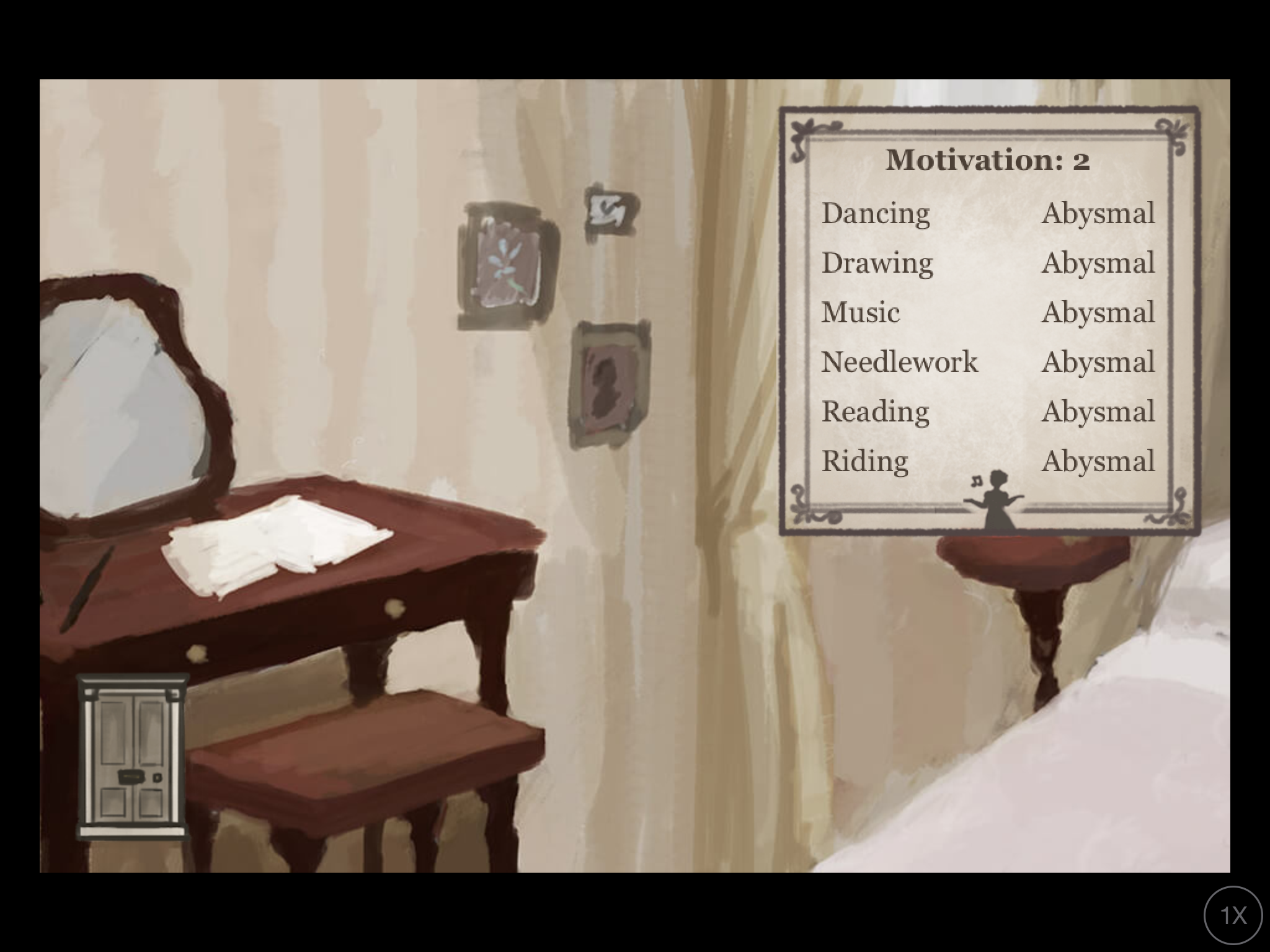
The core interaction loop is that the player can select a place from the map of Darlington, their town; the place may yield one or more possible activities. The activities can either be quizzes about Regency life (how long should you properly mourn a sister? how much did muslin cost?) or social interaction scenes that are primarily dialogue-driven. From time to time, there’s an opportunity to do another quiz-like activity, a game of hangman in which you’re trying to fill in a missing word from a famous quotation, mostly from Austen. Doing quizzes and hangman gains you motivation points which you can spend to raise your skill in one of six “accomplishments” — drawing, needlework, reading, dancing, riding, music (harp and pianoforte and singing are not distinguished). Some of the social activities depend on you having a certain accomplishment level in a certain area before they will unlock. Other social events depend on what has already happened.
Using a map to pick the next little story you want to participate in also reminded me a bit of StoryNexus, though whether the underlying engine relies on anything like quality-based narrative, I have no idea.
Before the game began I evidently paid NO attention to my governess.I was never a great enthusiast for the quizzes and stats part of this game. The questions refer to information from Austen that is not provided internally, so you either already know the answers or you have to guess. There aren’t enough hangman sentences and quizzes to last the whole game, either, so you’ll see the same things repeat over and over again before you’re done. Meanwhile, your accomplishments are necessary enough that you can’t ignore this part of the system, but there’s not enough variety to what the stats do to make it an interesting choice which one you raise next. Somewhere between halfway and three quarters of the way through play I had maxed out all my accomplishments and could now afford to ignore the whole quiz-and-hangman ecosystem, which was a relief.
Based on your behavior, the game also tracks character traits, reflecting whether you’re witty, dutiful, etc. It displays what your traits are, but I never worked out exactly what was moving the dials. What I said in conversation must come into it, but I didn’t know which dialogue did what. Nor did I ever figure out how it mattered. Some events were plainly closed to people with less than 12 Needleworking, but I never saw an explicit flag that excluded people who weren’t witty. So the character trait system may have been doing important things, but it was opaque enough that eventually I started to ignore it.
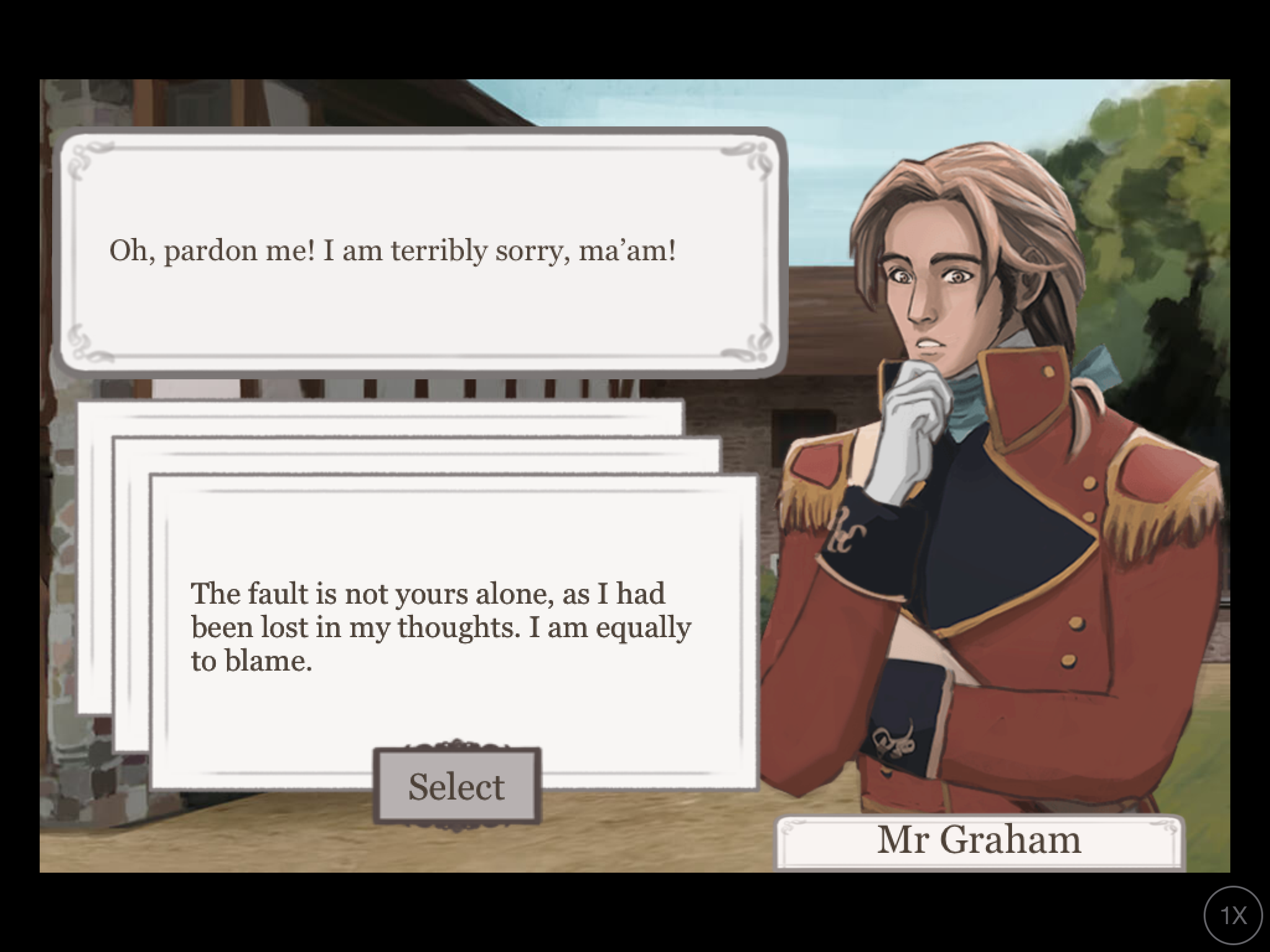
What does that leave? Talking. Lots and lots of talking. I like talking games! This one made some slightly peculiar choices, though.

 Emily Short's Interactive Storytelling