Cinders (Moacube)

only it was really too inconvenient, you see,
not least when it shattered on the staircase
I was running up to catch the last train…
Apologies for Breaking the Glass Slipper, Isabel Yap

When I’m drawn to adapt a traditional story to interactive fiction, it’s often because there’s something about the original that bothers me so deeply that I feel I need to address it. Part of the reason I rework fairy tales is that I have such a love-hate relationship with them: I was raised on them, read them avidly as a child, but consider them to have been terrible guidance in many many ways. Especially, especially, the Cinderella-style model of passive virtue for women that said, Don’t complain if people aren’t giving you your fair share. If people ask too much of you, comply anyway. Put yourself last in all circumstances. Endure anything that comes your way. Never speak up for yourself. In the end, your patience may be acknowledged and rewarded by someone else, but not, of course, at your own instigation.

This bit of feminine cultural programming is grotesquely unhealthy, not only because it subjects the model Patient Woman to a lot of unnecessary suffering, but because it actually makes it hard for other people to treat you well or for resources to be sensibly allocated. Other people cannot be expected always to guess accurately what’s a reasonable thing to ask of you and what’s an unfair imposition. When they ask something that’s an imposition, a lot of the time they’re relying on you to say no if no is the appropriate answer. If you don’t ever push back, you cast other people as the villains in your story without their necessarily ever intending to have that role. If you never say no, you allow your time to be spent frivolously on things that might not even matter all that much to the asker, instead of on things that might make a big difference elsewhere.

I’m still fighting to reprogram myself. I think maybe other women sometimes are too. Cinderella, I notice, gets retold a lot from the perspective of women who are trying to make the lead character a little less passive, a little less obedient. Rosamund Hodge’s novella Gilded Ashes explains Cinderella’s cooperation through a novel twist: the ghost of Cinderella’s mother still haunts the area, and reacts with such terrible vengeance towards anyone it perceives making Cinderella unhappy that the girl has to feign a good mood all the time, or face being responsible for the violence that will result.

Then there’s Cinders.
Screen Shot 2015-05-06 at 6.21.50 PM

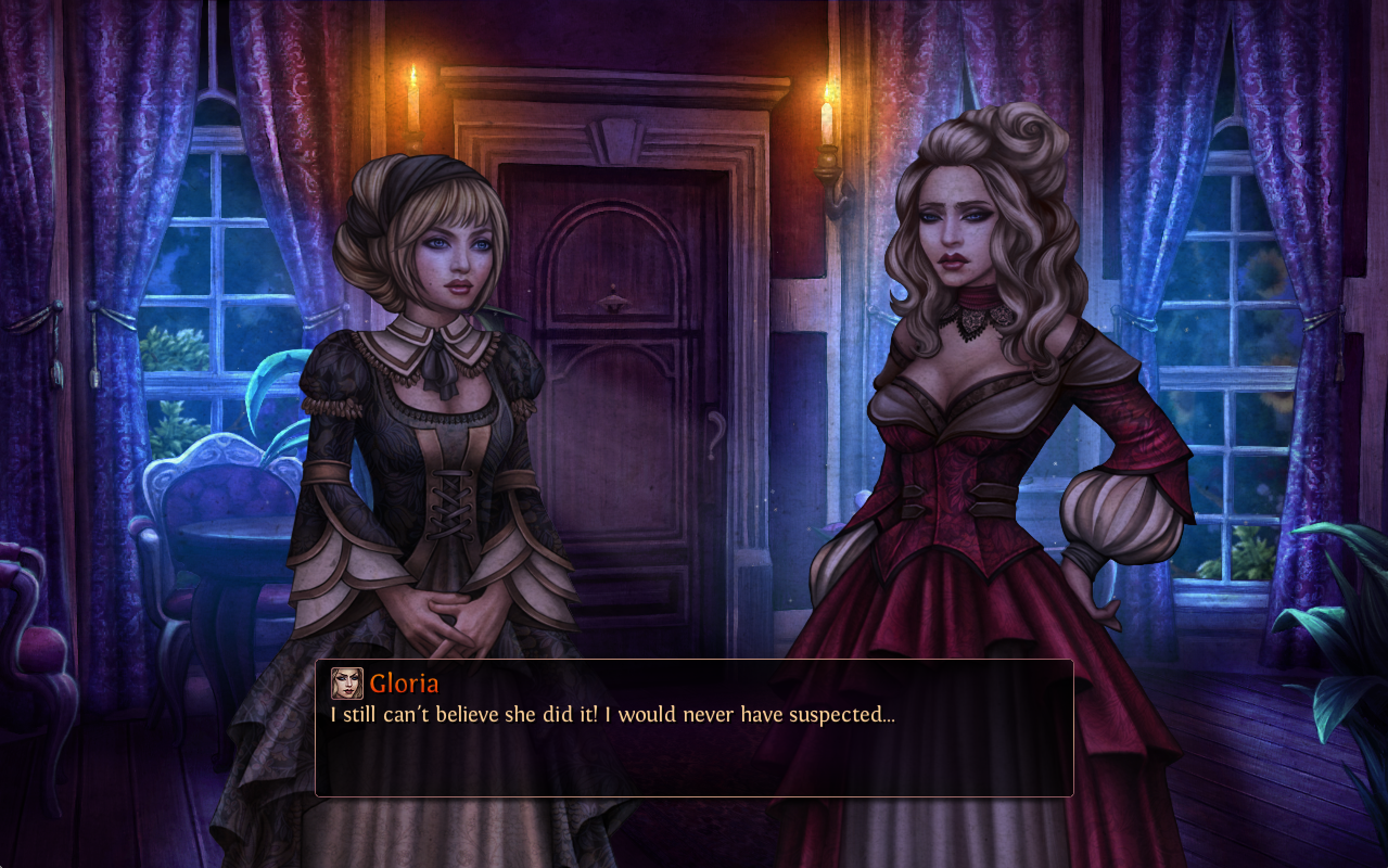
Cinders is a visual novel adaptation of Cinderella that takes a shot at this same issue. It’s been out for a few years, but recently a friend gave me a Steam key for it, so I only played a month or so ago. It has a lot to commend it: the art is very attractive while not belonging to the usual anime categories; the story offers a high number of branches and subbranches; and the whole thrust of both story and mechanics is to interrogate the “be quiet, put up with being bossed around, and eventually you’ll be rewarded with a man” message of the original fairy tale.

This Cinderella has the opportunity to be passively obedient (“good”), assertively selfish (“bad”), or “smart” (here’s a spoilery breakdown of how stats are distributed over the course of the game). Being smart is usually a third-way path that acknowledges nuance and complexity in interpersonal matters while rejecting fantasies and delusions about magic. The conventionally “best” outcome, where Cinders marries the prince and then presides over a happy kingdom, requires a balanced behavioral profile. And whatever happens, the Cinders in this story doesn’t get any outcome without working for it.

I think there’s still further to dig into the Cinderella problem — the difficult thing in my experience is not so much about whether one should sometimes stand up for oneself, but about when, and how, and how to balance other people’s needs with yours when you’re out of practice making that calculation, and how to deal with the emotional fallout of standing up for yourself when you’re still counting your own “virtue” in terms of the number of other people’s tasks you did today.

Nonetheless, I enjoyed the spin Cinders put on this old problem, and the fact that some of the happy endings didn’t wind up joining me with the prince at all, but let me have other lovers, or solitude, or even something approximating a career.
Interactive Fiction Fund Titles

The Interactive Fiction Fund is a patron-supported initiative run by Javy Gwaltney to commission new works of interactive fiction each month. Because of the amount of funding and the timeframe, these tend to be short, choice-based pieces. Patrons get access to each new piece as it is finished, and the author then has the option of arranging to sell it on otherwise. If you too would like access to these when they’re published, though, you can sign up to the Patreon.

So far, there have been five IFF works, one for each month from January to May of 2015.

Continue reading “Interactive Fiction Fund Titles”

Lifeline (3 Minute Games)

lifeline-ios-02Lifeline is an iOS and Android mobile game in which you are fielding a distress call from someone named Taylor (gender never actually specified — I’ve seen some reviews refer to Taylor as male, but I pictured a woman). Taylor was the youngest, most naive crew member aboard a space ship that has crashed on a distant moon. They have no previous space experience and only the most rudimentary safety training. For some reason you are the only person in communication range, so they need you to prompt them through a series of survival decisions.

The story plays out in roughly SMS-sized messages from Taylor, which sometimes come in rapid succession and sometimes only after a substantial real-time delay. These exchanges are backed by atmospheric music, and though the actual content is quite bare-bones and without visuals, the presentation is glossy and solid.

Lifeline has also garnered reviews calling it the best game available for the Apple Watch — one of those statements that might feel like faint praise while still being quite important from a marketing perspective. As far as I can tell from here, Lifeline is another example of the success of commercial IF on mobile. (This Offworld article talks a bit about how the piece was actually prototyped in Twine.)

Continue reading “Lifeline (3 Minute Games)”

Mystical Creatures: Hunting Unicorn (Chandler Groover); Iron Rabbit Encounter (Caeth)

hunting_unicorn

HUNTING UNICORN, Chandler Groover (play online). HUNTING UNICORN is the recasting of classic unicorn legends, the story of a poor and unattractive woman whose chief income comes from serving as unicorn-bait, drawing the animals out so that they can be captured by hunters. It often feels as though there is nothing she can do to improve her situation, and the story is in part about whether that is really true. The unicorn itself is a fearsome animal, not at all sparkles and rainbows, which can only be controlled via its own consent.

Groover’s authorial notes explain that one of his main aims is to make the player feel like it’s not necessary to replay, in contrast with forms that encourage lawnmowering all the possible endings. For me this partly worked and partly didn’t: when I got to the end I felt that I’d experienced an effective story with a good narrative arc. Certainly there was nothing that formally encouraged me to go looking for the other branches in order to understand the piece better.

Continue reading “Mystical Creatures: Hunting Unicorn (Chandler Groover); Iron Rabbit Encounter (Caeth)”

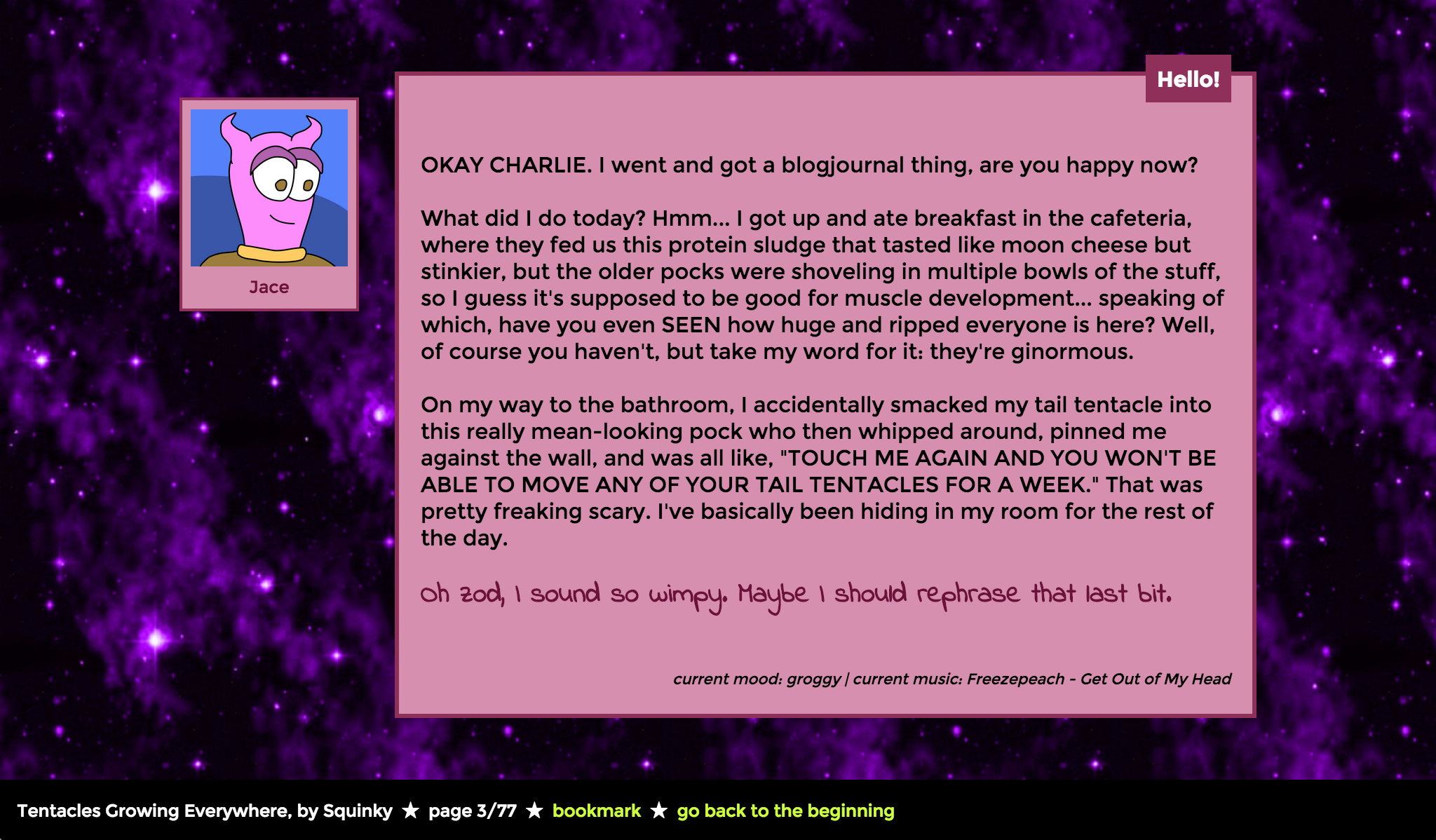
Tentacles Growing Everywhere (Squinky)

Screen Shot 2015-05-16 at 11.27.47 PM

Tentacles Growing Everywhere is the story of three young tentacled aliens who are just transitioning into their lifeform’s version of puberty.

The primary mechanic is one of editing posts: each of the three protagonists keeps a blog, and you’re in the role of helping them write, sometimes deciding what to take out and what to leave in place — which puts this story in perhaps a very small genre with a few other interactive epistolary pieces. I happen to be quite fond of this form, which explores both what someone is thinking and what they’re willing to write down about their thoughts, and Tentacles uses it to good effect as the characters fuss over how their friends might interpret their adventures, whether it’s a good idea to give one another advice, and so on.

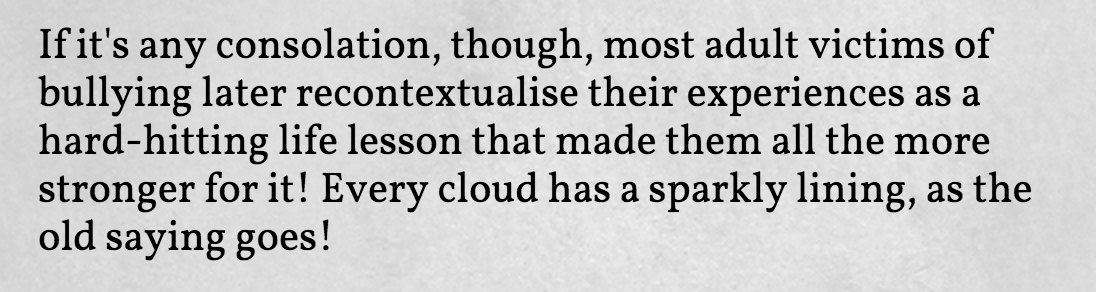
These interactive passages are interspersed with excerpts from a “helpful” guidebook to puberty, written in the same faux-casual voice so often employed for this purpose. Here’s its guidance about being bullied:

Screen Shot 2015-05-17 at 12.39.54 AM

Overall the story is pretty linear: there are some choices to make, but I don’t have the impression that they have more than a local effect on the story (if there’s major branching available, I missed that fact). Even so, there’s a fair bit of text here — 77 pages, with your current page number clearly visible as you play. It’s a novella-sized interactive read, with each protagonist having their own plot arc, though they have a fair amount of interplay as well.

Continue reading “Tentacles Growing Everywhere (Squinky)”

ShuffleComp, 2015 edition

ShuffleComp is an interactive fiction comp in which participants send in lists of songs; the songs are shuffled and redistributed, and each participant writes a game based on one or more of the songs they received. (Last year’s competition yielded some 34 games and is responsible for not one but two games titled Fallout Shelter.)

Here are some favorites from this year’s comp:

Continue reading “ShuffleComp, 2015 edition”