Four talks at GDC

Well, GDC is officially over for the year. This conference was a powerful one for me in a lot of ways, exhausting and inspiring. Thumbnail sketches of some memorable talks from the last two days:

(1) Chris Crawford spoke on the history of computer game programming, complete with lots of fun pictures of positively ancient machines, and ending with his pitch for games to be about people. I’d heard a lot of it before, but it was an enthralling and well-delivered talk, and even though we disagree on some fundamental approaches to the problem, I sort of love hearing the point made over again. Afterward we met up in the hallway and there was a curious playground-fight vibe from some of the onlookers as we discussed our different approaches to the gameplay-about-people problem. Which isn’t what I intended — I just wanted to say hi to him after assorted emails and comments exchanged over the years. But whatever the surrounding circle may have thought, I have no beef with Chris, nor I think does he have any with me.

Anyway, one of the points Chris made in our unfortunately brief discussion was that he felt the parser in IF doesn’t do a good enough job of taking in information from the player — that it doesn’t listen well enough; it doesn’t allow the player to make a big enough part of the conversation between game and machine. I’m not quite sure what this indicates: is the input not granular enough, or the output too wordy, or the range of things that can be said via parser too narrow, or…? I’m not sure whether I’ll agree once I figure out what this means, but it’s an interesting statement.

(2) Brenda Brathwaite talked about her series of tragedy-focused games, the series to which Train belongs. The core of her talk that stuck with me was this: “Whenever there’s human-on-human tragedy, there’s a system.” So her approach is to explore that system in rules, and make the player complicit. There was a lot else in the talk, about the personal nature of her work and about her own feelings in creating it. I don’t really feel comfortable trying to summarize here, but it was a brave talk to give, and fascinating.

In fact, quite a lot of this GDC has felt unusually personal for an industry conference, from Michael Todd’s talk (which I didn’t see but heard praised by many many people) about designing games while clinically depressed, to the rawly open content of the rapid-fire indie talks, to conversations with Deirdra Kiai and Terry Cavanagh about the motivations behind my own work and/or theirs.

(3) Ernest Adams gave a talk on spec’ing out an interactive narrative, in which he discussed a lot of standard problems: the freedom/agency/story problem, the question of whether the player should be able to change outcomes (and the fact that an interactive narrative doesn’t have to be one in which the player changes the plot), etc. It wasn’t as flashy a talk as the others, and it didn’t contain a lot of information that was new to me, but it was cool to see these issues organized in one place. You can see it too, since he has put the slides (odp) and storytelling template materials (odt) online.

(4) Brian Moriarty gave the most coherent and philosophically interesting argument in support of Ebert’s “games can’t be art” dictum that I’ve ever heard. (This gets long.)

Edited to add: there is a set of point by point notes from Moriarty’s talk here, which covers some details my analysis doesn’t discuss.

Continue reading “Four talks at GDC”

Highlights from the first two days of GDC

So tired, so very very wired. But some of my favorite moments from GDC so far:

The weird, wired, super-fast Rapid-Fire Indie Game session. Chris Hecker’s speech at 250 miles an hour about getting your game out there and getting it known. Hearing about the genesis of pOnd, a game that made me laugh so hard I had trouble breathing. (Or have so much trouble breathing that I had to laugh? One of those.) Anna Anthropy’s talk on the indie game scene being so much about the same set of nerds making games for the same set of nerds… followed by a hilariously in-crowd-y performance during the Q&A session. Getting to meet Anna.

Seeing Aaron Reed’s book in the GDC bookstore:

The AI Summit, in just about every particular. Content-wise, even the stuff that has no bearing on my own work, like the talk on influence maps, has been fascinating. People-wise, they’re cool, brilliant folks, and tremendously approachable.

Eric Zimmerman and Naomi Clark’s talk on the Fantasy of Labor, which postulates that people play time management games and their ilk — games that are more or less impossible to fail and largely decoupled from skill — because they like believing persistent work will get them somewhere. I wanted to ask whether they thought this fantasy has become more powerful and more pervasive as the economy has tanked, but that seemed like too much of a downer even for a fairly serious talk. I think there might be some psychological terrain to be mapped that goes even deeper and to even stranger places: namely, a sense of virtue from doing large amounts of busy work that someone else has bidden you to do. I can’t say that has motivated me in real life very much as an adult, but it’s what got me through the first few years of elementary school for sure.

Not favorite: I didn’t get my speaker t-shirt! They asked me what size I wanted, but then it was not in my bag. I am sad. Childishly sad. I don’t wear my shirt from last year much, but I like having it, you know?

The Sacrifice Mechanic

Over on the Escapist, Extra Punctuation has an awesome article about a game mechanic of leveling down rather than up. I’ve occasionally kicked around a similar idea, though starting more from “how do we do choice narratives where the choice feels significant?” — and one way to make the player actually care about choices is to tie the results into gameplay.

I’m attracted by the idea of a plot reminiscent of (the movie version of) “Last of the Mohicans,” where our protagonists start out as wealthy, happy, proper young ladies of English extraction and end up as bedraggled, hardened, and — in one case — dead. It’s a story of stripping away all peripherals until each character’s deepest feelings and commitments are revealed. That kind of story could make a compelling tragic game, or a story of triumph at excruciating cost, not far off from the structure of Victor Gijsbers’ Fate.

Leveling down, or gradually giving up your collection of Batman gadgets, or losing one after another of your crew of sidekicks until you stand alone, or burning away one after another of your huge inventory of doodads — that’d be a way to do the gradual-loss plot. Like I said, awesome.

Homer in Silicon on Date/Warp

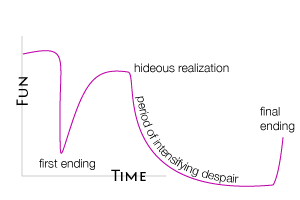
Date/Warp is a visual novel from Hanako Games, paced out with puzzles. I liked a lot of things about it, but had some issues with the structure; essentially, my discussion is about how to handle situations where you want the player to replay and try most of the alternate versions of a multiple-ending game, where that will mean that late replayings will be mostly the same experience over again. Date/Warp enforces this more than many other games (though in a way I gather is not unusual for visual novels) by having the best ending be completely locked and inaccessible until you have played through almost every possible variation.

It’s a problem that has some bearing on multiple-path IF. I know, for instance, that there are people who did play Alabaster this way and found it exasperating to do so — see TempestDash’s review here — even though the intention was to steer players aggressively towards interesting endings and point out which mysteries were missed, rather than to encourage complete exploration of content. So, though I’m critical of Date/Warp as an experience in that regard, I think it raises some useful questions.