
Contradiction (Pneuma Films)

denton

Contradiction is a murder mystery game set in a small English village. You control the movements of police inspector Jenks, who wanders around interviewing suspects, finding contradictory elements in their statements, and pressing them for more. Conceptually it’s akin to Detective Grimoire or (to a lesser degree) Phoenix Wright; the twist being that it’s interactive film, with live action segments for the interrogation scenes and for many of the transitions as Jenks wanders the village. It’s available for the iPad, and for Mac/PC via Steam. Though I have some criticisms of the design, I enjoyed it quite a bit; it is vastly better than Tender Loving Care.

Conceptually, this doesn’t stray that far from its graphical adventure inspirations: you run into locked doors and have to find the key elsewhere, or dark rooms that need a light, or so on. Most of these puzzles are pacing devices and aren’t tremendously difficult, though it’s possible to get stuck because you haven’t noticed a useful object.

That issue is compounded by the fact that the game is divided into one hour segments: “after 5 PM”, “after 6 PM”, and so on. The clock advances automatically when you’ve reached critical plot beats. This allows the game’s creators to move characters around, make the pub and houses open and close at different times, and give a sense of life to the village. There are sometimes new cut scenes when you go someplace you haven’t been already that hour, opening up new information. The downside is that this means you really need to revisit every location during every hour, even if Jenks doesn’t have a good reason to do so at the moment. Not realizing this is what got me a bit stuck several times in the early game. There is a TIPS panel you can open to get advice about what you’ve missed exploring recently, but I found it was occasionally buggy in the late game.

“Always nice to randomly find a key on the floor.” — Jenks’ voiceover, at one of the more credulity-stretching coincidences

Finally, the logic of the investigation is very much game-logic rather than real-world logic or even TV investigation logic. There are a lot of things that we discover simply because Jenks finds a set of keys and decides to do some warrantless searching. He has no compunctions about small acts of petty theft. Sometimes he decides that objects are interesting and worth pursuing even when they’re not yet of any obvious relevance to the investigation — a point that stands out the more because of the realism of the sets. In an animated graphical adventure, it feels semi-plausible that the protagonist interacts with the one object in the room that has a hotspot, especially if (as is often the case) the setting is otherwise a bit bare. In Contradiction, Jenks will often wander into a storage room crammed with objects, as storage rooms often are in the real world, and light on the one piece of paper that he has arbitrarily decided is going to matter, even if at first glance it says nothing about anyone involved in the case. And of course, he’s right — but it’s weird. One just has to suspend one’s disbelief.

The contradiction mechanic is also constrained, in that you can only ask people about contradictions in their own statements, not challenge them when you’ve heard some contradictory news from another character. This probably keeps the game within the bounds of playability — even as things stand, by the end of the game I was struggling to juggle all the things I was supposed to remember being told — but it means that some very obvious avenues of investigation are closed. A character admits having an affair with another character? Fine, but you can’t go asking that second character about the affair. You’re never even allowed to bring it up. I’m guessing that real police don’t operate that way.

Then there are restricted pieces of evidence. Jenks takes a loose view of property ownership, but he’s strict about keeping confidences. If a character has told him not to reveal something to another witness, you don’t have the opportunity to bring that up with said witness, even if it seems like it might be a good idea. This, again, is probably to avoid letting Jenks cause scenes that might branch the investigation plot, but it feels artificial.

But if the mechanics are only moderately innovative, the FMV presentation makes it distinctive. The village is rendered with lovely atmosphere and attention to detail, and many of the locations have idle loop film with a much stronger sense of presence than a still image. The live footage of rippling lake water and of the trees blowing in the wind makes the outlying areas of town both attractive and sinister. By the end of the game I was intimately familiar with the glass in the pub door, the steps to a character’s cottage, the gates around an out-of-town mansion.

There are no deeply absurd puzzles of the sort where you make a fishing rod from a rope and a banana, because anything that Jenks needs to do has to be filmed, and so the solutions can’t rely on physical impossibility. Perhaps the author wouldn’t have been inclined to include those types of puzzles anyway, but dedication to the FMV aspect provides limits. (Contrast the also-FMV Missing, which incorporates various unlikely actions and then just doesn’t film the actor performing the ones that would be hardest to replicate in real life. I didn’t finish the first episode of Missing because it was doing too much with hidden object mechanics and implausible puzzles, and not enough with convincing plot, characters, and setting.)

As for the character performances, they’re not realistic in style, but they are fun to watch. Jenks has a way of cartoonishly widening his eyes at people and exaggerating all his movements. Many of the witnesses are entertainingly passive-aggressive about being questioned. Some feel that Jenks is bugging them or wasting their time, and I can’t say I blame them, after I have knocked on their door for the fiftieth time to ask them about, say, a random business card I found on the ground. Paul Darrow’s performance is especially hammy and entertaining, as he plays a no-ethics businessman, unencumbered by tact, who has a snarky word to say about everyone. There’s a quality to these interactions that would be very hard to capture in animation and voice-over.

Per genre, Contradiction is the sort of story in which pretty much everyone is up to at least one or two things they shouldn’t be doing. There are some references to drug addiction, alcoholism, and mental illness, and these aren’t always handled tactfully by the characters, though the game itself doesn’t necessarily endorse the views of the witnesses. I’d like to say a little more about the plot, but since this is an entertaining piece of work that you might well want to play first, I’ll put that after spoiler space.

Disclosure: I played a copy of this game that I bought with my own money.
Continue reading “Contradiction (Pneuma Films)”

Secret Agent Cinder (Emily Ryan)

Screen Shot 2015-09-11 at 12.24.13 PM

Secret Agent Cinder is a retelling of the Cinderella story, except not: though you dress up and dance with fancy people, it’s really about espionage and sneaking about at Versailles shortly before the French Revolution.

It belongs to that small but growing category of Twine games — with Hallowmoor, Krypteia, and This Book is a Dungeon — that feature a world model and a map you can get to know. There are some light puzzles, and you can reach a sudden bad ending, though the game will then automatically restore you to the last reasonable checkpoint to replay. At the end, you get a rating for your stealthiness, revolutionary violence, and zeal. The result is short, polished, accessible, and quite a lot of fun.

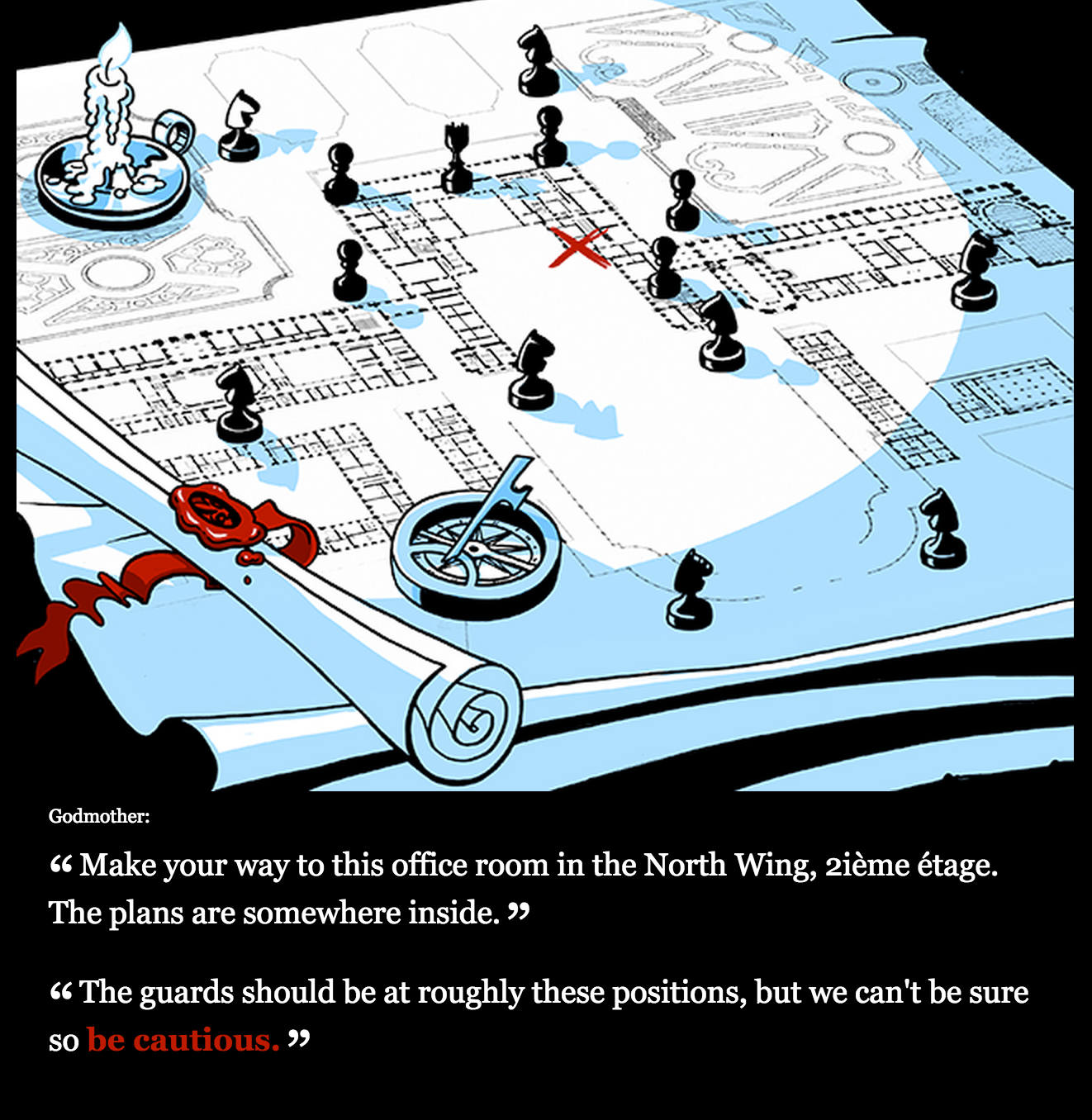
Besides having a map, Secret Agent Cinder uses illustration as a primary channel for storytelling: the pictures aren’t just a gloss on the text, but give key information about, say, the locations of guards. If you don’t pay attention to them, you’re likely to get caught. Many of the jokes are embedded in the imagery as well; it plays more like an interactive web comic than most things I can think of.

Mildly spoilery discussion of the humor follows the break.

Continue reading “Secret Agent Cinder (Emily Ryan)”

Digital Narratives of Time, Death, and Utopia: Arcadia (Iain Pears) et al

I began Arcadia – a novel conceived and written for an app – over four and a half years ago when a lot of people were musing about digital narrative. After working my way through three publishers, two designers, four sets of coders and a lot of anguish, I am no longer surprised that few others have done anything about it.

Thus Iain PearsArcadia Cover, on why his latest novel is an app and why it took so long to build. His “few others have done anything about it” is characteristically dismissive and makes me grit my teeth. There is so much going on in digital narrative and related fields that it’s challenging to keep up with the variety. What Pears apparently means is that few novelists with London literary agents have done anything with digital narrative, and possibly that he doesn’t regard anything outside that circle as worth checking out. That is his prerogative, but a little more awareness of the world outside might have brought tools to his attention that would have lightened the workload.

It is true, though, that Arcadia is different in structure, scope, and conception from a lot of other interactive literature. The piece is a series of short scenes about many different characters, together with an app whose narrative map allows the reader to follow one character at a time or leap across time to seek the answers to questions. This puts it in a category with Snake Game and The Strangely-Browne Episode in that it is primarily letting the reader choose a course through the story, not alter the plot itself: it is not linear and the reader does have important agency, but that agency affects the reading experience, not the development of events.

Further, Arcadia takes place in three separate settings — Oxford of the 1950s and early 60s, a fantasy world invented by one of the Oxonian characters, and a technocratic dystopia of the future — though over the course of the plot, the reader may come to question whether these are in fact alternate universes and whether the fictional world is less real than our own. Another reading strategy might be to read all the events in one setting first, then pursue those in another.

*

The app

Pears has said that he wants reviewers to focus on the content of the work and not on its structure, and that he wanted the app to avoid being gimmicky and flashy. It does succeed in being fairly transparent, but I have a few thoughts about it nonetheless, before I go on to the content or the structure of the piece.

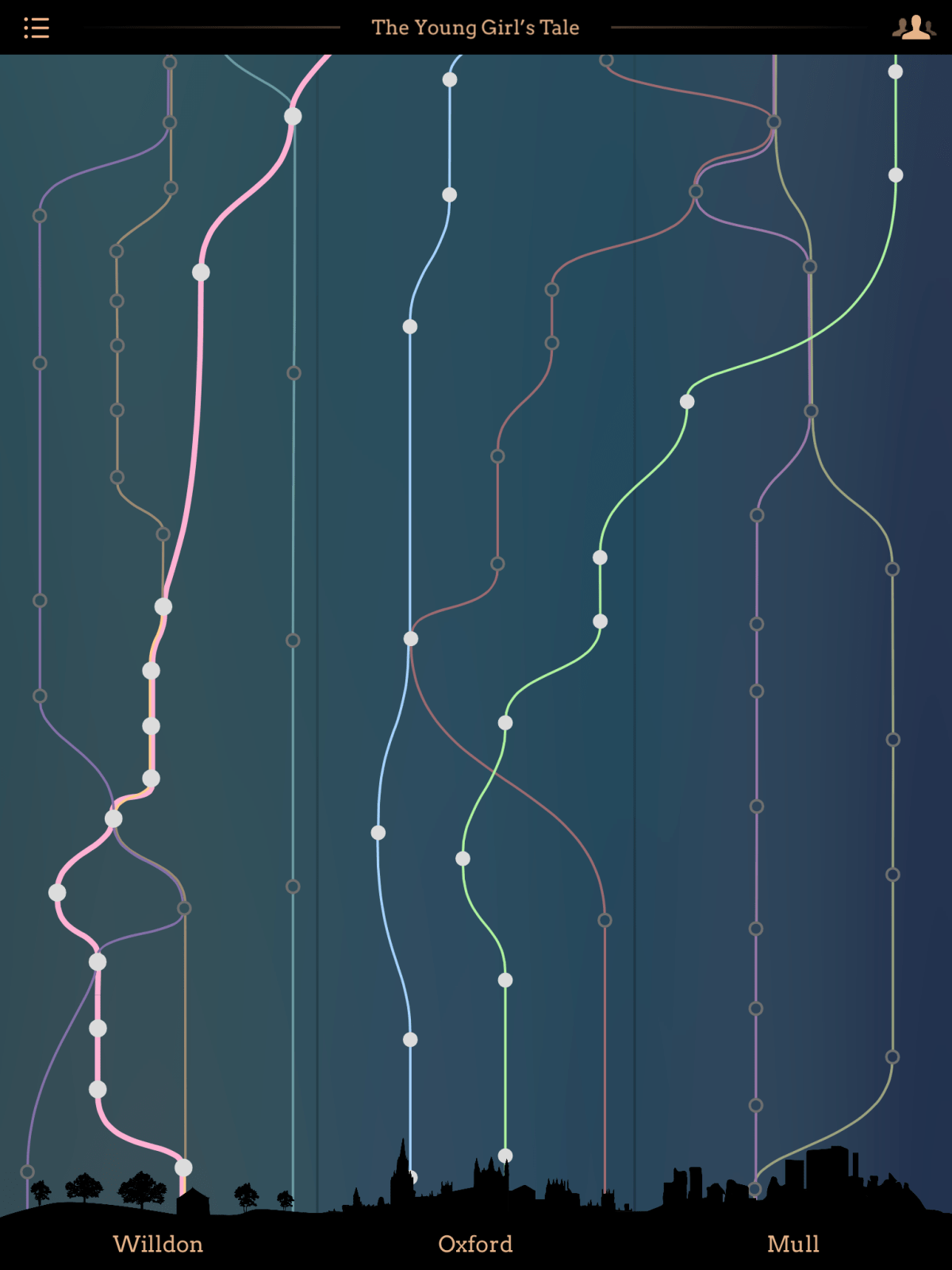
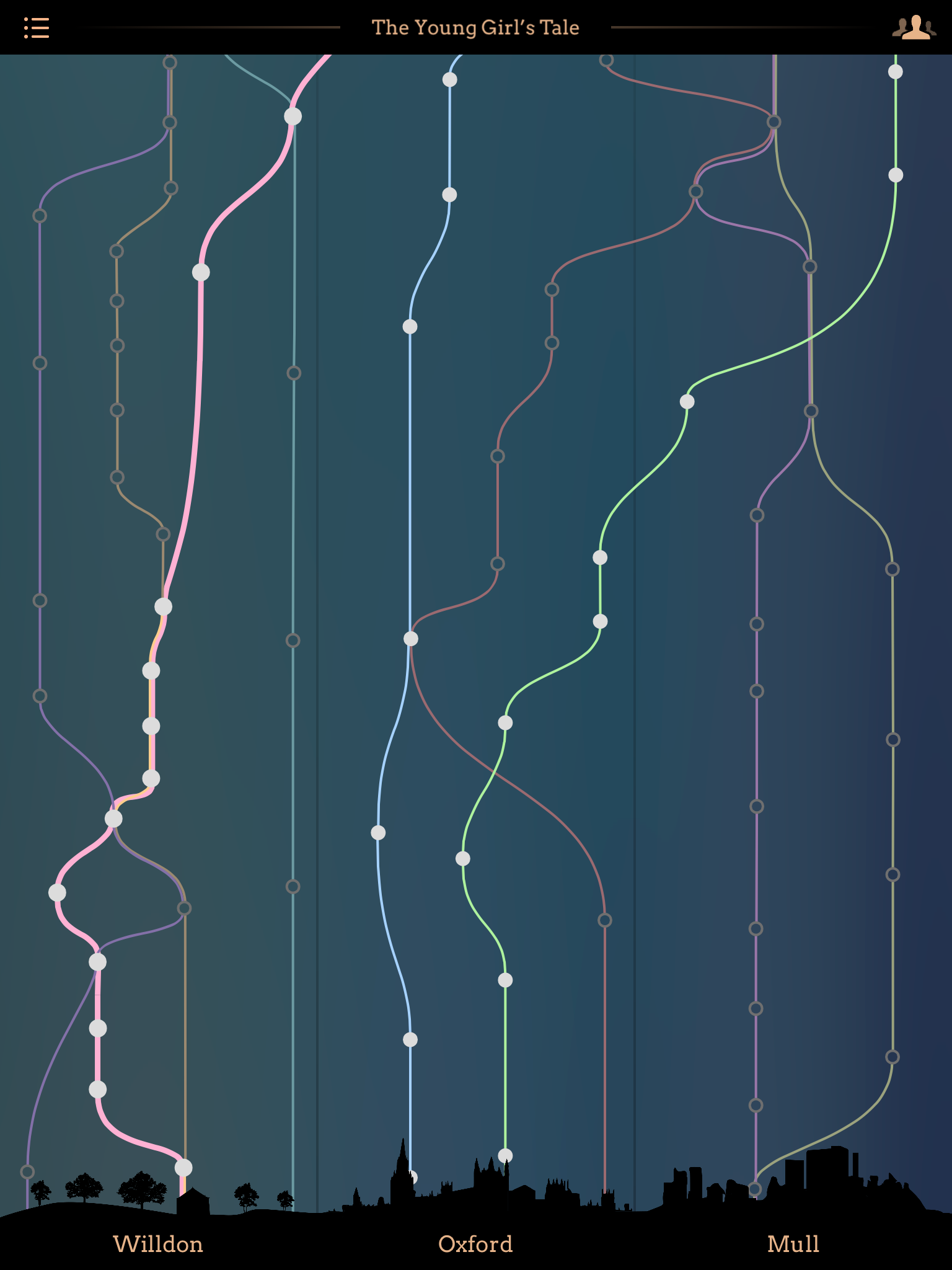
The app’s narrative map reveals some intriguing things if you study it carefully. One line splits in two when a character is in two places at once. (This is a story of time travel and alternate universes, after all.) Elsewhere a fresh line comes into being when a new character is introduced to the story. Crises in the story are evident because so many character threads come together and intertwine.

IMG_0172

In the reading interface, though, the app downplays these important moments. When you read a chapter whose characters subsequently split up, the page looks like this:

IMG_0154

…and you have to swipe sideways in that last quarter of the screen to check out what the alternative continuations might be. It’s understated, even possible to miss. In this particular case it is both striking and narratively important that either of your two next pages will belong to the Young Girl’s Tale, but you don’t see this at a glance. I could see aesthetic arguments for playing this subtle, but I think I myself would have preferred something that more clearly showed what was happening at this moment.

Meanwhile, once you’ve started reading a new chapter, you can’t jump sideways to any of its siblings unless you first go back to the top-level map. That’s something that I often would have liked to do. And if you swipe to go back a page when there are multiple strands leading to where you are, you also don’t get a choice of which backward step to take. At least once, I’m pretty sure I tried to back up to a vignette I’d just been reading but accidentally switched tracks and wound up confusing myself further. So the navigation here, while conforming somewhat to Pears’ declared desire for simplicity, did still miss some functionality I would have liked to have.

*

Routes through the map

IMG_0155There are many, many possible ways to read this — by which I mean not just that the combinatorial numbers are large, but that there are multiple reading strategies one might pursue. Follow one character to the end first? Read about events in one of the settings, then go to a different one? Switch back and forth between strands frequently, to try to get contemporary events at the same time?

I experimented with several of the characters, but soon settled on the story of Angela Meerson, a time-traveling scientist whose experiments in the future apparently precipitate a lot of the rest of what happens — though of course, as always with a time travel story, the question of cause and effect becomes rather tangled.

Once I’d read all of Meerson’s story, I went back and started filling in what had happened to some of the other characters. Other reviews I’ve read don’t center their discussion on Meerson, but focus instead on Professor Lytten (the Oxford man who has written the fantasy story) and on a young woman named Rosie — which seems to bear out Pears’ remark

Minor characters can become major ones at will, and central characters become bystanders equally easily.

In my readthrough, Meerson took on a primacy that she might not have for other readers. I chose to start with her because I thought her understanding of events would be the most authoritative, and would then give me the structure that would let me understand the more subjective, confused, and often emotionally richer experiences of the other characters. Her scenes are also, uniquely, narrated in the first person when she is alone.

I then filled in a lot of the events set in Oxford and in Willdon (the main scene of action in the fantasy universe of Anterwold), and last of all the strands for the characters who remain in Angela’s future world. Here, again, I was chasing the bits of the text that I thought might answer whatever questions I had next.

I can also see, though, why one might start with Lytten, the 1960s don-and-spy living in North Oxford who has designed Anterwold. We first meet him telling his story to a group of Inkling-likes in a setting not obviously distinguishable from the Eagle and Child, though a few years after the historical Inklings had stopped meeting there. He is friends with Tolkien and impatient with Lewis, and his comments on both sound a lot like authorial ventriloquism. Of all the characters, he seems most likely to offer Pears’ own perspective on events.

That these diverse reading approaches work is a tribute to Pears’ meticulous construction. The storyline of each character does make sense read through by itself, though it may appear full of startling coincidences. Each character line does come to an emotional conclusion. But the book is also seeded with hints of what might be found elsewhere. Towards the end of the Willdon section, a character mentions that there is a long story to explain something she has done, and it was immediately evident where I should go look for that explanation. Elsewhere there is a mystery laid out so that you might discover either the culprit or the significance of the act, but not both at once. It remains mysterious regardless of which end is up.

The effect is also down to Pears cheating — or, at least, not quite keeping the implicit promise of the narrative design. You can follow most of the characters from one vignette to another using the narrative map, but there are a few who go uncharted, including one very significant character.

Continue reading “Digital Narratives of Time, Death, and Utopia: Arcadia (Iain Pears) et al”

Private Games

This is the talk on Games and Intimacy that I gave at Now Play This on Friday.

*

Many of my favorite games to write have been written for specific people.

As indie designers, we talk about writing for the market (which involves a lot of guessing, because who can read the minds of the masses?) or writing for ourselves, to create the game that we most want to play or the game that expresses some deep-held belief or the game that fits our artistic vision. And then a lot of people sink their teeth into one of those approaches and growl at anyone who tries to take it away. Like it’s not realistic to write for yourself, or it’s not honest to write for a large audience.

But there’s a third option, which is to write for a specific recipient or a small group of recipients that you know personally. And that’s actually how a lot of us start, of course. The first computer game I ever completed, I wrote for my little brother because he was bored with math. It was a dungeon where the monsters asked you arithmetic questions as a form of combat. Astonishingly he liked it, which shows you something about the power of personalization.

* For someone else’s friend

Once as part of a charity auction, I auctioned off a small work of custom interactive fiction. The person who bought it asked me to write a game for her brother. She told me about the kinds of games he liked to play and the puzzles he’d enjoyed in the past, and she asked me to set it in a particular fan universe I’m also fond of.

Even though I didn’t know the recipient myself, I really enjoyed working on this project. Game design best practices are often about trying to suit the largest number of people and accommodate different play styles, but when you have one person in mind, when you know what that person likes to do in games, you know what that person is likely to find funny, you can calibrate every aspect so much more tightly. The game rewards are rewards FOR YOU.

* For a collaborator, then the general public

One of my larger on-going projects is providing support for the text adventure tool Inform 7. One of the things I do for that project is provide small — in some cases really tiny — example games, showing off all kinds of code functionality. Over the years I’ve written nearly five hundred of these, and while they were written for the broader Inform community in the long run, their first reader has always been my collaborator on the project, Graham Nelson. So I want to make them amusing and enjoyable in general, but there has always been that additional point of wanting to entertain him personally — especially since he was often reading over the examples I submitted as break from doing some boring or arduous batch of bug-fixing.

And, full disclosure, partway through this project I married him, so we have a lot of shared history.

The result is that those example games are now like a stratified record of shared references, TV shows we were both watching, places we’ve been on vacation, disagreements we were having about game design.

* For a friend

Many years ago some of my friends and I got really into buying and trading perfume oil from Black Phoenix Alchemy Lab. If you’re not familiar with this, it’s an online perfume shop from which you can buy tiny bottles of perfume oil with names like Tezcatlipoca and Severin. Their perfumes are designed after Neil Gaiman characters and voodoo spirits and ancient lost cities; the descriptions of their perfumes are some of the most evocative advertising copy on the internet. And they send samples, but you can never get samples of everything because their product line runs to the hundreds, or maybe even the thousands at this point.

So my friends and I would order these perfume samples, keep the ones we liked, and swap the ones we didn’t like. At one point, I’d decided that when I mailed perfume samples to my IF-loving friends, I would also send along some tiny little IF games that were based on the scents. It felt like a more creative way of doing a review, which had been our custom up to that point.

To a friend who wrote gorgeous surreal IF, I sent a little interactive machine room in which the devices controlled different scent notes. That friend has a really lovely, spare prose style, so I found myself concentrating on my prose, trying to make it worthy of the recipient.

To another friend who was a Harry Potter fan and Snape enthusiast, I sent a small scene set in the Potions classroom, in which the samples I was sending were all Potions ingredients. If you solved its main puzzle and figured out which of the three perfumes I personally liked best, you got an ending that shipped two characters she liked to see together.

One of the things I look for when I’m writing is the moment when a passage rings true. This is so much an intuitive measure that I can’t provide any objective qualifiers for it. It’s different from thinking that something is clever or funny when I write it, though: instead it’s an experience I have when I’m reading it back, and think, “Yeah, that’s right.” What I write for specific people, though, has to ring true in the context of what I know about them.

This is not the kind of game I’d ever write and release for the general public, even if there were some niche audience of Snape-loving BPAL fans who happened to have the exact same three perfume samples that I put in the game, but in the context of this particular friendship it felt really cool.

It was a goofy way to spend a couple of afternoons on vacation. I never would have written those pieces for myself. They were like letters, and had as much to do with the recipient as with me.

Continue reading “Private Games”

Lithomobilus / NonBinary Review / The Strangely-Browne Episode

IMG_0150Lithomobilus is a free reader app that advertises itself as being for non-linear storytelling:

Lithomobilus is the first e-book platform that augments existing narrative forms and makes entirely new nonlinear narratives, without eliminating the things that make books wonderful. Our online writing software gives authors the power to expand upon their existing works, create new works with built-in expansion opportunities, and craft amazing nonlinear works.

Currently the content includes five issues of the NonBinary Review, one issue of Unbound Octavo and a few standalone stories. NonBinary Review takes existing, public domain work and sets it side by side with response material from current authors; so far these include The King in Yellow, Bulfinch’s Mythology: The Age of Fable, The Wonderful Wizard of Oz, Frankenstein, and Grimm’s Fairy Tales. Unbound Octavo contains three short prose pieces that, as far as I could tell, could have been presented in a standard ebook format with no loss of structure.

Meanwhile, the pitch to readers is as follows:

When you are consumed by a story, you can never get enough. You want more characters, more details, more commentary, more of what makes that book addictive. The Lithomobilus e-book platform delivers it all without taking you away from your book.

Which isn’t that far off from the pitch for the Coliloquy novel I covered last month, but Lithomobilus takes a different approach to the same challenge.

Continue reading “Lithomobilus / NonBinary Review / The Strangely-Browne Episode”

Against Captain’s Orders (Punchdrunk / National Maritime Museum)

aco-eventlandingpage_950x2942

Against Captain’s Orders is an interactive theater experience run by Punchdrunk for the National Maritime Museum in London. It’s designed for a group of about 30 kids. Most of the productions require an adult to be accompanied at least one child between the ages of six and twelve, but they do run a special evening edition of the show for adults who are members of the museum. I’ve never been able to get to Sleep No More or any of Punchdrunk’s other work, and I was curious enough about them that I got a museum membership largely to be able to go to Against Captain’s Orders without having to obtain a child first.

The show has been reviewed as a piece of theater: the Guardian gave it ***, said it wasn’t dangerous enough; the Evening Standard an ungenerous ** and called it confused; Timeout went with ****, thought it was good but mostly for kids. The Register assures readers that the show provides value for money, which is true, but a grim sort of review of any sort of art. None of those reviews really gets into the interaction design side very deeply, though.

At the end of the show they ask you not to reveal too many of its secrets. I’m not going to give away the absolute ending, but it’s hard to analyze without spoiling a bit. So I’m not publishing this blog post until after the show finishes running. Still, if for some reason you want to avoid spoilers for a show that you can’t see now anyway, you should not read on.

Continue reading “Against Captain’s Orders (Punchdrunk / National Maritime Museum)”