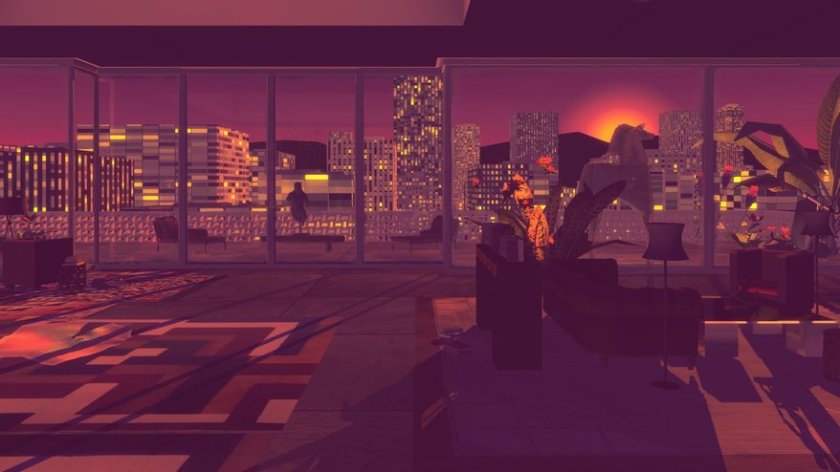
Sunset is the story of Angela Burnes, an African-American woman who has become the housekeeper of Ortega, a wealthy man in the fictional Latin American country of Anchuria. The time is 1972, in the middle of that country’s civil war. Every week Angela spends an hour before sunset tidying her employer’s house in the rose-orange half-light.
During that time the player can go through Ortega’s possessions, getting to know the man better, checking chores off the day’s list. Eventually, Ortega starts leaving notes around the house, which the player can answer. Many chore actions and note-answers offer two variants, a flirtatious one and a cold one, but Ortega also responds to any sign of human presence. Leave his lights on, leave his water running, and his love for you will grow.
The apartment changes from visit to visit. Sometimes there’s a mess, left over from Ortega’s activities. Sometimes there’s new mail or rearranged books. Ortega changes from week to week which doors of his apartment are locked, which means that the whole floor plan of the apartment is rarely available to us at once; the apartment retains some more private areas that we only get to visit once or twice.
The ability to section off parts of the floor plan helps direct the player each day, though it was (I found) an only middling solution: on several days Angela was assigned chores so vaguely described that I couldn’t figure out where I was supposed to go in order to perform them. Somewhere in the apartment, from some angle, there would be a hot spot that would complete the chore in question, and I’d wander around all the rooms over and over, curious, then confused, then bored.
I began to enjoy Sunset more when I decided to let myself skip chores that proved too hard to find.
Fortunately, Ortega’s a forgiving boss, so even if Angela leaves some tasks undone, he never fires her and the story never comes to a mid-game halt. And the system seems designed in part to push the player towards romance, towards the flourishing of a sense of intimacy with someone never seen or encountered.
Sometimes the interactive flirtation worked for me, though more when it took the form of physical gestures rather than words: I was happy enough to leave Ortega’s possessions attractively laid out, but some of Angela’s flirtatious messages to Ortega are more overtly sexy than I found… plausible? comfortable? …given that they’ve never even been in the same room together. This may partly be a reflection of the writing generally: Angela’s inner monologues were often a bit on the nose for me, too, though not so much so as to ruin the experience. Conversely, I was amused the time I took the black queen off the chess board, and returned to find that he’d removed the black king as well.
Eventually, as things break down in the city outside, the apartment becomes more and more cluttered with objects that Ortega has rescued: crates and boxes, maps, museum plans. Hallways that used to be useful become blocked with junk, forcing me to go the long way around. Angela’s inner voice was frustrated, though not as frustrated as my own.
The thing I like best about this gameplay is the way it allows for improvising small expressive moments. The way I’m drawn to the window by the sound of jet fighters outside, and watch the contrails nervously even though I know it’s just a parade demonstration. The way I turn on a record and sit in a chair to listen to it after my chores are done, reaching for some quiet. The way, on other days, that I rush through my chores and leave again as soon as possible, currently annoyed with Ortega and not willing to linger in his space. The pleasure I take in the sight of my shadow cast across the carpet. The nervousness when I look out the window and see the city burning right before the protagonist was supposed to head home — surely it would be safer for her to sleep overnight in Ortega’s apartment than to go out alone in that chaos? The shock of hearing a bomb go off and seeing its flash in the lighting change around me.
Late in the game I found myself updating the calendar to the current date, even though that seemed pointless and futile, just as a touchstone for the earlier times when I had been meticulous about that ritual.
Continue reading “Sunset (Tale of Tales)”
 Writing about Videogames for Humans, Robert Yang noted some ways in which he found it a useful but not comprehensive guide to the games it covers. His review includes this passage:


 Emily Short's Interactive Storytelling