Tabletop Storygames: The Quiet Year

quiet-year-promo-1024x672

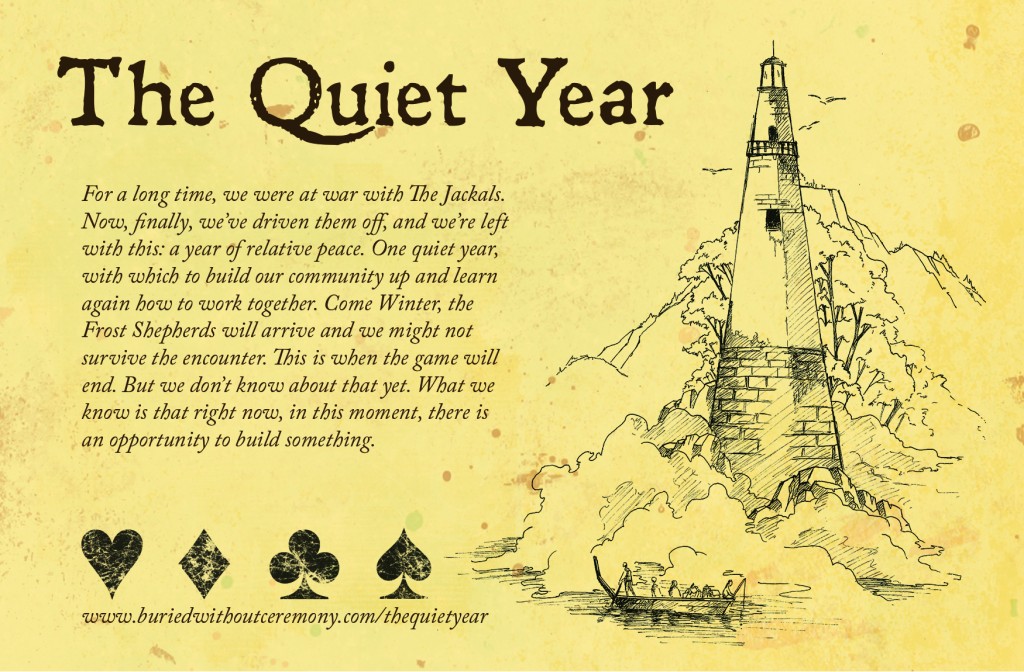
The Quiet Year is a story game about one year in the life of a threatened community. The War with the Jackals (not explained) is just over. The Frost Shepherds (also not explained) will turn up in a year, though the inhabitants of the town don’t know that.

In the meantime, there are up to 52 turns (one for each week of the year), and a deck of cards is used as a randomizer to determine what sorts of things might happen during those weeks. Each turn, a player draws the next card, follows instructions from a chart about what that card means for the community, and then takes one of three actions: proposing a communal discussion about a particular issue; discovering something new in or around the community (which means drawing it on the map); or starting a project (also drawn on the map, but set to conclude several turns later). By the time play is over and the last card is drawn, the map is large and complex and bears signs of many events that have happened to the community.

Our story told of a group divided by religious disagreements, threats from outsiders, limited resources (especially iron, which we didn’t have much of until late in the story), and a certain amount of archaeological curiosity.

Continue reading “Tabletop Storygames: The Quiet Year”

A view from a different rock

Here are some things I want to say from my own perspective about the IF community. I acknowledge starting out that my perspective is one of considerable privilege and good fortune, and that I know my experience is not the same one everyone has. But I think also that what I’ve said may give the wrong impression about what I think is going on, and I would like to balance it a little. Necessarily this is more personal than my usual output, and I do it in a separate thread because I don’t want to frame this as an excuse for things that are wrong. If that’s not input you’re interested in and you mostly hang out here for the reviews, that’s totally cool too.

Continue reading “A view from a different rock”

More about yesterday’s post

I’ve gotten a lot of email about yesterday’s post, and it’s clear that at a minimum I need to say a few things to clarify what I meant by it.

I intended to say:

— when I hear about things like the hate mail people receive, my instinctive reaction is to say something like “we would never do that!” “we are all far too decent!” or “that is not at all my experience!”; but this is not true, and I know it is not true. There are people in our community who would and do write threateningly to women. For me, because I know the community as a whole much better, it is easy to say “this person is a jerk, but not representative”; that is not always so obvious for recipients in a different position, and it gives us the reputation that the community is an unsafe place. I have had enough conversation with Porpentine about this situation to feel certain that it was neither invented nor from some random non-IF person.

— I feel shame at being associated with a community known for such behavior, even if the reasons are not under my direct control and were not caused by me. Shame is not the same as guilt, and deals in perceptions and associations, not in technical justice.

— to the extent that I do harbor any blame towards someone other than the author of said email, that blame is directed first toward myself, not toward “everyone” or “the men of the IF community” or another nebulous group. I do believe there is some collective responsibility for the trends of communities we’re part of, and that sometimes it’s not enough not to endorse something; it’s necessary to explicitly call it out as unacceptable.

I have known for a long time that women in the IF community sometimes get threats or inappropriate romantic advances or inflammatory rants, because I’ve received them and heard from others who received them. But I’ve avoided talking about my own because it seemed self-dramatizing and self-centered; I’ve avoided talking about other people’s because conveyed privately. Porpentine’s public statement about her experience provides a context in which to explicitly say “this happens and is not okay” without betraying anything said to me in confidence about anyone else’s experience.

Here are some things I did not intend to express, but that other people have thought I did:

— that I agree with everything Porpentine wrote in the rest of her article. We’re different people with different experiences and views
— that I think most of the IF community would endorse this email-sending, or that I regard most of the IF community with animosity
— that I have the exact same take on Porpentine’s reviews that she did. I didn’t quote that bit for a reason. Most of nastiest feedback I saw about howling dogs came from sources outside the traditional community; but I’m not sure I’m interpreting the reviews in the same way that Porpentine does, and am not sure I’m drawing the lines of the IF community in the same place she would.

At the same time, I know there are things about IF community reviewing and expressions of community standards that do cause hurt and alienation, and I am fairly routinely told about bad experiences by people who bounced off the community; it seems like every time I go to a game dev conference, I’m guaranteed to have at least one of each of these conversations:

1) I love the concept of IF but hate the parser!
2) IF is the reason I got into writing my own games! (sometimes there are surprise hugs here)
3) I tried to engage with the IF community and I felt totally excluded/everyone was mean/no one was interested in me.

Over time, that adds up. You’d be surprised how many game designers are in the business because of IF or partly inspired by IF. And you might also be surprised by how many people have found themselves on the outside, looking in sadly, for reasons that I at least didn’t ever detect. Porpentine, again, is unlike most of the people I’ve talked to about this in that she’s articulated some reasons and issues aloud.

I am not sure what to do about this aspect of things. I am still learning to hear people when they tell me about this, because my instinct to say “oh no we are incredibly nice really” or “that’s not what happened to me (so therefore I don’t think it really happened to you)” is so powerful. I don’t know what to do, but I am trying at least to listen when people tell me about these encounters with the community and not dismiss them even when they come in forms I find painful.
A word about who we are

Porpentine wrote this about her experience of entering howling dogs in the IF Comp:

It was natural for me to approach the circle of interactive fiction. I made games with words in them. But there was nothing for me. I was poor, not middle class. I was queer, not straight. I wrote experimental hypertext, not traditional parser. I was a woman, not a man, and there were many of them, and one of me.

It was intimidating.

Once I did participate, by submitting my Twine game howling dogs, I got harassing emails saying making howling dogs was a “crime”.

It shames and angers me that that was her experience with the IF community. I am sorry for it, but cannot repair it; I’d like to think we’re better than that, but I can see that we aren’t, because the reality is right there.

Tabletop Storygames: Polaris

Screen Shot 2013-05-02 at 11.38.30 PMPolaris is a tabletop RPG in which you know from the start that all the protagonists are doomed, and their civilization is doomed, and everything is ruined and is going to end in flames. This is exactly what happened in our recent session. I also can’t remember an RPG session in which I’ve laughed so much. It was great.

Okay, back up. Polaris is framed on the website linked above as a game to take 12+ hours. We needed to compress it into an evening’s play, so instead of having each player be a protagonist, we instead set it up to be about two protagonists and two players who were playing antagonist roles. Each of the protagonists was the knight of a civilization that had already partially fallen to The Mistaken; the latter, in our game, were a kind of body-jumping demon eager to bring about the end of time.

The mechanic enforces the idea of character corruption while leaving a lot of room to work out how this happens. In each scene, a protagonist is confronted by one or more characters played by the antagonist-player. These may be enemies, but it’s often more effective for them to be a friend trying to dissuade the protagonist from doing his knightly duty, or a family member asking for personal rather than public loyalty, or something of that nature — characters who have the ability to sway the knight through persuasion or deception or simply by presenting a conflict of priorities, rather than by direct opposition. The scene escalates into conflict, at which the protagonist and antagonist engage in a kind of narrative bidding process, which for us went something like this:

Protagonist: I lunge at Musca with my sword and run her through.
Antagonist: …but only if, when you kill her, you also destroy the sacred crown you’d come to seek.
Protagonist: …but only if, even though the crown is broken, there are shards I can take home with me.

There are also mechanics for rolling back part of the negotiation if you don’t like where it’s gone, also using key phrases (“You ask far too much”), but we didn’t invoke those as much. Things specified in the conflict stage can get quite large in scope; at one point a negotiation wound up narrating how the character would die, who would survive afterwards, and about five years of subsequent civil war and chaos. The entire extinction of the Polaris people was put on the table, but ultimately bargained down to a deal where they just had to leave the north pole and go to live in warmer, less happy climates.

Continue reading “Tabletop Storygames: Polaris”

Assorted Releases and Events

Sorcery! header

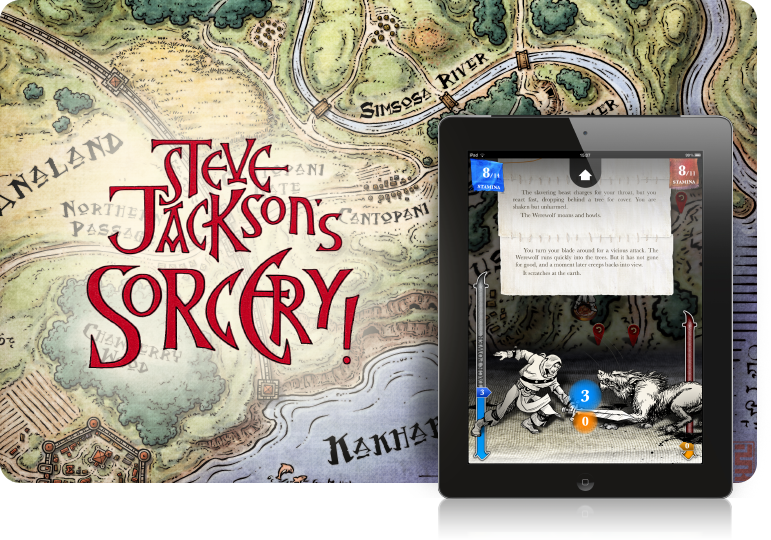
inkle has been posting for some time about their Sorcery! project with Steve Jackson, and it’s now available for iOS. I haven’t had a chance to try it out yet, but it looks gorgeous, with fun gamebooky play, a revamped combat concept, and a really attractive map. Here’s more about the making of, including discussions of the combat system and the creation of the user interface. It looks gorgeous, however, and is getting rave reviews at the app store, as well as positive coverage at Pocket Gamer. One unfortunate note: it’s not (yet?) really playable with VoiceOver.

The People’s Republic of IF in Boston is organizing another IF meetup this year, September 14-15, coordinated with the NoShowConf and the Boston Festival of Indie Games. This is an opportunity to hang out with other IF authors, share in-progress concepts, demo to the public (at Boston FIG), and attend game design talks (at NoShowConf). There may be some IF-specific programming there, though this isn’t finalized.

I’ve mentioned this before here briefly, but I’m speaking next week at the Inventing the Future of Games conference put on by UC Santa Cruz. That’s in Mountain View May 10. I’ll be talking about tools for interactive narrative creation, drawing on experience with Inform, Versu, and (to a lesser degree) various other IF tools.

XYZZY Award voting is ongoing through May 7. If you want to participate, check out the nominees and voting page.