Alfe Clemencio on interactive narrative in Don’t Save The World

Alfe Clemencio of Sakura River Interactive is the author of highly branching visual novels in Ren’Py. His previous work Fading Hearts features a wide range of possible player paths and outcomes; now he is working on an ambitious RPG project called Don’t Save the World. His Indiegogo page describes Don’t Save the World thus:

Don’t save the World: An RPG is a game where the effect of player’s choices are so strong they can change the genre of story and game. Live a life of adventure (RPG gamplay) or a normal life of running a shop (management-sim). Say “No” to saving the world!

…Near the end of the game gamers might be given the chance to slow down or stop the hero from defeating the dark lord.

I will guarantee that some players trying to be “good” will try to stop or slow down the hero.

In this scenario you are not the hero and won’t be defeating the dark lord. If the dark lord isn’t stopped then all the lands will be flooded with monsters that will bring the cities and towns to ruin. The hero is definitely a good person and is trying to do good.

It’s because moral choices like this that morality meters won’t work for this kind of game. Can you figure out why gamers trying to do good would do something like stop the hero?

Here he talks about that project, about the challenges of managing highly-branching narrative, and about the moral elements he is hoping to explore in his new work.

Continue reading “Alfe Clemencio on interactive narrative in Don’t Save The World”
Edge article on video game AI

This has been out in print form for a while, I believe, but the content is now available online: I was interviewed for an article on video game AI for Edge. The article draws extensively from the talk I did at the AI Summit at GDC 2012, with subsequent followup. I talk about social behavior AI and its potential in gaming, and there are also comments from Ben Sunshine-Hill (whose GDC talks always leave me in gobsmacked awe) and Mike Treanor (talking about Prom Week and Facade).

“Choose Your Own Interview” on RPS

Rock Paper Shotgun’s Cara Ellison interviewed me, Adam Cadre, and Andrew Plotkin, and then assembled the result into a CYOA. We talk about interactive fiction primarily, but also text-based gaming more generally. I have a long riff about inklewriter and related tools, and another one about the project I’m working on now for Linden Lab, to the extent that I can talk about that publicly.

The Act

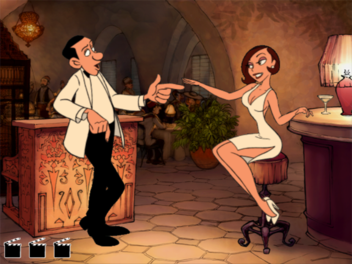
The Act is a very unusual arcade game I’ve been hearing about for years but until recently had never gotten a chance to play. The player has a single dial, which she can use to move the body language of the main character along a spectrum. Typically (though not always) that spectrum runs from Bashful Dope to Hardened Pickup Artist. The gameplay centers on getting the character to moderate his behavior appropriately in a number of social situations, but especially when flirting: don’t come on too strong at first, but don’t be too slow to pick up cues. Get the interplay just right, and you can complete the scene and move on.

Given that even such supposed interactive narrative stars as Heavy Rain have characters who routinely walk into walls, the idea of a game that was pretty much entirely about reading and responding to body language intrigued me. (L.A. Noire tries that too, of course, but in a very different way.)

And now that The Act is out for iOS, I finally got a chance to play.

Continue reading “The Act”

Phrontisterion, and some more thoughts about tools and the art

A couple of weekends ago I went to Phrontisterion 7, a living-room-sized conference on interactive storytelling run by Chris Crawford at his home in Oregon. Participant comments from that are now available.

For context for people who weren’t there: it was a really wide-ranging discussion about what projects currently exist in interactive storytelling and how/how well they work (Saturday) followed by forward-looking stuff about what to do next (Sunday). On Saturday, we talked about (among other things) Prom Week and Storybricks, Storyteller, LA Noire, Chris’ plans for Storytron 2.0, StoryNexus, ChoiceScript, and the project that I’m working on for Linden Lab. Though there weren’t formal presentations on these items, people also talked a bit about conventional interactive fiction, and about Varytale and StoryDeck.

Sunday was directed more at the question of “well, what next?” — and that was a more challenging discussion, one that I think frequently frustrated Chris. We generally agreed that we’re not trying to reproduce the Holodeck as such, at least not in its full technicolor, surround-sound, smell-o-vision glory, and quite possibly not in most of its other aspects either. I may possibly have gone on a short rant on the value of text, darn it, you know, with words, and how text is not inherently a second-class citizen and a cheap substitute for the greater expressivity of visuals. (Visuals are cool, and if there were to be a Holodeck that could conjure up a 3D immersive sensory experience, you bet I would want to try that thing out for sure. But. The art I personally want to create is made of language.)

Continue reading “Phrontisterion, and some more thoughts about tools and the art”