Phrontisterion, and some more thoughts about tools and the art

A couple of weekends ago I went to Phrontisterion 7, a living-room-sized conference on interactive storytelling run by Chris Crawford at his home in Oregon. Participant comments from that are now available.

For context for people who weren’t there: it was a really wide-ranging discussion about what projects currently exist in interactive storytelling and how/how well they work (Saturday) followed by forward-looking stuff about what to do next (Sunday). On Saturday, we talked about (among other things) Prom Week and Storybricks, Storyteller, LA Noire, Chris’ plans for Storytron 2.0, StoryNexus, ChoiceScript, and the project that I’m working on for Linden Lab. Though there weren’t formal presentations on these items, people also talked a bit about conventional interactive fiction, and about Varytale and StoryDeck.

Sunday was directed more at the question of “well, what next?” — and that was a more challenging discussion, one that I think frequently frustrated Chris. We generally agreed that we’re not trying to reproduce the Holodeck as such, at least not in its full technicolor, surround-sound, smell-o-vision glory, and quite possibly not in most of its other aspects either. I may possibly have gone on a short rant on the value of text, darn it, you know, with words, and how text is not inherently a second-class citizen and a cheap substitute for the greater expressivity of visuals. (Visuals are cool, and if there were to be a Holodeck that could conjure up a 3D immersive sensory experience, you bet I would want to try that thing out for sure. But. The art I personally want to create is made of language.)

Continue reading “Phrontisterion, and some more thoughts about tools and the art”
Cover Stories minicomp

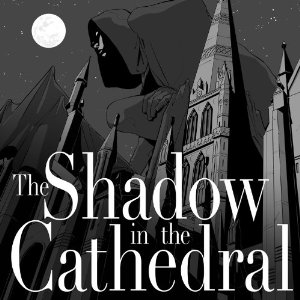
Cover Stories was a minicomp in which artists contributed cover art in the first half, and then in the second half authors chose covers they liked and wrote games to fit them. A lot of cool covers were submitted, not all of which got used (alas).

The comp followed the lead of the Apollo 18 Tribute Album project in that it explicitly incorporated a time period for beta-testing and encouraged authors to beta one another’s work. I really like this model, and it seems to result in more consistently polished output than some of the other models. The term “minicomp” isn’t entirely applicable, since it’s really more like a mutually edited anthology, but I’m not going to quibble too much.

I’ve posted reviews of a number of the Cover Stories games I played on IFDB. I especially recommend Olivia’s Orphanorium, a dark comedy about managing a Dickensian orphanage, and Home Sweetie-Bot Home, which rather surprisingly includes a voice-recognition feature allowing you to play the game via speech.

IF Community links and resources

Recent reader email prompted me to revise and expand my guide to ways to get involved with the IF community. But the IF community (or communities, I should say) have been dramatically expanding and diversifying in the last couple of years, and I’m sure I’ve omitted some useful content. Did I miss things you think I should have covered? Events or venues people should know about? Please feel free to comment and I’ll update with whatever seems like a good fit.

No Show Conf, Boston July 14-15

There wasn’t an IF conference alongside PAX East this year, but people may be interested in the No Show Conference, an indie game conference running on the MIT campus July 14-15. It will have something of an IF community presence. (Not me. But other people. Note the talks by Clara Fernandez-Vara, Deirdra Kiai, and Jim Munroe.)

In particular, if you liked last year’s IF Demo Fair, you may be pleased to hear that there’s a demo hall as a significant part of the conference. Interactive fiction games and interface demos are welcome.

Writing for Varytale

As mentioned in a previous post, Varytale is a platform for interactive stories. It’s put together by Ian Millington, the same person who created the Undum tool, but Varytale goes quite a bit further.

Writing Tools

Undum provides a slick front-end and a way to build a few choices and otherwise leaves everything up to the author (hey, you don’t mind learning some javascript to code your story, do you?). It’s been used for a couple of neat IF works, including Deirdra Kiai’s 3rd-place Comp 2011 winner The Play and Andrew Plotkin’s The Matter of the Monster.

By contrast Varytale comes with a complete authoring tool; a website where books are showcased and attractively presented online; the capacity (eventually) to use one of several payment schemes to charge for content; and feedback and statistics tools that allow the author to collect ratings and comments on content, and to see which story choices are especially popular or unpopular. These tools require vastly less coding than traditional interactive fiction, but they do allow for world state and player stats-tracking. (Some time back, I described why CYOA without world state is a bit too restrictive for most of what I want to write.)

Continue reading “Writing for Varytale”