Jon Ingold’s The Colder Light

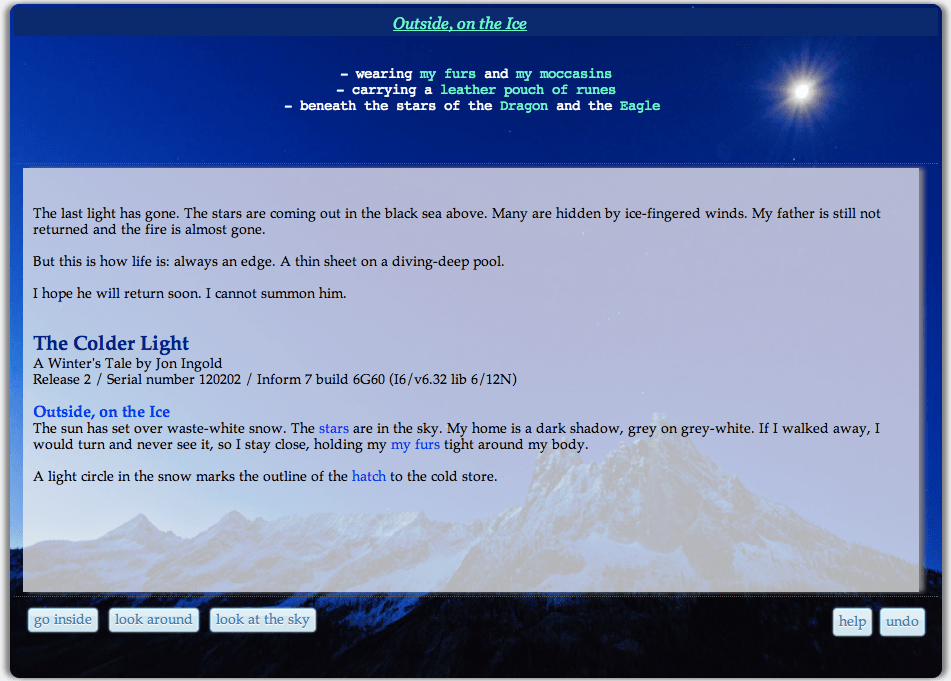
The Colder Light (online play, IFDB page) is the latest game from Jon Ingold: in this case, a spare, melancholy tale about life on the ice. It also uses an interface evolved from some work by Erik Temple (see for example Erik’s alternate interface to Sand Dancer).

This interface attempts to address some of the community’s long-standing concerns about the parser by presenting affordances explicitly. The player can click on hyperlinked objects in room descriptions and inventory and receive a list of plausible ways to interact with these. The result is a play experience with the noun-and-verb variety of classic parsed IF, a more consistent world model than the average CYOA, and enough diversity to make for genuine puzzles; but without any guess-the-verb issues. It also, I imagine, eased the authoring burden that Jon didn’t have to write the vast range of error messages that typically come with parsed interactive fiction.

There are some other possible novice-friendly features it doesn’t have: HELP only produces credits information, there are no hints to speak of, and mapping is also up to the player. But it’s still pretty accessible and I would be interested to see what new-to-IF players might make of it.

So that’s worth noting, and has already received some discussion. There have been a lot of user interface experiments over the past year and a half or so, but to my mind A Colder Light is one of the most successful in capturing the sense of possibility and setting immediacy that I like from parsed IF, while offering a significantly more accessible experience to the user and avoiding unnecessary screen clutter.

But the work also bears analysis on a couple of other levels.

First of all, it centralizes all its puzzles around a consistent mechanic — achieving this is a bit of an obsession of mine, I admit. To discuss that, I’ll need to be slightly spoilery, though I’ll try to avoid giving away specific puzzles.

Continue reading “Jon Ingold’s The Colder Light”

The Written World on Kickstarter

The Written World is a computer-mediated interactive storytelling game (additional details available here). The authors describe it as an interactive fiction MMO, but it’s also not completely unlike a library of Fiasco-style playsets.

The game provides assets — characters, character goals, possible events — embodying a story concept, but each actual experience is a two-player exchange between a Narrator player and a Hero player, a bit reminiscent of Sleep Is Death. The players participate primarily through writing, by creating descriptions of what happens next. If either of them doesn’t like what’s been done by the other, they can spend some Force to override the decision; Force is in turn earned by writing particularly compelling content. The aim of the exercise is not essentially competitive, but mediated cooperation aimed at producing an interesting story.

The Written World chief Simon Fox was kind enough to answer a few of my questions about how the mechanics work.

Continue reading “The Written World on Kickstarter”

Angal Tentara; inkle’s Frankenstein

Periodically I check out interactive narrative projects on Kickstarter, whether they’re by people I’ve heard of before or not. Angal Tentara and The Root of All Evil is an “interactive animation” for iOS. It looks like it’s working with a fairly standard fantasy premise about a young person who has a destiny tying her back to an ancient civilization. Two things struck me about it, though. First, it comes with a backer reward consisting of a “storybook kit” with what look like some pretty nice-quality feelies:

Second, check out the video on the Kickstarter page — no, not the main video, the one a little lower down that’s titled “Story Telling 2.0”. The “you become the editor” model, with a conscious attention to the reader’s ability to expand or advance the narrative, is reminiscent of stuff the IF community sometimes talks about. Though the video is brief and doesn’t go into a lot of detail, this strikes me as a more mature/considered description of how the story is going to be interactive than I’ve found in a lot of interactive project proposals. Remains to be seen whether the project will actually deliver on that model, but hey.

Meanwhile inkle studios — the company formed by Jon Ingold and Joseph Humfrey — has just announced that it’s working on an interactive version of Frankenstein for iOS, published with Profile Books. Their press release is not so specific about the theory underlying the project (perhaps intentionally). Nonetheless, I’m keen to see what Jon and company come up with here.

Tabletop Storygaming: The Shab-al-hiri Roach

Thursday night’s storygame was The Shab-al-hiri Roach, which I’ve wanted to try for ages. The premise is that the player characters are all academics striving for power and status in a small but prestigious college somewhere in New England in 1919. Introduced into their midst is an uncanny archaeological discovery, the eponymous roach, which represents a Sumerian cockroach deity of deep and sinister powers.

At any point during the game, the players can choose (or be forced) to “swallow the roach,” thereby gaining power, but also making themselves subject to the roach’s commands. These commands come from a deck of cards: during each of six acts, the players draw to discover a task they have to complete this act, with different tasks depending on whether they currently have the roach. The deck of cards can also make players possessed, or give them the opportunity to be freed from possession. No one can win while roach-possessed, so there’s a trick of allowing yourself to be possessed and then get rid of the roach again — which may or may not work.

Our play session was pretty successful from moment to moment. Having the goal from the card provided some goals for players trying to frame scenes; and there’s nothing like speaking some guttural faux-Sumerian to unlock one’s hammier acting. I had a really good time playing.

But I didn’t feel that the mechanics produced a very coherent arc story. In particular, when a player’s attempt failed (the theft of some pygmy bones from a museum, for instance), the failure was pretty final and didn’t really allow for interesting ramifications afterward; so there were a fair few storylines that were developed and then dropped again immediately, forcing players to come up with new schemes instead. Another difficulty was that the setting and situation tended to encourage a lot of the same kind of action: Player character A saying nasty things about player character B to university authority C. (Or maybe it was just us?)

Also, it was definitely the most fiddly with dice of the storygames I’ve tried so far, with each resolution requiring a certain amount of discussion between players about which dice to roll (“is this a power/status roll or not? do we think my enthusiasm for gossip counts here?” etc.).

Still. I had fun with it and want to play more, as I really liked the setting and core concept.