Liza Daly on “First Draft of the Revolution”

Here is Liza Daly (Threepress) talking at Books in Browsers 2011 about an interactive epistolary story I’ve been working on for and with her.

Liza’s talk is about the possibilities of interactive narrative, her background with IF and hypertext, and what we’ve done together with this story in specific.

As you may gather from the screenshots, “First Draft” is not parser-based, but also not CYOA: the interaction is all about revising the letters between the various characters and then choosing when to send them. So there are lots of small, parallel choices submitted at once rather than a sequence of large choices submitted serially — an effect I am hoping creates some of the texture and exploratory feel that I often feel is missing from CYOA. It’s set in the universe of Savoir-Faire and Damnatio Memoriae at the cusp of that world’s French Revolution.

There will be a public release of this project when it’s done, but I do not yet have a date for that.

Tabletop Storygames: Microscope

Tonight at the Seattle Storygames meetup I played Ben Robbins’ Microscope, which describes itself as “a fractal role-playing game of epic histories.”

Play begins with the participants agreeing on some very broadly-described beginning and endpoint to a history — the rise and fall of an empire, the glory and decline of a dynasty. Our group chose the history of a multi-deity religion from its inception (a sort of contract between gods and men) to its downfall (the point where the gods refused to interact that way any further).

The selected beginning and end are written on blank cards and set on the table. Players then proceed to add more cards to the timeline: named periods (which can be inserted anywhere between the beginning and the end), events (attached to a particular period), and scenes (involving a particular event, and intended to answer some narrative question about that event). The scenes are where the roleplaying actually occurs, starting from some premise and continuing until the narrative question is answered.

There are a few additional mechanics to provide some focus, and it’s possible to challenge a story choice that another player has made, though in practice we never did this.

In general, the mechanics were less concerned about creating and resolving conflicts (a theme found in both the story games I played at a previous meeting) and more about discovering and developing interesting concept threads in the world-building. Players are encouraged to move back and forth through the timeline, creating longterm repercussions for one another’s choices, or conversely setting up other parts of the story by designing prequels for them.

In practice, I felt like this design made for some very loose, uncertain play at the beginning. When the game is just starting out and the players are throwing in almost random events, there’s a sense that continuity is never going to be established. How are we ever going to link up The Great Pilgrimage with The Revision of the Dietary Laws? What matters and why? Do we all just have completely different ideas about who these characters are, or what? And because collaboration is restricted only to the contribution of periods/events/etc., you’re not allowed to propose an idea in full, by, say, laying out a whole imagined sect you have in mind. As in improv, you can only make offers and then let your collaborators pick up on them.

Later on, though, things started to come together in a fairly satisfying way, events plugging into one another and making a more complete fabric. (Sam Kabo Ashwell’s play report for the full session is here.)

Even so — and I don’t say this as a complaint, exactly — it felt to me in a lot of ways more like a collaborative world-building game than an interactive story-telling game. What we ended up with was a semi-coherent history with several major recurring themes or issues and some brightly-colored incidents. People had partitioned souls, and could use specific soul-aspects to do things. It was possible to bottle up some aspect of your soul in order to keep it under control. The Coracle Philosophers discovered the way to elevate the God of Swamps to Living status by accident during a council session, though fortunately their ritual coracle-skirts allowed them individually to paddle away and survive the deluge. The moosetaur guardians — but no, I’m verging on sacred secrets here.

In any case, it all makes a kind of performance art out of the act of invention itself. Which is cool. I think I need a few more playthroughs to really be at ease with this one, but the concept is definitely neat.

Meanwhile for iPad and iPhone

Jason Shiga’s choose-your-own-path comic Meanwhile has been around in book form for a while now. There’s even a copy in my household, but I haven’t ever gotten to the point of reading it properly (and there is a “properly”, as one soon discovers). Now, thanks to Andrew Plotkin, it’s available as an iPad/iPhone application, and in that new format I finally finished it last night.

Meanwhile is a puzzle story: there are many endings, but you’ll know when you’ve reached the point where you finally understand. Structurally it has more in common with Möbius, Rematch, or other replay-puzzle IF than it has with, say, the Choice Of series. Going through the choices with the right knowledge puts a new spin on the things you see, and equips you for a couple of combination lock puzzles that otherwise would be laborious to guess your way through. And — like many games of this ilk — it uses time travel and parallel universe tropes to explain its loops of repetition and discovery, so that you can if you wish rationalize all your playthroughs as belonging to one(ish) reality.

Meanwhile is self-graphing CYOA — you don’t just jump pages, you actually see the lines of narrative — and it plays with that fact frequently and intentionally. Embedded in the story are many witty moments: places where you find yourself stuck in an infinite loop, points where two paths reconverge for comic effect, panels that mirror or summarize other panels in surprising ways. Sometimes the lines connecting panels spiral or tangle or knot, indicating narrative complication or a breakdown of causality.

As a book, it’s a pretty cool artifact — lines running out from the comic panels to the edge of the page, leading to tabs leading to new pages.

As an iPad app, it’s more solvable. All the elements of the story are assembled on a single infinite canvas, making it easier to see how panels relate to one another. A trace records where you’ve been on the current playthrough, so you can easily jump backwards to the last choice or to an earlier segment of the story if you want to try taking a different route. There’s even voiceover functionality for the visually-impaired, though I didn’t experiment with this myself.

If you’re inclined to read Meanwhile, I highly recommend the app version. The crazy, mindboggling outcome is worth getting to — and worth getting to honestly — and it’s easier to do that with those helps.

IF Comp 2011: The Elfen Maiden / A Comedy of Error Messages

A Comedy of Error Messages is Wodehouse-style comedy — social comedy, romantic entanglements, plenty of misunderstandings — only reimagined for a world where Jeeves is a computer.

A Comedy of Error Messages is Wodehouse-style comedy — social comedy, romantic entanglements, plenty of misunderstandings — only reimagined for a world where Jeeves is a computer.

Continue reading “IF Comp 2011: The Elfen Maiden / A Comedy of Error Messages”

Tabletop Storygames: Shock, Fiasco

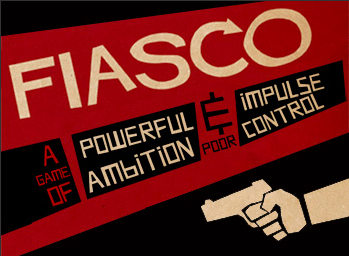
Last night, per Dan Fabulich’s recommendation, I checked out the Seattle story games meetup and played through a game each of Shock and Fiasco. Shock is about exploring social issues (whichever ones the participants choose) in the context of a science fictional future; Fiasco is about emulating the wacky, everything-goes-wrong misadventure plots typical of Coen Brothers movies. I’d heard about Fiasco before from Stephen Granade (here’s a play report of his as well as an academia-themed playset he wrote). Both were a lot of fun and went in rather goofy, unexpected directions.

Our particular play group went back and forth between actually role-playing scenes out and doing quick narration, and was really cooperative in terms of trying to get interesting, narratively satisfying outcomes for the story. Quite a few times, one player had the opportunity to help or oppose another player’s character and made the decision based on what would generate the most aesthetically effective scene. That was a lot of fun — the spirit of collaborating towards a common (if not always clearly perceived) outcome is a standout feature of this kind of play. Our group seemed to tend towards the tragic or bittersweet, preferring outcomes that were mixed success and failure for our characters.

Continue reading “Tabletop Storygames: Shock, Fiasco”