Highlights from the first two days of GDC

So tired, so very very wired. But some of my favorite moments from GDC so far:

The weird, wired, super-fast Rapid-Fire Indie Game session. Chris Hecker’s speech at 250 miles an hour about getting your game out there and getting it known. Hearing about the genesis of pOnd, a game that made me laugh so hard I had trouble breathing. (Or have so much trouble breathing that I had to laugh? One of those.) Anna Anthropy’s talk on the indie game scene being so much about the same set of nerds making games for the same set of nerds… followed by a hilariously in-crowd-y performance during the Q&A session. Getting to meet Anna.

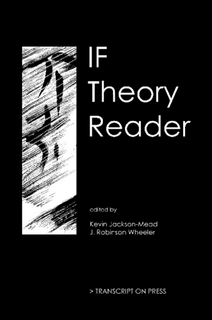
Seeing Aaron Reed’s book in the GDC bookstore:

The AI Summit, in just about every particular. Content-wise, even the stuff that has no bearing on my own work, like the talk on influence maps, has been fascinating. People-wise, they’re cool, brilliant folks, and tremendously approachable.

Eric Zimmerman and Naomi Clark’s talk on the Fantasy of Labor, which postulates that people play time management games and their ilk — games that are more or less impossible to fail and largely decoupled from skill — because they like believing persistent work will get them somewhere. I wanted to ask whether they thought this fantasy has become more powerful and more pervasive as the economy has tanked, but that seemed like too much of a downer even for a fairly serious talk. I think there might be some psychological terrain to be mapped that goes even deeper and to even stranger places: namely, a sense of virtue from doing large amounts of busy work that someone else has bidden you to do. I can’t say that has motivated me in real life very much as an adult, but it’s what got me through the first few years of elementary school for sure.

Not favorite: I didn’t get my speaker t-shirt! They asked me what size I wanted, but then it was not in my bag. I am sad. Childishly sad. I don’t wear my shirt from last year much, but I like having it, you know?

The IF Theory Reader is available

This news is a little old because of my being at GDC, but it’s worth amplifying the signal anyway: the IF Theory Reader, aka the IF Theory book, now exists, thanks to Kevin Jackson-Mead’s dedication in reviving it from an undead state. It can be downloaded as a free PDF, or purchased in physical form for about $14 American.

Some of the articles in it have been revamped. I substantially rewrote my article on IF geography to talk more about route-finding across a map, status line compass roses, and other navigation and UI elements that have come much more into vogue since the article was written. My piece on conversation I rewrote less extremely, but still adjusted here and there.

That’s not to say that old = useless. The book opens with Roger Giner-Sorolla’s article Crimes Against Mimesis, posted years ago on the rec.arts.int-fiction forum. That series of posts formed the starting point for many, many long discussions about game design, storytelling, and simulation in the years to follow. Other selections include a lot of coverage of different areas of IF craft — writing room descriptions, designing puzzles, coming up with NPC dialogue — as well as some more theoretical discussions.

Preview of the IF Demo Fair

The IF Demo Fair will be held from 8:00 to 10:00 PM on Saturday, March 12, in the Alcott conference room at the Westin Boston Waterfront Hotel adjacent to PAX East 2011 (map). No PAX badge is required to attend. This is an IF community event sponsored by the People’s Republic of Interactive Fiction.

We have 23 pieces, including interactive poetry, journalism, and documentary; experiments with styles of interaction that go beyond the puzzle, and modes of input other than the standard parser form; new prototype authoring tools; and new interpreters, both serious and whimsical.

Here are some highlights:

The XYZZY-nominated Automatypewriter, Jonathan M. Guberman and Jim Munroe. Like a more literate cousin of the player piano, the automatypewriter is a manual typewriter that types by itself, and takes input. You may have seen the video online where an early version of this project plays Zork — the one being showcased here is an entirely different typewriter, playing a custom-built interactive fiction piece by Jim Munroe (Everybody Dies, Roofed).

A new way to interact with fiction from Jonathan M. Guberman on Vimeo.

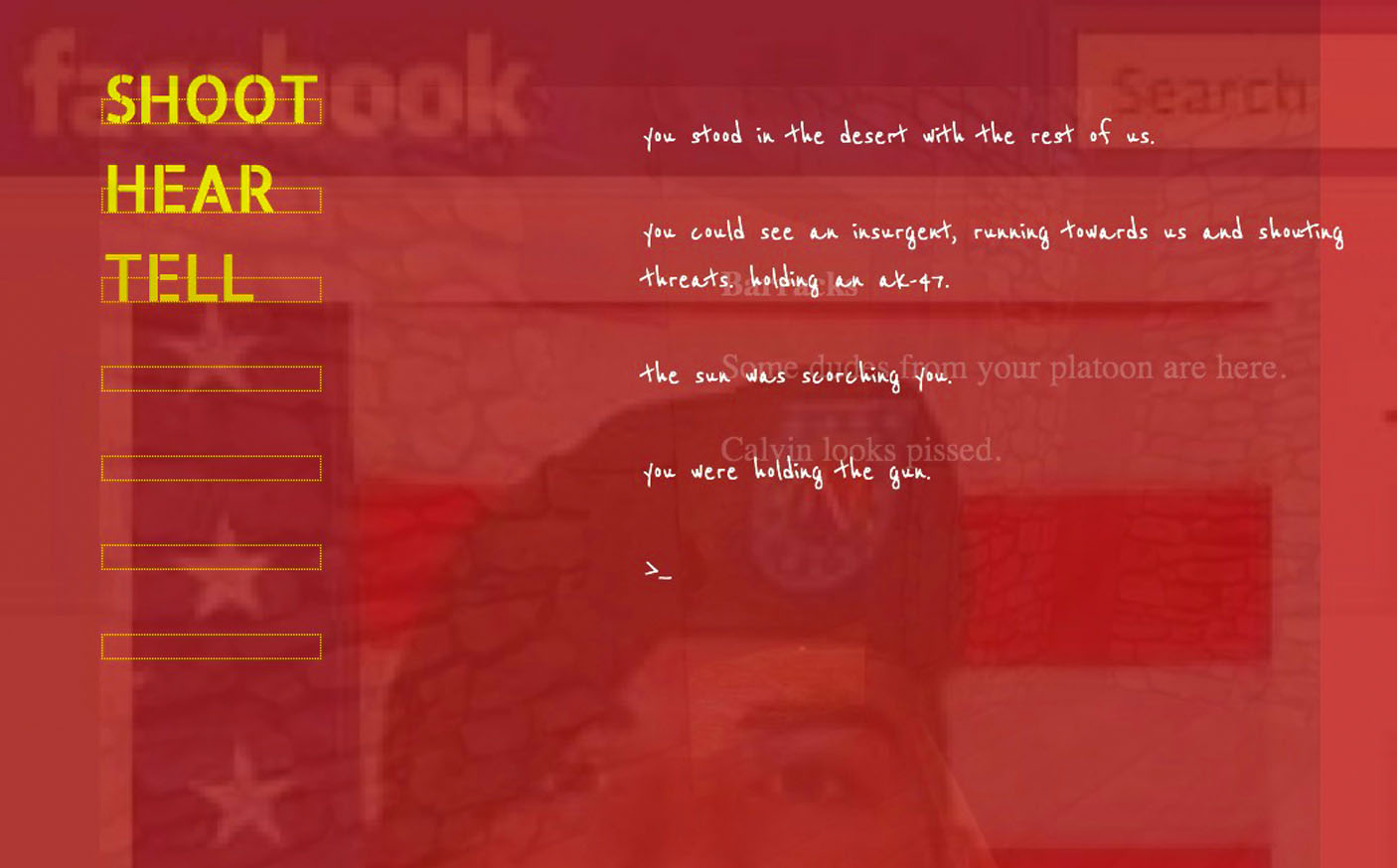
what if im the bad guy?, Aaron Reed, UC Santa Cruz. Exploring a frozen battlefield moment from a half dozen violently conflicting perspectives, this prototype (part of the author’s work towards a digital arts MFA) merges traditional IF with video, sound, and web conventions. Inspired by the currently unfolding trials of six US Marines accused of committing war crimes in Afghanistan, the project asks what interactive stories can say about contemporary, real-world events, and wonders if there can be such a thing as an IF documentary.

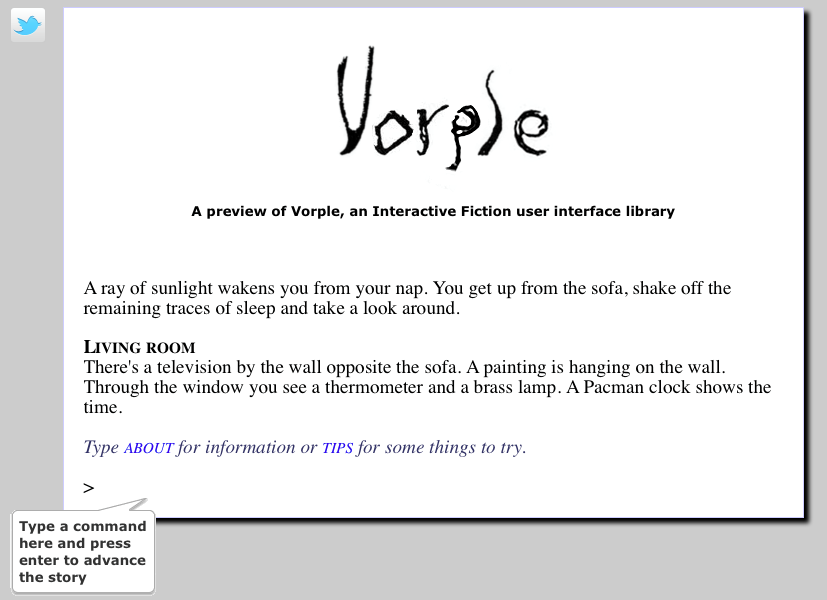
Vorple user interface library, Juhana Leinonen. Vorple is a JavaScript user interface library designed to be used together with interactive fiction and hyperfiction systems. Vorple provides an additional user interface layer on top of existing web interpreters and systems. Story and library authors can build user interface and web elements the underlying system might not support natively. Through Vorple, stories can display YouTube videos, pull data from Wikipedia, communicate with Twitter or Facebook, integrate to blogs, or use any other services and techniques available for web applications.

Procedurally Generated Narrative Puzzles, Clara Fernandez Vara, Michaela Lavan, Alec Thomson, Singapore-MIT GAMBIT Game Lab. This project focuses on methods to generate narrative puzzles procedurally. The point-and-click game Symon was a proof of concept of what an adventure game would be like if players had the chance to restart the game and get different puzzles, because they were being generated by the system. The project here presented are a set of tools for designers which eventually should be compatible with different development environment, including those dedicated to interactive fiction. The tools include a series of building blocks to build puzzle patterns, and a database editor, which designers can use to create the characters and items involved in the puzzles.

Also to look forward to:

  • Combat and conversation demos from Bob Clark, Victor Gijsbers, and Robb Sherwin
  • New browser interpreters by Dave Cornelson and Alex Warren
  • Nick Montfort’s Curveship system for narrative variance
  • Adam Parrish’s Frotzophone interpreter, which interprets changes to the object tree in the Z-Machine into music

The Sacrifice Mechanic

Over on the Escapist, Extra Punctuation has an awesome article about a game mechanic of leveling down rather than up. I’ve occasionally kicked around a similar idea, though starting more from “how do we do choice narratives where the choice feels significant?” — and one way to make the player actually care about choices is to tie the results into gameplay.

I’m attracted by the idea of a plot reminiscent of (the movie version of) “Last of the Mohicans,” where our protagonists start out as wealthy, happy, proper young ladies of English extraction and end up as bedraggled, hardened, and — in one case — dead. It’s a story of stripping away all peripherals until each character’s deepest feelings and commitments are revealed. That kind of story could make a compelling tragic game, or a story of triumph at excruciating cost, not far off from the structure of Victor Gijsbers’ Fate.

Leveling down, or gradually giving up your collection of Batman gadgets, or losing one after another of your crew of sidekicks until you stand alone, or burning away one after another of your huge inventory of doodads — that’d be a way to do the gradual-loss plot. Like I said, awesome.

IF Demo Fair Update

So intents are in for the IF Demo Fair, and they look awesome. And there are a lot more of them than I was anticipating — 23 in total. I’m really excited about this.

However, it also means that we’re going to need to change the format a little bit, since the original plan of playing through everything as a group makes a lot less sense with that many entries. If you’re an entrant, you should have already received email from me about this; if you didn’t get it, please let me know and I’ll re-send.

A tangent about marketing

This is a spin-off from the post about Jon Blow’s remarks on the IF parser, but it goes in a different direction, so I wanted to take it back to the front page.

I’ve been having a comment exchange with a commenter named Veridical Driver, who suggested a number of possible improvements to the IF interface (automapping, journaling events as they happen, bolded words to show what’s interactive, etc.). I pointed out that there are games that try most of those things; Veridical Driver responded that it’s not enough because IF should be standardized on those features.

So this post started as a response to Veridical Driver’s last comments, especially these bits:

These are things that the IF community may have experimented with, but not things that are any way standardized in the IF interface. The standard IF interface has barely changed from the Infocom days.

Adrift may have mapping, but Inform and z-machine is the standard for IF and do not. Some games might have custom note systems, but this is really something that should be standard, just inventory is standard in all IF. Sure, there is a keyword interface extension… but this kind of functionality should be a standard part of all modern IF.

…The problem is, you are thinking as an IF author, not as a gamer. You don’t like the ideas/features I mentioned, or suggestions other have made, because they constrain your artistic vision. But as a gamer, I don’t care, I just want some fun.

Nnno, I don’t think that’s quite it. Two of the examples I pointed to (Floatpoint, Bronze) are my own games; other projects of mine (especially Alabaster and City of Secrets) include graphical sidebar content that’s nonstandard but is designed to ease player experience and communicate game state better. So it’s not that I dislike these features categorically.

Where I’m pushing back is on the idea that we can or should enforce these features as a standard.

There I’m speaking not just as an artist, though I can think of several of my works for which the features you describe would be a bizarre and awkward prosthesis on the text — what’s automapping for in a one-room conversation game? what’s journaling for, in a game that runs for five minutes and is designed to be replayed?

But setting that aside, I’m also coming to this as someone who’s handled a lot of feedback on one of the most-used tools in the IF community for the last five or six years. People want to do a lot of different things with their interactive fiction, and they should have the opportunity to try their various visions. Some specific use cases, other than the artistic concerns I already mentioned, where your suggestions might be an active hindrance include

  • games intended for mobile platforms or small screens, where screen real estate is at a premium
  • works for the visually impaired, which need to be simply accessible with a screen reader
  • works written with a heavy narrative focus, which may put aside the concept of “rooms” entirely in favor of a different style of presentation; these aren’t always even intended for a gaming audience at all

These aren’t hypothetical; they’re things that people are actually working on and are the basis of real support requests.

So the issue is, tools that force too many features run a big risk of narrowing the creative range to just the projects that work well with those features. Inform has tried to err on the side of making a lot of things optional — through extensions — while not imposing too many constraints through core library decisions. This is always an area of compromise, and there are some features we’ve added that have made Inform games larger, to the chagrin of those optimizing for very small, low-processing-power machines. So these things are always on our minds.

I’m happy to say that a lot of progress has been happening, and continues to happen, on the extensions and interpreters side. The desire to foster collaboration, conversation, and creative thinking about IF interfaces is a major part of the impetus for the IF Demo Fair we’re putting together for PAX East.

Still, this opt-in stuff is obviously more work, and it’s not going to force authors to include the features you’re looking for — and the novice authors are the ones least likely to put in the extra work if the tool doesn’t make them do so. I typically consider it a good sign — not always but often — if I start up a competition game and find that it has cover art, a splash screen, a non-standard status bar, etc. That’s not because I think those are universally important, but because it means the author put some time into generating non-default content. Which means he thought about it. Which is good.

From a game consumer’s point of view, I think what would help the most is curated collections and branding.

Continue reading “A tangent about marketing”