PAX 2011 programming

People who might come to IF events at Boston PAX, is there anything in particular you’d like to see discussed in the IF programming? Tutorials, panel talks, other stuff?

(If so, obviously you can edit the wiki with ideas, but I am wondering whether there’s stuff people would like to see but didn’t write down because it’s not something they would offer themselves, or whatever.)

Randomized variation

Something that’s come up on several of my projects recently is the question of how much randomized text variation can add to the sense of depth in a scene.

In particular, how good a job does it do of simulating lots of different, hand-crafted pieces of content? Are there better and worse ways to deploy random content for this purpose? Do you have a generic sentence form with a lot of randomly swappable elements, like

A red/brown/black/grey dog/fox/squirrel scampers/runs/hurries past you into the undergrowth. ?

Or a table with a lot of hand-rolled sentences, each unique, but each going to be the same every time it appears? Or some variation on all these?

For interactive fiction, this tends to come up a lot in cases where we want to make the world feel deeper and more fleshed out. We want a player to be able to browse a bookshelf and find the titles of many many books. Or hang out in an outdoor area and see lots of environmental messages suggesting people going by, animals passing through, etc. Sometimes it’s possible to rig up a full simulation for this kind of thing — that is, actually track dozens of animal objects running through the gameworld — but usually that’s a lot of overhead for a lightweight effect. (And see Matt Wigdahl’s comments on the “foley” system in Aotearoa.)

My current operating theory is:

1) it’s good to have a mix of more generic sentences with lots of variation and more hand-crafted sentences with moderate variation. This keeps things from feeling too predictable.

2) where random variation is used, the most productive way to use it to maximize the *impression* of content is to construct pairings/arrangements of random elements that are themselves striking and memorable or distinctive.

I brought this up on the #craft channel on ifMUD, where I had the following conversation with Andrew Plotkin (“zarf”) and Dan Shiovitz (“inky”). They had a couple extra points I hadn’t come up with, so, with permission, here’s what they said:

Continue reading “Randomized variation”
Homer in Silicon on Date/Warp

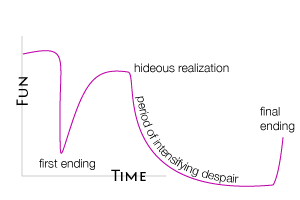
Date/Warp is a visual novel from Hanako Games, paced out with puzzles. I liked a lot of things about it, but had some issues with the structure; essentially, my discussion is about how to handle situations where you want the player to replay and try most of the alternate versions of a multiple-ending game, where that will mean that late replayings will be mostly the same experience over again. Date/Warp enforces this more than many other games (though in a way I gather is not unusual for visual novels) by having the best ending be completely locked and inaccessible until you have played through almost every possible variation.

It’s a problem that has some bearing on multiple-path IF. I know, for instance, that there are people who did play Alabaster this way and found it exasperating to do so — see TempestDash’s review here — even though the intention was to steer players aggressively towards interesting endings and point out which mysteries were missed, rather than to encourage complete exploration of content. So, though I’m critical of Date/Warp as an experience in that regard, I think it raises some useful questions.

PAX East 2011

So, as last year, there will be organized IF events at PAX East this year (March 11-13, Boston). Last year’s event was a big event with lots and lots of IFfers, and plenty of fun all around, so we’re hoping for good things again this year.

I’m going to be speaking on interactive dialogue, as we just got this panel approved:

Interactive Drama: Dialogue as Gameplay

Jonathon Myers (Moderator) [Writer, Reactive Games]
Stephen Dinehart [Narrative Designer, Narrware]
Evan Skolnick [Writer, Producer, Editorial Director, Vicarious Visions]
Emily Short [Interactive Fiction Author, Independent]
John Gonzalez [Lead Writer, Lead Creative Designer of Fallout: New Vegas, Obsidian Entertainment]

Other IF and IF-related stuff: zarf will be speaking in a main-PAX panel on self-funding via Kickstarter. There will also be an IF suite as before, with some organized meetings and discussions, Speed-IF, and casual socializing; there may be some overlap activities with the IGDA Writers SIG, the special interest group for professional game writers; the IF theory book may, Kevin Jackson-Mead hopes, be finished and ready to share.

Note that you will need a PAX badge to see my panel talk or zarf’s, but that all the rest of the IF activity is separate and free to attend.

If you’re interested, check out the ifwiki page for a current list of people attending, or to sign up or suggest events.