Working on updating some old articles for the IF theory book, and reading discussions on the intfiction forum, I found myself wondering about some of my preconceptions of IF history. So I decided to check some of my assumptions against IFDB, by searching on certain tags and then reducing the results to a list of dates.
My initial hypotheses were more or less as follow:
- Recent years have seen some experimental break-aways from the early convention that all IF must be second person.
- Female protagonists are much more common after the mid/late 90s.
- Single room games took off in the late 90s and have been relatively frequent ever since.
- Puzzleless games took off in the late 90s and have been relatively frequent ever since.
(1) To get my worst prediction out of the way first, here is the result I got on first/third person games:
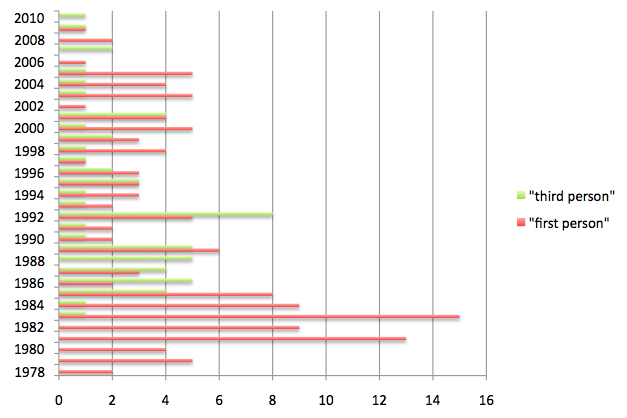
Assuming that the tagging on these is remotely accurate, the 80s actually saw a lot of experimentation at least with the first person, which then died off; since then there has been just a modest trickle of both first and third person. The early first-person trend is even clearer when expressed as a percentage of total publications per year:
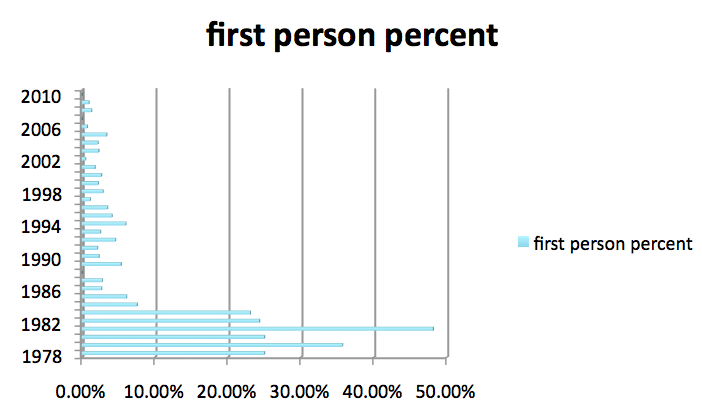
There are some serious issues with this methodology, I should point out. One, tagging on IFDB is not consistent; less-known games tend not to be covered, and many older games are likely to be less tagged than new ones. Many examples are likely to be omitted from these counts. (But if anything I would expect 80s games to be underrepresented in the tagging, rather than the reverse.)
Moreover, there is no distinction here between English-language games and those in other traditions. I know that some language traditions tend more towards the first person than others, so probably a more intelligent approach to the data would break out the Italian, Spanish, etc., games from the English ones. Even with those caveats, I’m kind of surprised by this one.
Assuming the data are worth anything, though, they suggest that language/library support is not actually the key issue determining whether IF authors use persons other than second person. TADS 3 (via built-in support, I believe) and Inform 7 (via extensions) both are better at letting the author select another person or tense than the previous generations of these languages. But their introduction hasn’t led to a boom in non-second-person games.
(2) On female protagonists, I was sort of right, but not in the way I expected.
I had vaguely assumed that there would be a lot of male protagonist games and then a gradual rise in female protagonist games to match it, more or less at the point around 1997 or so when the gender balance of the IF newsgroups seems to have started shifting to include more women. (A bit of anecdata: “Everybody Loves a Parade” (1997) has a moment that reveals the PC as female; at the time, reviewers hailed this as an amusing surprise twist. A couple of years later it no longer seemed all that surprising and twisty.)
What actually happens is that there’s a spike in female protagonists, but subsequently a rise in the count of explicitly male protagonists as well. I’d guess that reflects changing gender proportions in the writing and playing communities, but also a movement towards having specific player character personae at all:

(3) Here’s the chart for single room games. It more or less does do what I expected:
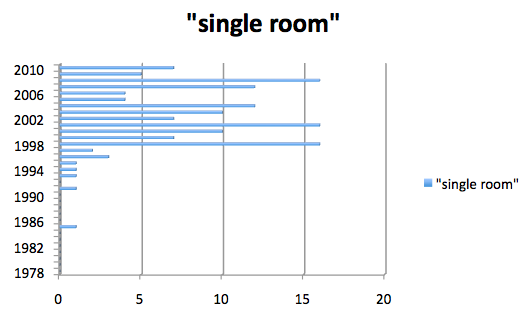
Perhaps the most notable thing about this chart is the way the number jumps suddenly at 1998. But 1998 was a year of very high production overall, and a lot of minicomps. Suddenly there were a lot more venues for bite-sized works. And once that trend started, it continued.
(4) Puzzleless games, I was sort of right about.

My first impulse was to think, hm, I wonder whether this phenomenon correlates with years when the IF Art Show was running, since that competition encouraged experiential and often puzzle-free work.
But there was an IF Art Show in 2007; it just seems that the entries were not as frequently puzzleless as the earlier ones, or aren’t labeled as such.
Reformatting the data to represent not absolute numbers but percentage-of-all-published-games for these periods shifts the effect even harder:
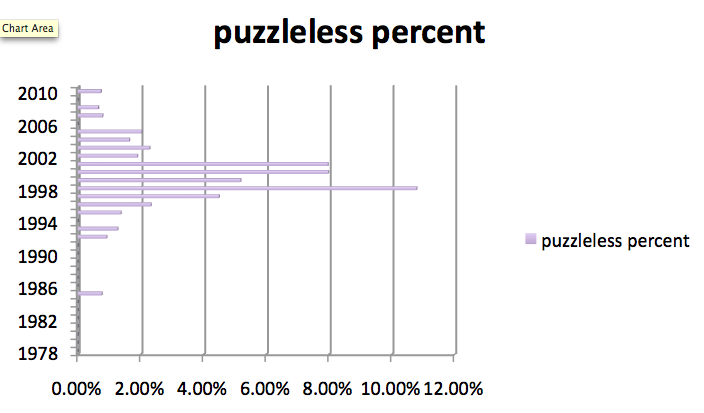
Over ten percent of the games published in 1998 are tagged as puzzleless. 1998 again! That 1998 was a big year for IF is obvious just from a glance at the XYZZY list: this was the year of Anchorhead and Photopia, Spider and Web and Losing Your Grip, Once and Future and Bad Machine. But the other numbers suggest it was also a year of massive innovation and change in the community and in the types of games that were being produced.
The drop-off is as striking as the pickup. It suggests either that the IF community has actively rejected the puzzleless experiments of 1998-2001 or so; or that we’ve stopped labeling as “puzzleless” games that would previously have come under that category.
My personal, fuzzy sense of this is that we had a boom in experimental puzzleless games, and that that gave way to a series of works that are more balanced between puzzle and story than what went before. “Make It Good”, “Blue Lacuna”, and “King of Shreds and Patches” are hardly puzzleless, but they tend to integrate their puzzles more deeply with stories than many older works.
So. I’m not sure what to make of all that. As mentioned, the data is pretty flawed, and there’s a lot I’d like to be able to look up (average play times, for instance) that isn’t covered by IFDB. I wouldn’t mind doing some comparisons on game genres as well (am I right that “slice of life” IF has become more prevalent since 2000 or so?), but there are just too many games in each category for my partly-manual counting process to cope with, so I’d need some other way to get the IFDB data on those.
And finally, what the charts don’t show at all is the relative influence of the games in question.
There are only nine games tagged “moral choice” in the whole database, but I feel like “Fate”, “The Baron”, “Tapestry”, “Slouching Towards Bedlam” and “Whom the Telling Changed” all raised significant discussion — enough so that I think of this as an important focus of mid-2000s IF even though, by IFDB standards, there are very few examples.
 Emily Short's Interactive Storytelling