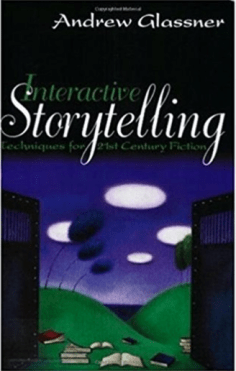
Interactive Storytelling: Techniques for 21st Century Fiction (Andrew Glassner)

Screen Shot 2017-06-04 at 2.36.51 PM.pngInteractive Storytelling: Techniques for 21st Century Fiction (Andrew Glassner, 2004). Glassner’s book is rather more effort to read than most of the other guides to interactive story I’ve covered so far: it’s hundreds of pages longer, and in a somewhat more pedantic style. It begins with two long chunks on the nature of story and the nature of games.

He begins the section on stories by introducing many standard concepts of writing from scratch: character, plot, scenes. Conflict and stakes. Three-act structures and inciting incidents. The monomyth, again (though mercifully he admits that it is not necessary to use and is not the guarantee of a good story). Maslow’s hierarchy of needs. Viewpoint and dialogue. At the end of this section — about a hundred pages, much of it consisting of example narrations from film and other sources — Glassner proposes a “Story Contract,” which he will use throughout the rest of the book to make value judgments. The contract contains the following clauses:

  • The author is responsible for the psychological integrity of the main characters.
  • The author is responsible for the sequencing and timing of major plot events.
  • The audience must allow itself to be emotionally involved.

Glassner later uses this contract to evaluate various works and forms of interactive story (about which more below), so baking in what the author is “responsible” for gives him a way to dismiss a lot of techniques in existing work. In many other respects, the story segment is largely a not very edited overview of basic writing advice.

In the section on games, Glassner also offers quite a bit of review. Like late 90s IF theory, he distinguishes puzzles from toys (this is something that we talked about quite a lot back then). Here, again, he offers a bunch of broad background: types of games, game loops, participation vs spectating, the nature of rules; the uses of scoring; the types of resources that can be included in game design, and the ways resources are deployed. He also gets into individual vs. team sports, competition and cooperation, applications of chance, some basic game theory chestnuts like the Prisoner’s Dilemma, and a section on terminology from Go.

All of this discussion is on the more abstract end and includes examples from sports and board games as well as computer games; it’s by no means focused purely on executing a AAA first-person shooter experience, and much of his game typology is not focused on the video game industry.

Continue reading “Interactive Storytelling: Techniques for 21st Century Fiction (Andrew Glassner)”

End of September Link Assortment

Events

IF Comp goes live October 1. That’s tomorrow! It looks like there will be quite a few entries this year.

October 7, I am speaking in Buenos Aires about AI (more an artificial intelligence than a narrative talk per se, though I do get a bit into some recent AI-aided work).

Also October 7 is the next meeting of the SF Bay Area IF Meetup.

October 12 is the next meeting of Hello Words in Nottingham.

As it has for many years, the Saugus.Net Halloween story contest accepts IF submissions as well as static ones. Submissions are due October 22.

October 23, the People’s Republic of IF meets in Cambridge.

AdventureX is still forthcoming in London Nov 11-12, and there will be a sizable contingent of IF folks there, including some from out of town.

New Releases

Bob Bates’ new kickstarted adventure Thaumistry is currently available to the backers of the original project, and will go on sale to the general public October 6. This is a parser-based game in TADS 3; I wrote up a preview version of the game some months ago for Rock Paper Shotgun.

Anya Johanna DeNiro has released A Bathroom Myth, a roughly 45-minute Twine story. All proceeds go to the Transgender Law Center.

From Adrao, Sashira, Cecilia Rosewood and Felicity Banks comes a Choice of Games Hosted Game called LOST IN THE PAGES. It is a book with a framing device surrounding seven very different short stories. Uncle Irwin has travelled through a portal into his book collection, and must be rescued from an ominous force.

Dialogue: A Writer’s Story is a heavily conversation-driven game from Tea-Powered Games, which tries on several different conversation mechanics:

Dialogue: A Writer’s Story is a game about conversations, writing and science. In Dialogue, you play as the writer Lucille Hawthorne, exploring characters and events through a year in her life via mostly ordinary, and occasionally fantastical, conversations.

The game consists of various types of conversations with different mechanics. Active conversations occur in real-time, and the effect of Lucille’s statements can be modified through her equipped Focus. Exploratory conversations map different subjects spatially, allowing for backtracking and finding new paths, while emails can be arranged and edited.

Be inspired alongside Lucille as you help her write her science fantasy novel, learning more about her neighbour Adrian’s biochemical research to see her book through to its conclusion!

Swipe Manager: Soccer is a ‘choose your own adventure’ football management game where (as in Reigns) you swipe left or right to make critical decisions about play. It’s available now via App Store and Google Play.

Crowdfunding

The Colossal Fund, gathering funds for the IFTF and for IF Comp prizes, has reached its goal of raising $6000.

Giada Zavarise is kickstarting Selling Sunlight, a narrative RPG:

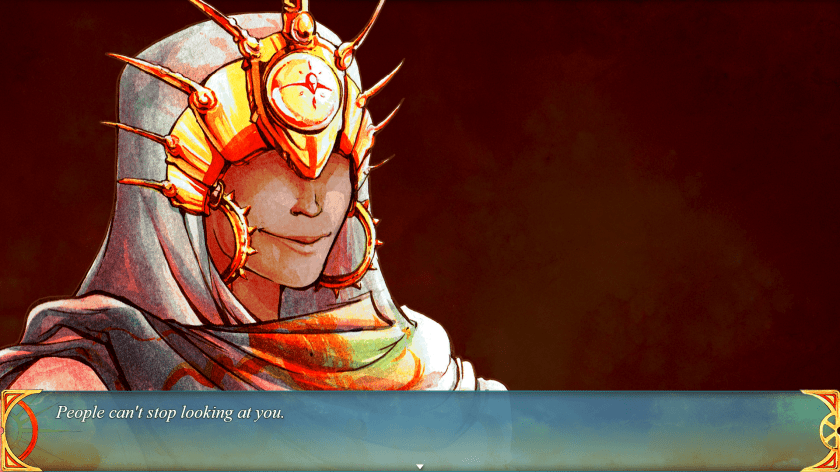
In narrative RPG Selling Sunlight, you are a wandering merchant whose face got stolen by the Sun. To get your identity back, you’ll have to explore a strange, hand-painted world, befriend other travelers, trade goods and information and conspire against the Sun Himself. Will you ask for His pardon, or try to defy Him?

Articles and Resources

The Twine community has announced a new resource in the form of the Twine Cookbook, which is intended to bring together examples and resources for creating new materials in Twine. They are actively seeking new contributions in multiple Twine formats.

Earlier this month I spoke at the new conference Progression Mechanics at Northwestern, alongside Rami Ismail, Laine Nooney, Tarn Adams, and others. It was a very cool conference, and much of the program is available for viewing from the Progression Mechanics website. For various reasons, Laine’s talk is not available that way, which is a pity as it’s a fascinating view into the history of Sierra Online; however, much of the rest of the content is. Folks with a narrative interest may like (aside from my own talk) Tarn’s talk on emergent narrative and how to design interlocking systems that will produce good moments of play; and Ashlyn Sparrow‘s panel contribution about writing grant-supported games to support social purposes.

Moral Discernment as a Game Mechanic

Recently I’ve been trying to figure out what to do about a bad situation. I don’t see a solution that doesn’t violate some value I consider important. There are many possible things to do or refrain from doing, and I am concerned about the consequences of almost all of them. The stakes are pretty high. Outcomes affect quite a few people. It is hard to calculate the risks. People I love disagree with me about what the priorities are, and about who has a right or responsibility to do anything.

This is the kind of thing that makes moral choices hard in real life, in my experience. It’s not “kill puppy or save puppy.” Nor a Fate-style escalation, “poke puppy / kick puppy / make puppy ill / kill puppy” — though I realize that was partly philosophical thought experiment.

It’s not “there’s a very very painful, possibly heart-breaking, thing that you morally have to do.” I’ve been there, too, but while that situation might be miserable, it’s at least clear. There’s no A vs B. There is only option A, and what you have to do to get through A, and what you can salvage when A is over. Not a choice mechanic but a challenge mechanic.

It’s not “I have so many feelings about this that I don’t trust my own motives.” I do have feelings. I’ve also had quite a bit of processing time.

It’s not “I habitually do not behave as well as I want to behave, and I need to do the slow work to improve those habits: keep my temper, drop an addiction, work out more often, stop saying yes to projects I don’t have time for.”

This is something else. It’s a decision, but it’s a slow, complicated, multipart decision in which the possibilities all seem at least somewhat sickening, and not all the possible solutions are visible at the outset.

And I keep thinking: have I ever played a moral choice that felt like this? What would that even look like?

Continue reading “Moral Discernment as a Game Mechanic”

Mid-September Link Assortment

IF Comp goes live in a couple of weeks.

If you’d like to submit a game for presentation at WordPlay, the Toronto word-based-game festival, you still have until September 30 to do so. Accepted pieces will be displayed to the public as part of the festival, and the creators will receive an artist fee of 80 CAD.

Community Feedback

IFTF is running a survey about how people use IFDB and how the experience could be improved. You can let them know your views at the link attached.

New and forthcoming releases

Jam City has started a new line of interactive fiction in the mold of Choices and Episode, using a model that includes pay-to-unlock premium choices, but also a subscription option. (At $2.99/week, this is a bit more expensive than Fallen London’s Exceptional Friendship, and I wonder whether people will find a weekly sub more appealing than monthly. My instinct says no, but my instinct is often wrong.)

IF author and sometimes-conference-organizer Jim Munroe has been working on a new VR project called Manimal Sanctuary. It’s pitched thus:

Manimal Sanctuary is a lurking simulator. It leverages low-end VR technology to enable every player’s ultimate fantasy: to play a creature part coral reef, part Cthulhu, who consumes human emotions. Set on the Toronto Islands after the rest of the city is consumed by gibbering monstrosities, you eavesdrop on the survivors and their dramas involving things like bad potato crops and graffiti tags. And if those everyday emotions aren’t filling enough, you can always uncover some devastating secrets…

Naomi Clark’s Consentacle is now on Kickstarter. It is a card game about consent and mutual agreement, and I would be hard-pressed to describe it more than that. If you want your own print of the game (perhaps from seeing it played at GDC, as I did), this may be your one and only opportunity.

Misha Verollet has released a trailer for American Angst, a forthcoming choice-based game:

*

A total tangent: possibly I’m one of the few people who remembers this, but did you know that well before YouTube or the current trend for trailer-making for games, there was a TrailerComp for parser-based IF. The main thing I remember is that Fallacy of Dawn had a trailer set in part to “Smooth Criminal.”

Interactive Storytelling for Video Games (Josiah Lebowitz/Chris Klug)

Screen Shot 2017-06-14 at 9.36.06 AM.pngLast seen on this blog because Chris Crawford panned itInteractive Storytelling for Video Games: A Player-Centered Approach for Creating Memorable Character and Stories.The main body text is written by Josiah Lebowitz, but with interleaved commentary and examples written by Chris Klug.

This book is aimed at relative beginners, starting with a chapter on video game history and then three more chapters on basics of story in general (a point it has in common with a few other how-to-write-games books I’ve surveyed in the past). Each chapter ends, in textbook fashion, with a short list of questions for the student to ponder for later.

And, inevitably, there is a detailed breakdown of the hero’s journey, the references to Joseph Campbell and Christopher Vogler, the examples from Star Wars. However, despite Crawford’s shade, they’re pretty up front about recognizing when they’re talking about standard tropes and clichés, and discussing them as such with the reader, as well as recognizing how those elements are most commonly applied in games. Klug makes a pitch for why the Refusal of the Call phase of the monomyth is important — something I would agree with (though grudgingly, since I wish people were in general less hung up on mapping every game to this formula). (See also Skolnick’s remarks on the Refusal of the Call.)

In some places, though, Interactive Storytelling for Video Games does get pretty dogmatic about things that I would like to hope are flexible. For instance:

…video games tend to focus on fighting and strategy, exploration, puzzle solving, or some combination of the three. These types of external conflicts are far easier to portray in a game-like fashion than the more internal emotional conflicts that are often the focus of things like romance and sitcoms. Therefore, a “proper” game story needs to support a large amount of external conflict. (44)

Continue reading “Interactive Storytelling for Video Games (Josiah Lebowitz/Chris Klug)”

End of August Link Assortment

Events

September 2 is the next meeting of the SF Bay area Meetup.

September 14, Hello Words meets in Nottingham to write IF together.

Also September 14 is the next meeting of the People’s Republic of IF in Cambridge, MA.

September 15-17 is Progression Mechanics, a Chicago-area conference on the changing medium of games and the business of the games industry. I will be speaking there.

October 14 in Dublin is a one-day course in writing for video games and interactive narrative, offered by Charlene Putney.

WordPlay, the annual festival of word-based games that came to London in 2016, is this year returning to its native Toronto on November 18. If you’d like to submit a game for inclusion, you have until September 30. Accepted games will be presented to the public, and submitting artists will receive an artist fee of $80 CAD.

If you’re going to be on this side of the water in November, you might be more inclined to attend AdventureX in London, November 11-12.

There’s one more month before IF Comp goes live: this is your opportunity to finish a game, if you’re working on one, or to contribute testing if you’re so inclined.

If you enjoyed my post about ASMR but felt that there wasn’t enough in there about, like, games, Bruno Dias pointed out this game that is about making ASMR videos.

New Releases

The Secret of the Chatter Blocks is a children’s IF piece originally prototyped in Twine but with an iOS-friendly front end.

Matthew Ritter of the Boon Hill cemetery simulator has a new game out called Dead Horizon, a short fantasy-western story paced by lightgun-style shooting matches with various villains. It’s now available on Steam and itch.io. (If you play and are curious about the backstory of this world, there’s also some extra story material available from the menu.)

Vitaly Lischenko has made an Alexa skill to play classic IF. There is a demo video and a home page/source code.

Talks and Podcasts

Jeremiah McCall sends along a podcast where he talks about history teaching and interactive fiction — “and a host of other games and history ed topics, though mostly Twine.”

The talk I gave at Gamelab in Barcelona, about AI as Uncanny Mirror, is now available online. It’s covering a range of topics: a bit about what I’m doing now at Spirit, a bit about past projects including Versu, and the ever-vexed question of trying to make AI both sentient and obedient.

Talks from the GameDevsOfColorExpo are available online now.

Also available for viewing is this YouTube capture of the Procedural Generation Workshop 2017.

Especially recommended: here’s Nicky Case with a talk on Seeing Whole Systems. Nicky is the creator of Coming Out Simulator 2014, as well as some really fascinating work on understanding complexity by creating and testing simulations. If you too are interested in the juxtaposition of procedural rhetoric and narrative (interactive or otherwise), I recommend keeping an eye on Nicky’s work — perhaps, if you’re so inclined, via this Patreon account. Further, the talk mentions a sweet visualization tool Nicky created called Loopy:

Screen Shot 2017-08-25 at 7.25.14 PM.png

Articles

Renga in Blue has covered dozens of adventure games from the 1970s — all of them, the blog claims, though it seems possible that some obscure personal experiments might have escaped this accounting — and has thoughts about them, as well as a catalog of firsts.

Cat Manning writes about constrained, limited-parser games, with special attention to Lime Ergot and Take.

cwodtke writes about some core “big ideas” in game design. If you’ve been around industry game design for a while, a number of these will be familiar, 101-level concepts, but there may be a few that aren’t; and it links on to useful further background on several.

Strange Horizons has a long-form review of the storytelling choices in the tabletop narrative game T.I.M.E Stories. And speaking of that, SH is also in the middle of fundraising to pay for its next year of operation.

Jon Ingold writes about procedurally generated artifacts in inkle’s upcoming Heaven’s Vault.

Here is an article for Topic about female mentorship pairs; one of the mentors profiled here is Liza Daly (Stone Harbor, co-creator and commissioner of First Draft of the Revolution, et al).

And here is Tuukka Ojala on what it’s like to be a programmer who can’t see.

Tooling

Adliberum is a multi-player IF engine that is also available on Steam. This is the kind of thing that I would normally want to have more of a look at; the last few weeks have been comically over-busy, though. So I didn’t. Perhaps some of you will do so!

And along the same lines, Jeff Schomay writes about the ELM Narrative engine that he’s working on:

Here are the main points I’d like to share:

  • This tool is unique in that it uses a context-aware, rules-based system, similar to what I believe you have called a salience system.
  • A great strength of this tool is that it totally separates story logic, content, and presentation, making it possible to fully customize what a story looks like, or add interactive narrative to many different types of games.  I speak of this on my dev blog, and have some nice polished playable demos showing the variety of games the same narrative system can power.
  • I have a story starter to help people get started, and I am working on a visual editor with an exportable story data file as well.
  • I recently created an interactive story structure visualization tool for the unique graph-style nature of stories made with this tool.

You can read more about the tool at my dev blog. http://blog.elmnarrativeengine.com/, including a post on why I made this tool and what makes it unique, per your suggestion.

Other

A longtime friend writes about viewing the totality of the eclipse (which, being in England, I did not get to do); and in recollection of his father, one of the first science teachers in my life.