The Versu Galatea

galatea_quarter_reversed_sad

In addition to Blood & Laurels, in the late days of Versu we built — and came very close to releasing — a Versu remake of Galatea. The idea was that it was a piece that some people were familiar with, but which could be more accessible in this form; and releasing it this way would tell an interesting story.

Doing the conversion was a strange project. For one thing, I myself have a kind of weird love-hate relationship with Galatea at this point — a lot of people love the piece, but it’s pretty much the first thing I wrote that ever got any widespread scrutiny. I would write it differently now, in many ways and for many reasons. Parts of it strike me as flippant, parts clueless, parts overblown. I’ve gotten some great fan mail, art, and even music about that game, and also more creepy and bizarre email than about anything else I’ve written. And I’m also grateful, as that single piece is probably responsible for my career, a lot of my friendships, even my marriage. I remember it fondly but I almost never replay these days. So revisiting it long enough to reimplement all the text in a new context was strange. I disciplined myself not to change too much of the original dialogue, even when it wasn’t what I would now write.

From an implementation perspective, it wasn’t difficult to move the text of the original game into a Versu format. Versu’s conversation implementation is strictly more powerful than the one in Galatea while at the same time being much easier to author; often all I had to do was strip the strings out of the original code and do some minor formatting in order to feed the results into Prompter, Versu’s dialogue-authoring tool.

g_endings_5There were a lot of other considerations, though. This wasn’t, it couldn’t be, the kind of port that preserves the gameplay experience of the original. The original is a parser-based game with a lot of noun-hunting, and people get stuck on it sometimes, not sure what to do next or how to drive things forward. Versu is designed to surface those affordances, not to hide them; to produce forward movement, not a halting sense of difficult discovery. Versu characters talk, a lot, even if the player doesn’t say much.

There were some tweaks I made in order to emulate a little of the original Galatea’s reticence, to provide some pauses. But this Galatea was forthcoming in a way that felt very different. In the early prototyping, Richard Evans remarked that the game felt somewhat less magical because of its increased fluidity, and I did know what he meant.

galatea_profile_reversed_neutralAt the same time — this Galatea felt more active than the old one ever did. And there was also the point-of-view shift. The way Versu works, a protagonist and all the NPCs have to be instantiated as characters in more or less the same way. There was therefore a parity in Versu between the player and Galatea that never existed in the original code base. The original code models topics and things to say about topics; the character Galatea’s emotions and reactions are hung off of those, triggered by the player’s questions and gestures, and only ever very rarely by additional daemons that add one- or two-turn-later follow-ups. In Versu, Galatea and the protagonist were both modeled as agents with a range of social possibilities open to them, and it was a matter of run-time choice which of those agents were driven by the player. What that meant (among other things) was that I could make Galatea a playable character and go through the same scenes and the same dialogue as her, for the first time.

It was an astonishing experience, playing as Galatea. The protagonist came off as this tone-deaf jerk, since so much of his dialogue consisted of endless nosy personal questions.

Continue reading “The Versu Galatea”

Tales from the Borderlands (Telltale)

TFTBL-103-key-art-650px
I’m going to talk about the whole season, but the badass vault hunter Athena (pictured) is one of my favorite side characters, so we’ll start with her

This post needs a big, big disclosure message before I say anything else:

1. Though I had no involvement in this series, I have done some paid work for Telltale Games in the past, and it is conceivable that I might do so again in the future. I was consulting with them during the period that Tales from the Borderlands was being made, and I talked with people who were on the team at the time. 

2. I have no prior experience with the Borderlands franchise. Everything I know about it comes from playing the Telltale series and from a little casual Wikipedia-reading.

3. I did not pay for my copy of this game. It was given to me to cover, though by someone who is not affiliated with Telltale.

I haven’t been reviewing (or even really talking at all about) recent Telltale work precisely because of the potential conflict of interest here. However, during last year’s IF Comp I offered to do some review swaps in order to get more coverage of the competition: if the other person would write a review of an IF Comp game, I write a review of some work of their choosing. One of the people who took me up on this was Justin de Vesine, who reviewed Grandma Bethlinda’s Variety Box and Midnight. Swordfight. In exchange, he asked me to cover Tales from the Borderlands and offered to supply a Steam code for it, since it wasn’t freeware. I explained the caveats mentioned above, and he said he was still interested in my take on the series. That seemed cool to me too – Telltale is doing some really interesting stuff, and I’d like to be able to talk about it, as long as I’m not deceiving any readers about my level of distance.

So here we are. Consider yourself warned.

Continue reading “Tales from the Borderlands (Telltale)”

Being Edited

Discernment_promoFrom time to time I write a commissioned story for Fallen London. Writing for Failbetter Games means submitting material for inspection by their editor Olivia, the most meticulous prose editor I know in the interactive story space. She goes well beyond identifying typos, grammatical errors, word repetitions, and continuity problems. She looks at the cadence of sentences, at the novelty of the imagery, at whether terminology is of the appropriate period or not. She finds dead spots in the prose, places where nothing is really wrong but where there’s not enough happening to justify the expenditure of precious words.

For instance, here’s a bit of draft text, designed to be shown to the player before they’ve clicked on the choice to see the result, together with Olivia’s note:

Ask about his family. // He evidently came from somewhere. <– a bit meaningless. I’m trying to think of something that feels less stating the obvious. He must have had friends, family, before? (But then that means a repetition of the title. Hmm.)

Writing for interactivity, one often finds oneself building an interactive structure first — where do the branches go? How does the world state change? What happens to the stats? And it’s easy to write text that does the functional job of explaining those mechanics, but doesn’t accomplish much else. It helps having an editor who will go through and find those and send you back to rewrite them into something more interesting.

The flip side — prose that sounds lovely but doesn’t make things clear enough — is also an issue, in both choice-based and parser-based contexts. This is an old article I wrote mostly about parser interactive fiction, but some of it still holds.

Editing is also useful on larger issues. I have an editor for the Choice of Games piece I’m currently writing as well: part of her job is to help make sure that I’m sticking to CoG brand guidelines about how to structure the work, that the stats feel balanced and clearly communicated, and that I’m presenting the progressive worldview that is part of CoG’s approach.

That phase helps make sure that I’m not inadvertently communicating something that I don’t mean or want to communicate. For instance, my Choice of Games WIP has an NPC on one optional path who behaves extremely badly, and the protagonist has the option to cover for that NPC and protect him from the consequences of his nasty actions. My editor pointed out that the first draft of this scene didn’t do enough to distinguish the protagonist’s possible motivations (protect this person because it prevents other negative consequences) from an authorial stance that actually approved of this NPC (protect this person because his misbehavior is okay). Having some external help to recognize that problem is very helpful.

Then there’s humor-tuning. Graham Nelson edits the examples I write for the Inform manual. Typically he’s helping ensure that my explanations are accurate and make sense, and that the code style is consistent with what he wants to have represented. When he suggests a change to the actual content, it’s usually to substitute a funnier word or a better punchline. (Fortunately we mostly agree. Occasionally I will veto a change as being a bit too arch, or more his style than mine.)

I know there are writers who find being edited fairly excruciating. I mostly don’t. Heaven knows I can be made sad by other kinds of feedback, but maybe I’m just unusually oblivious in this one area. Maybe I’ve been lucky in my specific editors. But very often I find that editors are telling me things I would probably have recognized myself if I’d had the luxury of distance from my work. I’d much rather identify and fix those things than not, so the editor is doing me a huge favor.

(And before you say, “couldn’t you spend more time and find those problems yourself, then?”: practically speaking, no. “Luxury of distance” sometimes means “if I came back a year or five later.” It sometimes means “if I could figure out which of my reservations about my work are justified and which are the result of personal hangups.” Writing in the real world, with deadlines and commitments, doesn’t allow for that.)

That’s not to say that it’s never gone wrong.

Continue reading “Being Edited”

Vesp: A History of Sapphic Scaphism (Porpentine)

Screen Shot 2016-02-12 at 5.55.29 PM

Vesp: A History of Sapphic Scaphism  is a Porpentine game commissioned for Vice. It tells the story of a person obsessed with wasps, desiring to be a wasp, and inhabiting a world where wasps are pestilentially omnipresent. Leaving our apartment requires exiting through a wasplock, lest they get into our flat. (Edit: I originally misunderstood the titling scheme and thought the title was “Wasp”, but I’ve been corrected – sorry!)

There is a lot I might say about this piece if it were the first Porpentine piece I were writing about, but now it feels redundant to tell you that her worldbuilding is surprising and terrifying; that her words come in small servings per page, and that this is as much as you will be able to take at a time, because they are poetically intense; that she is inventive in how she deploys her links and that she is adding to the rhetorical toolset of hypertext with each new thing she releases; that the story concerns a protagonist at odds with the world around her; that it touches on a trans experience in the world even when it is not explicitly about gender (and it is often about gender). These things are true each time, but the effect does not become boring.

Continue reading “Vesp: A History of Sapphic Scaphism (Porpentine)”

Set, check, or gate? A problem in personality stats

As I’ve mentioned here before a few times, I’m working on a project for Choice of Games, and it’s once again brought me up against a challenge I’ve run into a few times before when writing for Fallen London and to some extent with Versu. As mental shorthand, I’ve come to think of this as “the check-or-set problem,” though really it should maybe be the check-set-or-gate problem. It is as follows:

When you’re writing in a choice-based medium backed with stats – so ChoiceScript, StoryNexus, Undum, Ren’Py, possibly a hand-rolled Twine system, or inklewriter if you choose to use variables extensively – you have to decide how to treat choices that relate to personality stats.

When I say personality stats, I do not mean “all stats that might make up the protagonist’s profile.” Choices that have to do with resources – how much money you have left, how many classes you have time to take – are comparatively easy to deal with because there are typically obvious narrative contexts where your resources might go up or down, or where your supply of a resource would come into play. I’m not considering that type of stat here.

No, the challenge comes in when dealing with personality traits where we’re trying to collect that data from the player and then reflect it back. In ChoiceScript, I’m especially talking about opposed stats. For instance, in ChoiceScript one might have the opposed stat of Daring/Practicality, where a score of 20% might represent that you are very daring and a score of 80% might represent that you are very practical. Both ends of the spectrum correspond to actual personality characteristics, rather than just the absence of something. And each end might be desirable in a different situation.

So here is the trick about personality stats. Some of the time you might be asking the player to make choices to establish character, in which case choosing to do something Daring should set the player’s Daring stat higher for future reference.

At other times, you might be using stats to determine whether the protagonist has the personality or skills to pull off the approach the protagonist just chose: are they Daring enough to do this skydiving stunt? In that case, you’re checking previously established stats to decide what result to report to the player.

Finally, you might use the player’s stats to determine whether a given choice is available at all. Perhaps a player with low Daring simply isn’t offered the skydiving option. Now you’re gating the option based on stats. At that point you have to make an additional decision about whether to show the player that the option exists but is just greyed out currently (*selectable_if, in ChoiceScript), or whether you want to conceal that option completely from players without the proper stat profile (regular *if).

Greyed out options advertise that alternate possibilities exist, which is useful for communicating to players when past actions are creating consequences in the present moment. On the other hand, secret options that appear only when you have the right knowledge or stats can be fun to discover on replaying.

If you don’t have a consistent strategy around when to check, set, or gate, you’re likely to confuse the player. I find this especially true in ChoiceScript, where the UI does not offer any warning about the mechanical implications of a choice: you just get “Skydive!” and no automatic information about whether that’s going to make you a more daring person or conversely test your previous daring.

For instance, here there are some narrative cues – this is the first move of the game, so we must be setting, and also the use of the past tense tells us that the player is establishing backstory and character aspects rather than taking a risk in the present moment. But nothing about the UI in this scenario distinguishes between setting and checking:

Screen Shot 2016-02-12 at 11.05.02 PM.png
The first move of The Daring Mermaid Expedition by Andrea Phillips

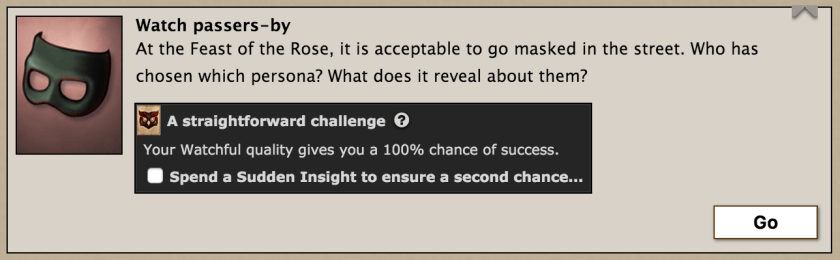
StoryNexus, by contrast, shows the player if a stat is going to be checked to determine chance of success, and gives information about what the current success odds look like. This level of mechanic-surfacing gives the output a more game-y flavor but also (in my opinion) provides the player with a greater level of control:

Screen Shot 2016-02-12 at 10.57.53 PM
One branch of the Feast of the Exceptional Rose, Fallen London

Undum sort of splits the difference by keeping the stats table permanently on screen in a sidebar, so while you might not know in advance what a link is going to do, you’re likely to be more aware of what is happening link-wise than in a ChoiceScript game in most UI configurations:

Screen Shot 2016-02-12 at 10.59.31 PM.png
The opening of Mere Anarchy by Bruno Dias

inklewriter, meanwhile, doesn’t automatically surface variables at all. And though there are personality stats underlying 80 Days, and though you sometimes get a message saying that yours have changed, you can never see a chart of all of them, and you don’t know when they’re being checked. You do get a number (see the lower lefthand corner) that describes your relationship to your master Fogg, but there’s quite a lot else happening here, to which the player doesn’t have access:

inklescreen.png
A screen showing limited status information in 80 Days

It largely works, I think, because those personalizing stats aren’t really the most important aspect of the game, and there’s a lot of state – cash flow, location, routes known, etc. – that the player does get to see. So our sense of agency focuses on those.

Below the fold, some thoughts on the different possible strategies for writing personality stats content.

Continue reading “Set, check, or gate? A problem in personality stats”

Firewatch (Campo Santo)

Screen Shot 2016-02-12 at 11.09.37 AM

Firewatch is a new narrative-and-exploration game from Campo Santo, put together by a skilled crew including Sean Vanaman and Jake Rodkin, writers on season one of Telltale’s The Walking Dead.

It took me about five hours to play; people who are more efficient or look at fewer scenery objects might make it through in four. It is effectively a short story, with a single emotional arc and minimal branching. I’ve seen people comparing it to Gone Home, but more happens in the present setting of the game; I also found a few moments that reminded me of Everybody’s Gone to the Rapture, but it is ultimately a very different game from that as well.

Firewatch tells the story of Henry, a guy whose wife Julia is suffering from early-onset dementia. Henry isn’t really equipped to handle that fact. He volunteers for a position watching for fires all summer in Shoshone National Forest. His main – and for a long time really his only – point of contact with other people is through his radio, which allows him to communicate with his supervisor Delilah. He lives in one tower in the woods and Delilah lives in another, far away; Delilah manages other lookouts, but we never communicate with them. Over the course of the summer, Henry spends a lot of time hiking the woods to various spots to do errands at Delilah’s instruction. Gradually, they begin to realize that there are more people out here than they knew about, and that someone is watching Henry and Delilah specifically. There are also, here and there, notes from rangers who used to watch these woods but who have now gone on to other work elsewhere, and hints of the hikers who passed through these woods before.

The game sets up Henry’s backstory through a piece of choice-based text, a passage that could quite plausibly have been prototyped in Twine, interspersed with scenes of his arrival in the woods. The hypertext portion gives you a chance to do a little immediate personalization of Henry. I don’t have the impression your choices there pay into any major story changes, but they do lightly tweak what Henry will say about himself later, and a few props he has. We see the effects of this more or less right away in the game world, in that we pick one of two ways that Julia might have sketched Henry, and then shortly afterwards see the sketch itself: an early promise from the game that there will be perceivable consequences for your choices.

Continue reading “Firewatch (Campo Santo)”